


US President Donald Trump has backed away from tomorrow's deadline for Ukraine to agree to a US-backed peace plan and shrugged off a report that US negotiator Steve Witkoff coached the Russians on how to approach him on the topic.
Mr Trump, speaking to reporters on board Air Force One as he flew to Florida for the Thanksgiving holiday, said US negotiators were making progress in discussions with Russia and Ukraine, and Moscow had agreed to some concessions.
He did not detail them.
A US-based framework for ending the war, first reported last week, prompted fresh concerns that the Trump administration might be willing to push Ukraine to sign a peace deal heavily tilted toward Moscow.
Mr Trump said his envoy Steve Witkoff would be travelling to Moscow to meet Russian President Vladimir Putin next week and that his son-in-law Jared Kushner, who helped negotiate the Gaza deal that brought about an uneasy ceasefire in the Israel-Hamas war, was also involved.
The Kremlin confirmed that Mr Witkoff will visit Moscow next week to meet Mr Putin.
"A preliminary agreement has been reached on (Witkoff's) visit to Moscow next week," Mr Putin's foreign policy adviser Yuri Ushakov said on Russian TV.
Several other officials from President Donald Trump's administration will accompany Mr Witkoff, Mr Ushakov said.

Mr Trump in recent days had set the Thanksgiving holiday of 27 November as the day when he wanted to see Ukraine agree to a deal to bring about an end to Russia's war in Ukraine.
But he and his aides have backed away from a firm deadline and now say they would like an agreement as soon as possible.
"The deadline for me is when it's over," Mr Trump said on the presidential aircraft.
Bloomberg News reported that Mr Witkoff, in a 14 October telephone call with Yuri Ushakov, the top foreign policy aide to Mr Putin, said they should work together on a ceasefire plan for Ukraine and that Mr Putin should raise it with Mr Trump.
Bloomberg said Mr Witkoff's guidance included suggestions on setting up a Trump-Putin call before Ukrainian President Volodymyr Zelensky's White House visit later that week, and using the recently concluded Gaza agreement as a way in.
Ukraine territory 'might be gotten by Russia anyway'
Asked about the report, Mr Trump said he had not heard the recording of the call that Bloomberg based its story on but that he was not surprised because "that's what a dealmaker does."
"You know, that's a very standard form of negotiation," he said. "I would imagine he's saying the same thing to Ukraine."
Mr Trump said it appeared that Russia had the upper hand in the war and that it would be in Ukraine's best interests to reach an agreement.
He said some Ukraine territory "might be gotten by Russia anyway" over the next couple of months.
Mr Trump said security guarantees for Ukraine were being negotiated with Europeans.
Mr Trump had earlier posted on his Truth Social platform that there were "only a few remaining points of disagreement" - but European leaders were sceptical, and Russian missiles continued to rain down on Ukraine.
He also expressed hope to meet Mr Putin and Mr Zelensky "soon", adding, "but ONLY when the deal to end this War is FINAL or, in its final stages."
An initial US plan, which was heavily weighted in Russia's favour, has been replaced by one taking in more of Ukraine's interests, and an official familiar with the new version told AFP it was "significantly better."
However, US officials acknowledged that "delicate" issues remain.
French President Emmanuel Macron threw cold water on the idea of a rapid solution, stating there is "clearly no Russian willingness" for a ceasefire or to discuss the new, more Ukraine-friendly proposal.
Frantic discussions have been under way since the weekend when Ukrainian and US representatives huddled in Geneva to discuss Mr Trump's initial 28-point plan for settling the conflict.
The latest talks including US and Russian delegates were taking place in Abu Dhabi. Leaders of a group of 30 countries supporting Ukraine also met by video yesterday.
US negotiator Dan Driscoll emerged upbeat from meeting with Russian counterparts, with his spokesman saying: "The talks are going well and we remain optimistic."
The White House cited "tremendous progress," while cautioning "there are a few delicate but not insurmountable details that must be sorted out."
Read more:
'Principles' of US plan could lead to 'deeper agreements' - Zelensky
But the war, which began with Russia's full-scale invasion of Ukraine in 2022, continued unabated.
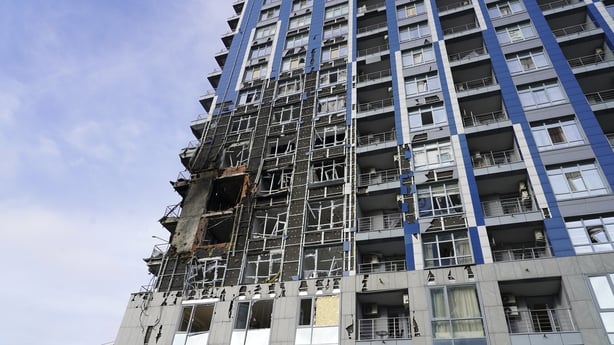
Russia launched a major attack on Zaporizhzhia that damaged at least seven high-rise buildings and caused 12 people to be taken to hospital, the head of the regional military administration said.
The night before, powerful explosions rocked Kyiv beginning around 1am local time (11pm Irish time), as Russian drones and missiles rained down, setting fires in apartment buildings. City officials said seven people were killed.
The initial peace plan, pushing numerous Russian war aims, sparked alarm in Ukraine and Europe. Among its points were prohibitions on Ukraine ever joining NATO and the surrender of swathes of new territory to Russia.
An official familiar with the text told AFP that one key improvement was raising a proposed cap on the country's future military forces from 600,000 to 800,000 members.
Baltic states see Russia as 'existential threat'
Minister of State at the Department of European Affairs Thomas Byrne has said that a number of European countries are "very, very concerned" about Russian threats.
Speaking on RTÉ's Today with David McCullagh from Vilnius, he said that countries such as Latvia, Lithuania and Estonia see Russia as a threat "to their very existence.
"It's very, very important to engage with them, particularly on these issues, particularly the threat of Russia," he said.
"They see Russia not just as a threat, but as an existential threat to their very existence. They're very, very concerned about what they see in Ukraine over the last number of years."
Mr Byrne said it was "incumbent" on Ireland to show solidarity to these countries."
He said that despite Ireland’s neutrality, it has been "constructive" in terms of the provision of military equipment to Ukraine, which he feels has been important.
Mr Byrne said that Ireland was supportive of the European Commission utilising €140bn in frozen Russian assets for penalties, despite concerns from elsewhere.
