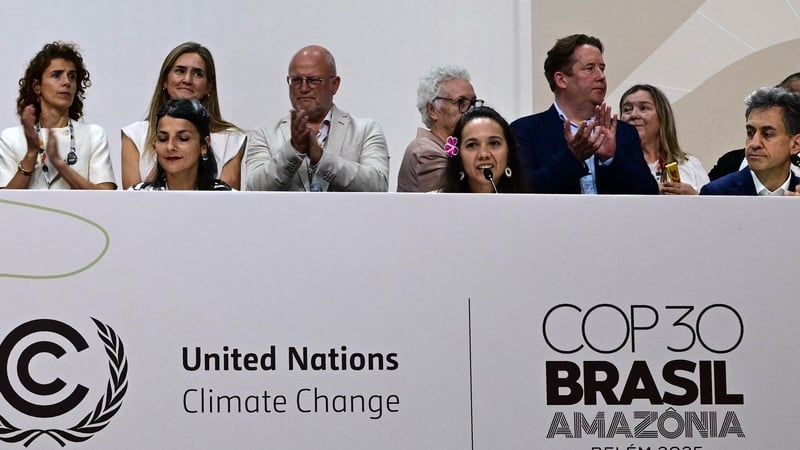
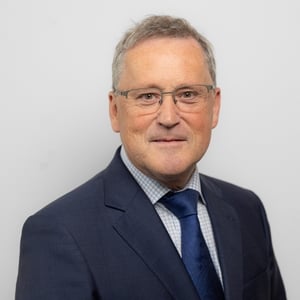
Minister for Climate, Energy and the Environment, Darragh O'Brien, who is leading the Irish delegation at COP30 in Belem Brazil this week, has said Ireland wants to see the phasing out of fossil fuels included in whatever text agreement comes about at COP30 over the coming days.
The Irish delegation hosted a meeting of countries that want fossil fuel usage phased out, as part of the Beyond Oil and Gas Alliance at COP30 yesterday.
Minister O’Brien stressed that yesterday’s meeting allowed him to coalesce in the Irish delegation rooms with ministers from other countries who want the same thing.
"We have been able to work with European Union colleagues and colleagues from all across the world, from Central America, from South America, from developing countries, and right across the globe to give a very clear message that we want to see a road map to end fossil fuel use in our countries.
"We are moving to do that in Ireland. We are accelerating renewables, and we have to give a very clear message that renewable energy is the way forward.
"We need a clear road map that shows how the world can exit fossil so we can bridge the greenhouse gas emissions gap and meet the climate targets that have been set," he said.
Minister O’Brien said he wants the roadmap to transition away from fossil fuels stitched into the so-called "Mutirao" - a collective and co-operative multilateral pact - that the Brazilian COP30 presidency is aiming to achieve before tomorrow night.
The Brazilian concept of Mutirao has many similarities to the traditional Irish practice of Meitheal, where rural communities and neighbours voluntarily come together to help one another with heavy or time sensitive work such as harvesting.
Mutirao is a similar traditional concept inherited by Brazilian society.
It is rooted in cooperation and the absence of competition, and the collective mobilisation of minds and hearts and hands to achieve a common aim.
Last night the Brazilian CO30 President Andre Correa Do Laga, said he is aiming for a Mutirao among all countries at COP30 about the most difficult issues.
These are - climate finance, trade, the demand for greater climate commitments - including phasing out fossil fuels, and a range of issues around transparency, measurement, and monitoring the climate actions countries truly deliver.
Mr Do Laga said his aim is to sign off on a Mutirao approach to these most controversial issues sometime tomorrow.
The negotiators would then move on to finalise agreements about a myriad of other climate issues that were part of the formal COP30 negotiating agenda.
Speaking after a Beyond Oil and Gas Alliance press conference, Minister O’Brien said ministers from the UK, Germany Colombia, Sierra Leone and Kenya have come together to show that there is a lot of support for the inclusion of a roadmap for the phasing out of fossil fuels in whatever Mutirao is agreed.
He said he is optimistic.
"We understand that any transition away from fossil fuels must be equitable and just, as well as being phased and planned.
"Many countries are doing this already. Now Ireland is on that journey. I think for COP30 to speak with one voice, be that through a road map, or a road map to a road map, and have all that agreed in a Mutirao is critically important," he said.
Ireland should be confident for climate 'challenge ahead'
Former Green Party leader and minister for the environment Eamon Ryan said even though Ireland exceeded its carbon budget to 2025 by ten million tonnes, the average greenhouse gas per person in Ireland has halved between 2020 and 2025.
That is because emissions have fallen while at the same time the size of Ireland's population has grown substantially.
Mr Ryan was speaking at COP30 where he now has a role working with the Climate and Clean Air Coalition.
This coalition is a voluntary international partnership of governments, intergovernmental organisations, scientific and academic institutions, and private sector actors.

The Climate and Clean Air Coalition operate under the aegis of the United Nations.
Its aim is to minimise the emissions of short-lived highly polluting greenhouse gases, with a particular focus on methane reduction, especially from oil and gas production processes.
"If you said to the average Irish person 25 years ago that they would be able to half their greenhouse gas emissions during the next 25 years, most people would not have believed you.
"So I think we should be careful. We shouldn't talk ourselves down all the time.
"Yes, of course we need to go further, and the next leap is going to be really challenging, but having done okay with our first carbon budget, that should give us confidence and inspiration for the challenge ahead," he said.
Ireland's carbon budget for five years to 2025 was to ensure it contributed no more than 295 million tonnes of greenhouse gas emissions to the atmosphere.
The overrun of ten million tonnes above this amount, as reported last week by the Climate Change Advisory Council, represents an overshoot of less that 3.4%.
Read the latest stories from COP30
Mr Ryan said that this is a very good outcome.
"I would say that we were close enough, and I would be proud of our role in government. We did deliver effective change, and in that first budget for 2020 to 2025 we came really close to achieving what we committed to.
"This real change in how we run our energy system, our transport system, our food system. It takes time. But I'm encouraged in the sense that we're starting to see it work," he added.
"We're seeing change in the energy area, where there is a renewables revolution happening that is not going to be stopped. We are seeing it in transport, and in cities like London and Paris. They are switching away from oil and diesel. And it's better."
The former Green Party leader said no one can force changes that would be bad for our health, bad for our wealth, or bad for society.
However, he insisted that ways of operating cleaner and doing things better can be found.
"The long, slow, process of that starts here at COP30, ends up on an Irish farm, or on a Irish road, or in a solar panel being installed on somebody's rooftop," he said.
"If you don't get it right here, that won't happen in five and ten years' time," he added.