


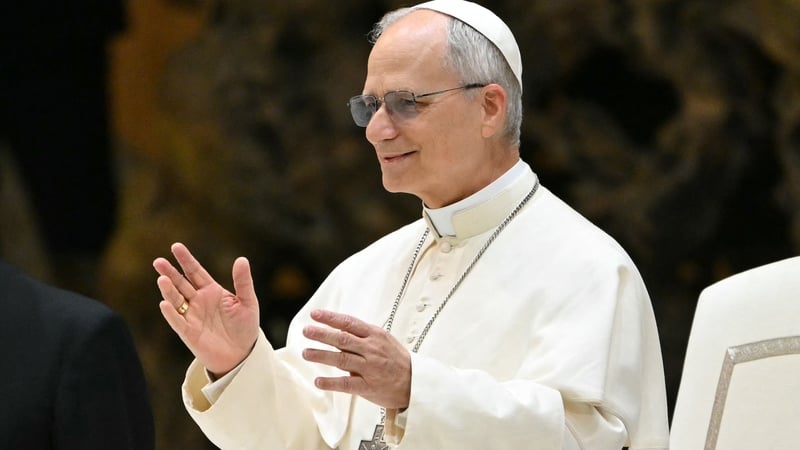
Pope Leo XIV, in his first address to the media, has spoken out against partisan bickering and called for the release of imprisoned journalists.
In his first address to the media, he spoke up for jailed journalists who, according to the Committee to Protect Journalists, numbered 361 at the end of last year.
"The way we communicate is of fundamental importance: we must say 'no' to the war of words and images, we must reject the paradigm of war," Pope Leo told thousands of journalists who covered his election and the death of his predecessor.
"The suffering of these imprisoned journalists challenges the conscience of nations and the international community, calling on all of us to safeguard the precious gift of free speech and of the press," he said.
"Let us disarm words and we will help to disarm the world," he added.
Pope Leo, the first pope from the US, addressed the journalists in the Vatican's large audience hall in Italian but started in English in jocular fashion.
"Good morning. Thank you for this wonderful reception. They say that when they clap at the beginning, it doesn't matter much. If you're still awake at the end and still want to applaud, thank you very much," he said.
He offered solidarity with journalists "imprisoned for seeking and reporting the truth" and called for them to be freed.
The pontiff also spoke about artificial intelligence (AI), saying it should be used with responsibility and discernment.
His remarks echoed his predecessor Pope Francis.
Pope Francis, who never visited Ukraine, had sparked frustration through his failure to clearly condemn Russia for the invasion and by calling for Ukraine to raise the "white flag".
During their first phone call, Ukrainian President Volodymyr Zelensky invited Pope Leo to Ukraine, in which he also thanked the newly installed pontiff for urging peace in Ukraine.
"I invited His Holiness to make an apostolic visit to Ukraine. Such a visit would bring real hope to all believers, to all our people," Mr Zelensky said in a post on social media.
I spoke with Pope Leo XIV. It was our first conversation, but already a very warm and truly substantive one.
— Volodymyr Zelenskyy / Володимир Зеленський (@ZelenskyyUa) May 12, 2025
I thanked His Holiness for his support of Ukraine and all our people. We deeply value his words about the need to achieve a just and lasting peace for our country and the… pic.twitter.com/4ocbA7jnMK
The two leaders also discussed "the thousands of Ukrainian children deported by Russia", Mr Zelensky said, adding that Kyiv was counting on the Vatican's help in returning them home.
Kyiv however had recognised the Vatican's efforts in mediating prisoner exchanges and the return of children taken to Russia from occupied parts of Ukraine.
Mr Zelensky also said that he had told Pope Leo about a joint ceasefire offer by Ukraine and its allies and that the two had agreed to "plan an in-person meeting in the near future".
Pope's schedule
On Friday, he will have an audience for foreign diplomats, followed by an inauguration mass at St Peter's Square on Sunday, which is expected to draw thousands of pilgrims.
The following week will see Pope Leo's first general audience on 21 May, usually a regularly scheduled event for the pope on Wednesdays.
Days later, on 24 May, he will meet with the Roman Curia over which he presides, the powerful top officials and department heads running the government of the Holy See.
The world is still getting to know the modest and soft-spoken pontiff born in Chicago, who spent much of his life in the priesthood as a missionary in Peru, where he holds a second citizenship.
Before making him a cardinal in 2023, Pope Francis entrusted him with the leadership of the powerful Dicastery of Bishops, which advises the pontiff on bishop appointments.
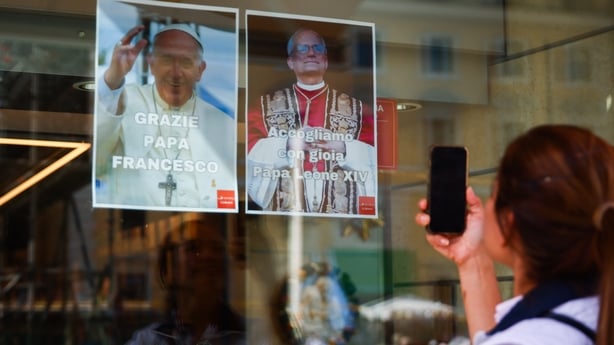
As pope, Leo will have to heal rifts within the Church, help renew a faith that is declining in many regions and address a host of modern-day challenges, including the fallout of the global sex abuse scandal.
Among the tens of thousands of faithful who came out to see him yesterday, many said they were cheered by signs that he would follow in the footsteps of Pope Francis, seeking unity in a fractured world with an attention to the world's poor.
"He gives me a lot of hope just trying to bring about the universal language of love and peace for one another, especially in such a divided world that we have today," said Christina Morey, a 31-year-old American.
"I love that he is both continuing Francis's path while also seeming to create his own and I'm really excited to see where that will go," Morey said.
Italian Leo Mita, 34, said the world's first pope from the United States actually appeared to be "a citizen of the world for rights and for peace".
