


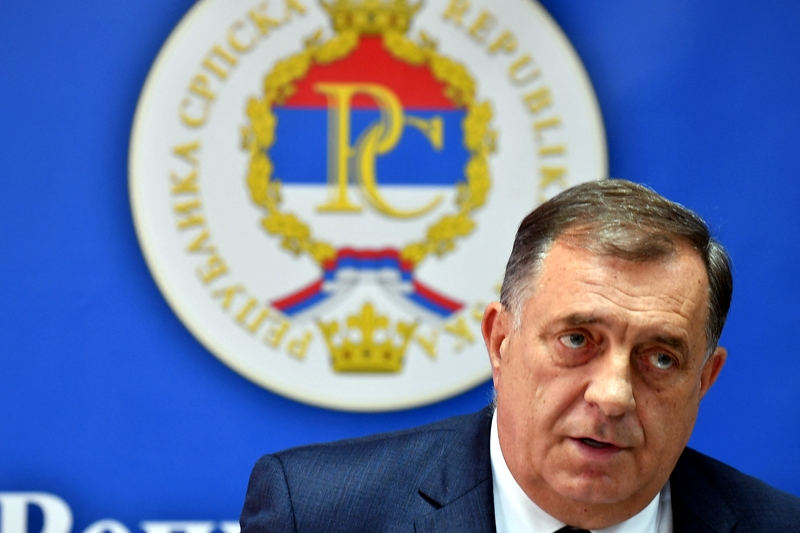
The leader of Bosnia's Serbs Milorad Dodik has slammed the imminent visit to Sarajevo by Kosovo's Prime Minister Albin Kurti, calling it an "insult" to the country's Serbs as tensions simmer in the Balkans.
Mr Kurti was set to arrive in the Bosnian capital for his first trip to Bosnia as premier, despite the country having no formal diplomatic relations with Kosovo.
Bosnia's Serb statelet has long served as a barrier to the country's formal recognition of Kosovo's independence declaration in 2008.
Mr Kurti was set to attend a conference in Sarajevo tomorrow and had no official meetings scheduled with political leaders.
Mr Dodik called Mr Kurti's visit "an open provocation and an insult to all Serbs" in a message posted on social media.
"Someone is rushing to create chaos in Bosnia-Herzegovina," he added.
The visit comes just days after Mr Kurti blamed neighbouring Serbia for an explosion targeting a strategic canal in Kosovo, calling the blast a "terrorist attack" masterminded by Belgrade.
Serbia has rejected the accusations.
Mr Dodik is an iron-clad political ally of Serbia and its leader President Aleksandar Vucic.
Nearly three decades since Bosnia's 1992-1995 war between its Croats, Muslims and Serbs ended, the Balkan country remains deeply divided along ethnic lines.
Since the end of the war, Bosnia has consisted of two semi-independent entities, a Muslim-Croat federation and a Bosnian Serb statelet known as Republika Srpska (RS) - of which Mr Dodik is president.
The two entities are connected by a weak central government but are guaranteed a large degree of autonomy.
Mr Dodik has been frequently accused of undercutting the country's fragile peace with frequent calls for the RS to secede from Bosnia.
Animosity between Serbia and Kosovo, which has an ethnic Albanian majority, has persisted since the end of a war in the late 1990s between Belgrade's forces and ethnic Albanian separatists in what was then a province of Serbia.
Serbia has never recognised Kosovo's 2008 declaration of independence and considers the territory an integral part of its historic identity.
