


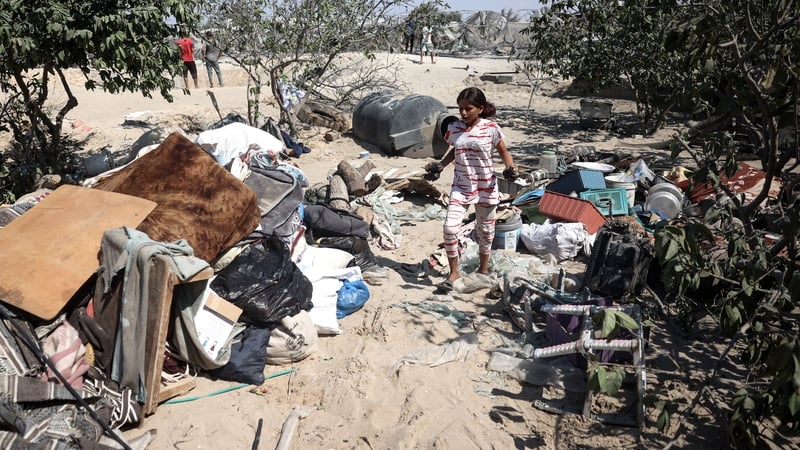
United Nations Secretary-General Antonio Guterres has strongly condemned a deadly Israeli air strike in a designated safe zone in southern Gaza before dawn this morning, UN spokesperson Stephane Dujarric said.
"The use of heavy weapons in densely populated areas is unconscionable," Mr Dujarric said.
"Palestinians had moved to this area in Khan Younis in search for shelter, in search of safety, after being repeatedly instructed to do so by the Israeli authorities themselves.
The health ministry in Hamas-run Gaza said at least 19 people were confirmed dead in the strikes, after the civil defence agency provided an earlier death toll of 40.
"Nineteen martyrs were brought to hospitals... while more than 60 people were wounded, some of them seriously" in the overnight strike on the al-Mawasi humanitarian zone in the southern city of Khan Younis, the ministry said in a statement.
The strikes tore a huge crater in the area.
Israel said it had struck a command centre for Hamas fighters whom it said had infiltrated the designated "humanitarian" area in al-Mawasi, a vast camp on sandy soil where the military has told hundreds of thousands of Palestinians to shelter since ordering them out of their homes.
Hamas denied any fighters were present.
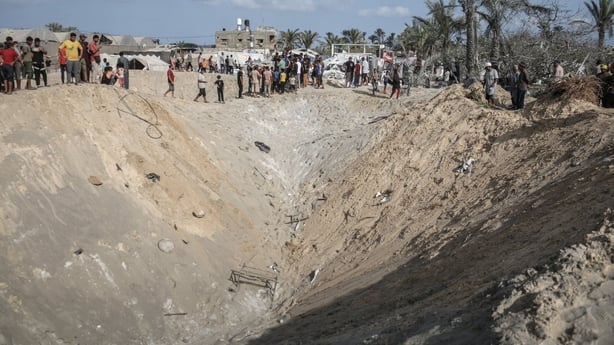
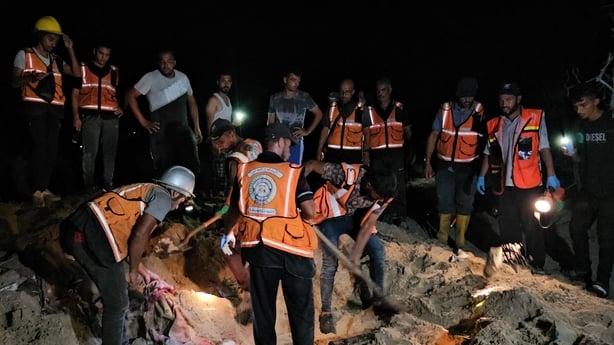
Rescuers dug with shovels searching for bodies and survivors buried where the strike had blasted a crater the size of a small football pitch.
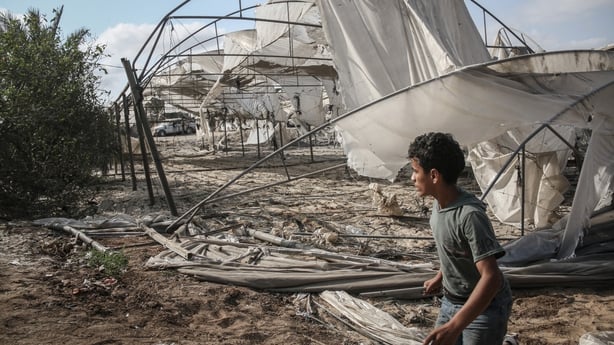
Tents in the surrounding area had been incinerated, leaving only metal frames dusted with ghostly ash in a wasteland littered with debris. A car had been completely buried, only it stop visible beneath the sand.
In the morning, mourners at a nearby hospital wept over bodies heaped in white plastic bags or wrapped in bloodstained shrouds.
One of Raed Abu Muammar's daughters had been killed. His wife and his other daughter had been buried but were pulled out alive. He carried the surviving baby girl.
"I was under the sand as well. I got out and started looking for my daughters and my wife. I saw body parts of the neighbours in my tent - I did not know those were our neighbours' parts until I saw my family in one piece."
"These are the Israeli targets. Look at them," he said, gesturing to the baby girl in his arms. "We were in humanitarian areas that were supposed to be safe".
Residents and medics said the camp was struck by five or six missiles or bombs.
The Gaza Civil Emergency Service said at least 20 tents caught fire.
It said the estimated 65 victims included women and children but did not immediately provide a breakdown of deaths and injuries.
The Israeli military said that it struck senior Hamas commanders who were operating in a command centre embedded inside a designated humanitarian area.
"These terrorists were directly involved in the execution of the October 7th massacre and have been recently operating to carry out terror activities," it said.
The military added that the casualty figure published by Hamas-run authorities in Gaza "do not align with the information held by the IDF, the precise munitions used, and the accuracy of the strike".
Hamas has denied Israeli allegations that gunmen were present in the targeted area, and rejected accusations it exploited civilian areas for military purposes.
"This is a clear lie that aims to justify these ugly crimes. The resistance has denied several times that any of its members exist within civilian gatherings or use these places for military purposes," said Hamas in a statement.
Shrinking safe zone
Hamas' 7 October attack on Israel that sparked the war in Gaza resulted in the deaths of 1,205 people, mostly civilians, including some hostages killed in captivity, official Israeli figures show.
Militants seized 251 hostages during the attack, 97 of whom are still held in Gaza, including 33 the Israeli military says are dead.
Israel's retaliatory offensive in Gaza has so far killed more than 41,000 people, according to the health ministry in the territory.
The UN human rights office said most of the dead are women and children.
The vast majority of Gaza's 2.4 million people have been displaced at least once during nearly a year of war, according to the United Nations.
From 1,200 inhabitants per square kilometre before the war, the Al-Mawasi humanitarian zone now houses "between 30,000 and 34,000 people per square kilometre", and its protected area shrank from 50sq/km to 41, the UN has calculated.
The United States, Qatar and Egypt have been mediating in efforts to forge a ceasefire and hostage-prisoner exchange deal between Israel and Hamas but talks remain stalled.
Hamas is demanding a complete Israeli withdrawal from Gaza as part of any deal, but Israel insists troops must remain along the Gaza-Egypt border.
Gaza polio vaccine push continues amid disruptions by Israel - WHO
The third phase of a giant polio vaccination drive targeting children in Gaza began in a particularly war-ravaged zone, but the WHO said a support convoy had to abort its mission.
After the first confirmed polio case in 25 years, a massive vaccination effort began last week targeting over 640,000 children under ten, aided by localised "humanitarian pauses" in fighting.
After covering central and southern Gaza, the campaign moved into its final phase in the north until Thursday, said World Health Organization spokesman Tarik Jasarevic.
However, "a WHO mission carrying fuel for hospitals and vehicles for the polio campaign as well as campaign monitoring experts was impeded", Mr Jasarevic said.
It had taken three hours for that mission to get a green light from the Israelis to move, "followed by five hours at the holding point, after which the mission had to be aborted", he explained.
The WHO also voiced concern that some areas in the north facing Israeli evacuation orders are part of the areas where humanitarian pauses had been agreed to allow the vaccination to go ahead.
Mr Jasarevic said a separate WHO mission to reach Gaza's largest hospital, al-Shifa, in the north was also "impeded" yesterday.
That marked the fourth time in as many days the WHO was unable to reach the hospital.
