


Iran is not looking to escalate regional tensions but believes it needs to punish Israel to prevent further instability, the foreign ministry spokesperson said, following the killing of Hamas leader Ismail Haniyeh in Tehran last week.
"Iran seeks to establish stability in the region, but this will only come with punishing the aggressor and creating deterrence against the adventurism of the Zionist regime (Israel)," Nasser Kanaani said, adding that action from Tehran was inevitable.
Mr Kanaani called on the United States to stop supporting Israel, saying the international community had failed in its duty to safeguard stability in the region and should support the "punishment of the aggressor".
The Islamic Revolutionary Guards Corps' top Commander Hossein Salami reiterated the elite group's threat that Israel "will receive punishment in due time".
The Pentagon said on Friday it would deploy additional fighter jets and Navy warships to the region as a defensive measure with a goal of de-escalating tensions.
"The overall goal is to turn the temperature down in the region, deter and defend against those attacks, and avoid regional conflict," Jonathan Finer, the White House's deputy national security adviser, said on CBS' 'Face the Nation' programme.
The US and Israel are preparing for every possibility, Mr Finer added.
In a post on social media platform X today, Taoiseach Simon Harris said: "Our travel advice for Israel has changed due to growing instability in the region. The Government is now advising Irish citizens do not travel to Israel. The same advice applies to Lebanon and Palestine."
The Tánaiste and Minister for Foreign Affairs Michéal Martin also posted on X, he said: "I strongly advise Irish citizens in Lebanon to leave the country and take advantage of the commercial options still available.
"Safety and security of citizens is our priority. DFA officials in the region and Dublin are available for consular advice."
There was a "very close call" of regional conflagration in April, Mr Finer said, when Iran launched an attack on Israeli territory with drones and missiles after what it called an Israeli strike on its consulate in Damascus on 1 April that killed seven officers of the Islamic Revolutionary Guard Corps in the Syrian capital.
The US wants to be prepared should that situation arise again, Mr Finer added.
In a call with his Israeli counterpart, the Pentagon said US Defence Secretary Lloyd Austin reiterated the United States' support for Israel's security and "right to self-defence against threats from Iran, Lebanese Hizballah (Hezbollah), Houthis, and other Iranian-backed terrorist groups".
US Secretary of State Antony Blinken spoke with Iraqi Prime Minister Mohammed Shia al-Sudani and emphasised "the importance of all parties taking steps to calm regional tensions, avoid further escalation, and advance stability," the State Department said.
The Group of Seven major democracies urged restraint and de-escalation, saying that recent events "threatened to ignite a broader conflict in the region".
The G7 urged "all involved parties once again to refrain from perpetuating the current destructive cycle of retaliatory violence, to lower tensions and engage constructively toward de-escalation," in a statement.
Israeli officials have not claimed responsibility.
Two dead in Israeli strike - Lebanon
Meanwhile, Lebanon's health ministry said two people were killed in an Israeli strike on the country's south, where Hezbollah has been trading near-daily fire with Israel since the start of the Gaza war in October.
"The enemy raid that took place near the (Mais Al-Jabal) town's cemetery killed two people," Lebanon's Health Ministry said in a statement.
"One of the two martyrs who fell in the Mais Al-Jabal raid this morning was a Risala Scouts paramedic," Lebanon's state-run National News Agency said.
Ali Abbas, a rescue worker from the Risala Scouts which is affiliated with Hezbollah ally the Amal movement, said that the paramedic had travelled by motorcycle with another person to inspect the site of an earlier strike.
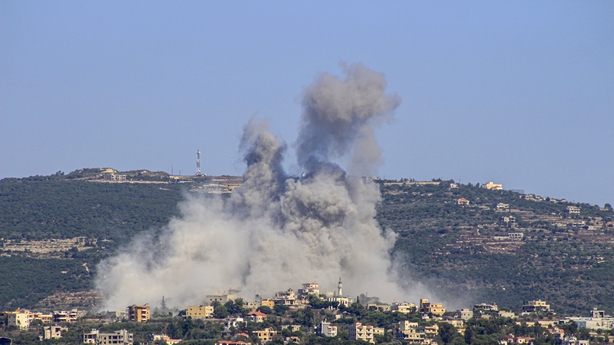
He went "to see if there were civilians or people (in the area)... and the second strike happened immediately," he said.
Mais al-Jabal, a frontline village less than two kilometres away from the border with Israel, has experienced heavy bombardment since the cross-border clashes began, forcing most residents to leave.
Earlier, Hezbollah said it had targeted military sites in northern Israel with "explosive-laden drones" in response to Israeli "attacks and assassinations" in southern Lebanon.
The Israeli military said "numerous suspicious aerial targets were identified crossing from Lebanon" into northern Israel, starting a fire and leaving an officer and a soldier "moderately injured".
The cross-border violence since October has killed at least 549 people in Lebanon, mostly fighters but also including at least 116 civilians, according to an AFP tally.
On the Israeli side, including the annexed Golan Heights, 22 soldiers and 25 civilians have been killed, according to army figures.
