


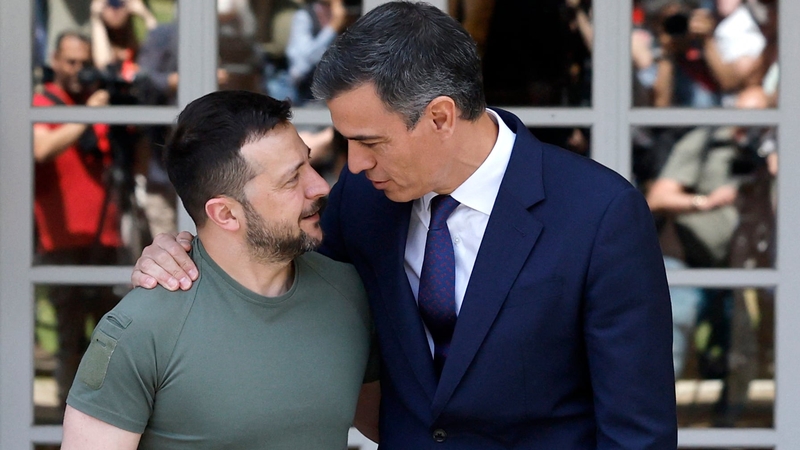
Spain will grant €1 billion worth of military equipment to Ukraine this year, according to a bilateral deal signed between President Volodymyr Zelensky and Prime Minister Pedro Sanchez and seen by Reuters.
As he touched down at Madrid's Barajas airport, Mr Zelensky was met on the tarmac by King Felipe VI and then headed straight into the Spanish capital to meet Mr Sanchez where the two leaders were to sign a security agreement.
The visit comes as Ukraine battles a Russian ground offensive in the northeastern Kharkiv region which began on 10 May in Moscow's biggest territorial advance in 18 months.
With the Russian assault now in its third year, Ukraine has been pleading for more weapons for its outgunned and outnumbered troops, notably seeking help to address its lack of air defence systems.
After their meeting, the two leaders were expected to hold a news conference, Mr Sanchez's office said.
Mr Zelensky was then expected at the Royal Palace for talks followed by "a lunch in his honour" hosted by King Felipe and Queen Letizia, a palace statement said.
The Ukrainian leader had been due to visit on 17 May, but postponed his trip after Russian troops began a major assault on the Kharkiv region.
According to El Pais newspaper, the deal would include €1.1 billion worth of military aid and include new Patriot missiles and Leopard tanks.
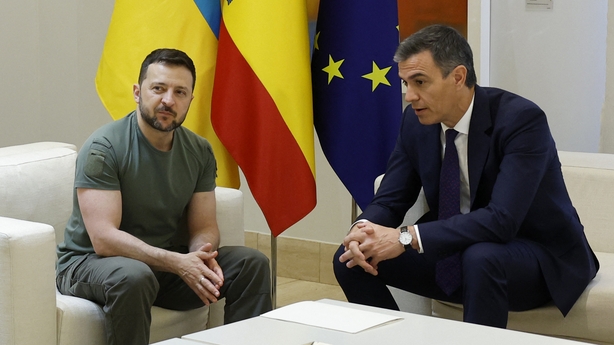
Mr Zelensky has already signed bilateral security agreements with several countries including France, Germany and the UK.
So far, Spain has only provided limited military aid to Ukraine.
According to the Kiel Institute - which tracks weapons pledged and delivered to Ukraine since the Russian invasion - Spain has so far committed €330 million in military aid, making it a small contributor on a European level.
By comparison, Germany, France and Italy have committed €18.61bn, €5.65bn and €1bn respectively.
In April, Spain pledged to send an unspecified number of Patriot air defence missile systems to Ukraine. It has also sent ten Leopard tanks.
Although the Ukrainian leader was in southern Spain for an EU summit in October, it was his first official visit to Spain since taking power in 2019.
Last week, Mr Sanchez told parliament the two nations were also preparing to sign a bilateral cooperation agreement.
"As soon as the situation on the front allows, we will sign an agreement with Ukraine that will increase economic, social and institutional cooperation between our countries," he said.

EU counterparts have lashed out at Hungary as a blockage from Budapest threatens to hold up billions more euros in funds to help arm Ukraine.
Hungary - the friendliest EU country to Russia - has repeatedly held up initiatives to aid Ukraine or punish Russia since Moscow's invasion of its neighbour in 2022.
Anger has been rising with Budapest over the past year as it has prevented payouts from a central EU fund to reimburse member states for weapons sent to Ukraine.
Now EU officials say a fresh blockage from Hungary threatens to hold up another €5 billion that could go towards aiding Kyiv's outgunned forces even though it was already signed off by EU leaders.
The Hungarian hold-up also threatens to delay the spending of billions more in profits from frozen Russian central bank assets that the EU expects to start receiving in July.
At a meeting of EU foreign ministers in Brussels, Germany's foreign minister Annalena Baerbock called on Budapest "to finally allow aid to Ukraine once again, because Europe is only strong if it is united".
"We cannot accept that a single country, which also signed up to this amount a few months ago at the heads of state's council meeting, is now blocking this crucial aid for Ukraine," said Belgian foreign minister Hadja Lahbib.
Hungary under right-wing Prime Minister Viktor Orban has long played a spoiler role on the EU stage as it uses its veto for leverage in disputes with Brussels.
But Lithuania's foreign minister Gabrielius Landsbergis said that Budapest's opposition now appears to have become a "systematic approach".
"So basically, almost all of the discussions and needed solutions and decisions by EU are being blocked by just one country," he said.
"I think it has gone very, very far."
Meanwhile, the Kremlin has scolded NATO Secretary General Jens Stoltenberg for suggesting alliance members should let Ukraine strike deep into Russia with Western weapons, and said it was clear that NATO was in a direct confrontation with Russia.
Mr Stoltenberg told The Economist that NATO members supplying weapons to Ukraine should end their prohibition on using them to strike military targets in Russia.
"NATO is increasing the degree of escalation," Kremlin Spokesman Dmitry Peskov told Russian daily Izvestia when asked about Mr Stoltenberg's remarks.
"NATO is flirting with military rhetoric and falling into military ecstasy," Mr Peskov said, adding that the Russian military knew what to do.
When asked if NATO was approaching a direct confrontation with Russia, Mr Peskov said: "They are not getting close; they are in it."
Russian President Vladimir Putin has repeatedly warned the West that it is risking a global war over Ukraine and that a direct conflict between Russia and NATO would mean the planet was one step away from World War Three.
Russian officials say Ukrainian attacks deep inside Russia, including on civilian areas and even parts of Russia's nuclear defences, are directly escalatory.
The United States has repeatedly said that it does not encourage Ukraine to strike inside Russia, though Ukraine has been lobbying hard to do so.
The Economist said that Mr Stoltenberg's remarks were clearly aimed at US President Joe Biden, who has resisted allowing Ukraine to strike with US weapons inside Russia.
In Ukraine, prosecutors said three people were killed during Russian shelling in three different towns in Donetsk region, the focal point of the Russian military's slow drive along the 1,000km front.
Prosecutors in Donetsk region, which Russia has annexed though it does not control all of its territory, said civilians had died in Siversk in the north of the region and further south in Krasnohorivka and Chasiv Yar.
Russia's military has advanced towards Chasiv Yar, the gateway to other cities in Donetsk region.
Prosecutors in Kharkiv region said a civilian also died near the town of Chuhuyev, southeast of Kharkiv, Ukraine's second largest city, where at least 14 people were killed in an attack on a hardware shop on Saturday.
Separately, one person was killed and three others were injured in a Ukrainian drone attack on a petrol station in Russia's Oryol region near the Ukrainian border, government officials said.
Governor of Oryol Andrei Klychkov said the facade of an administrative building was damaged when a drone "fell" in the town of Livny.
Another drone attack was launched after the arrival of emergency services on the scene, he said.
"According to initial information, the driver of a fire engine was unfortunately killed," Mr Klychkov said, adding that three other emergency service employees were injured.
The Russian defence ministry said it had neutralised a dozen Ukrainian drones overnight, including six over the Oryol region, which lies around 170km from the border with Ukraine.
Ukraine has upped its attacks on Russian border regions in recent months, particularly on energy sites.
