


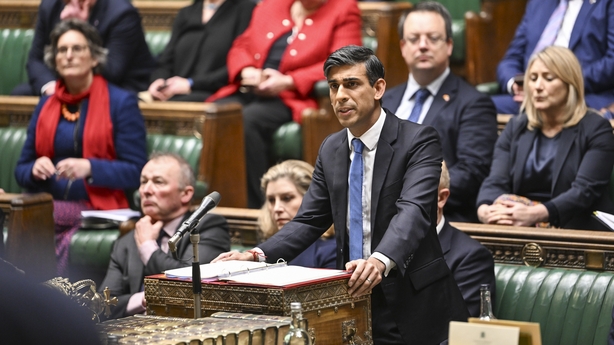
Prime Minister Rishi Sunak warned Iran-backed Houthis that Britain would stage new military action if the Yemeni rebels keep attacking shipping in the Red Sea.
"We are not seeking a confrontation," he told parliament hours after a second round of US-UK strikes.
"We urge the Houthis and those who enable them to stop these illegal and unacceptable attacks.
"But if necessary, the United Kingdom will not hesitate to respond in self-defence. We cannot stand by and allow these attacks to go unchallenged," Sunak added.
Royal Air Force jets struck two military sites just north of the Yemeni capital Sanaa, "each containing multiple specific targets, which the Houthis used to support their attacks on shipping", Sunak said.
He informed MPs that the government's initial evidence was that "all intended targets were destroyed".
Sunak added that the joint military operation with the United States, which followed similar strikes on 11 January, were "working to degrade" the Houthis' capability to launch attacks.
He insisted the strikes were "limited", in line with international law and that no decision has been made to start a sustained campaign against the rebel group.
Since the first strikes, the United States has also launched individual air raids against missiles that Washington said posed imminent threats to civilian and military vessels.
However, the Houthis have vowed to maintain their attacks - part of a growing crisis in the Middle East linked to the Israel-Hamas war, which has raised tensions across the region as well as fears of a broader war directly involving Iran.
The Houthis warned that the US-British strikes would not go "unanswered and unpunished".
The US and Britain launched new strikes on Yemen's Houthis late yesterday, saying their second round of joint military action against the Iran-backed rebels was in response to continued attacks on Red Sea shipping.
American and British forces carried out a first wave of strikes against the rebel group earlier this month, and the United States launched further air raids against missiles that Washington said posed imminent threats to both civilian and military vessels.
But the Houthis have vowed to continue their attacks - just one part of a growing crisis in the Middle East linked to the Israel-Hamas war, which has raised tensions across the region as well as fears of a broader war directly involving Iran.
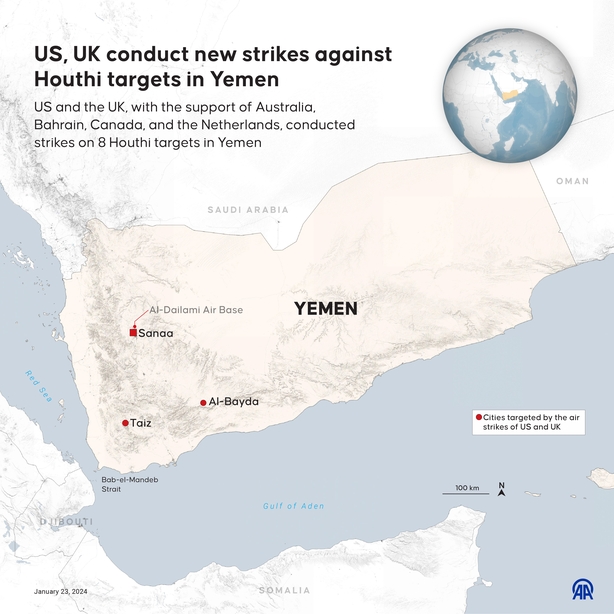
The latest US-UK strikes were against "eight Houthi targets in Yemen in response to the Houthis' continued attacks against international and commercial shipping as well as naval vessels transiting the Red Sea," Washington and London said in a joint statement with other countries that supported the military action.
"These precision strikes are intended to disrupt and degrade the capabilities that the Houthis use to threaten global trade and the lives of innocent mariners," the statement said.
The US Central Command said in a separate statement that the targets of the strikes "included missile systems and launchers, air defence systems, radars, and deeply buried weapons storage facilities."

A senior US military official said the strikes were carried out using a combination of precision-guided munitions from American and British aircraft, and Tomahawk cruise missiles.
There were no concerns about civilian casualties at the sites that were hit, while Houthi losses are unknown at this time, the official told journalists.
"The targeting was very specific and ... very deliberate to go after the capability that they are using to attack maritime vessels in the Red Sea, Bab al-Mandab and Gulf of Aden. They were they were not intentionally selected for casualties - they were going after weapons systems," the official added.
Yemen's official Saba news agency said strikes hit the capital Sanaa and several other parts of the country, while Houthi TV outlet Al-Masirah said four strikes targeted the Al-Dailami military base north of the capital, which is under rebel control.
Earlier yesterday, Houthis claimed they fired on a US military cargo ship off the coast of Yemen, with their spokesman Yahya Saree saying they "led a military operation targeting the American military cargo ship Ocean Jazz in the Gulf of Aden," near the Red Sea, with missiles.
Asked about the claim, a US defence official told AFP: "We're not seeing that at all on our end and believe that statement to be untrue."
The Yemeni rebels began striking Red Sea shipping in November, saying they were hitting Israeli-linked vessels in support of Palestinians in Gaza, which has been ravaged by the Hamas-Israel war.
The Houthis have since declared American and British interests to be legitimate targets as well.
In addition to military action, Washington is seeking to put diplomatic and financial pressure on the Houthis, re-designating them as a "terrorist" entity last week after dropping that label soon after President Joe Biden took office.
The rebels reiterated yesterday that they will "respond to any attack" on Yemen and continue to "prevent Israeli ships" from crossing the Red Sea and Gulf of Aden until the end of the war in Gaza.
The latest round of the Israel-Hamas conflict began after an unprecedented October attack by the Palestinian militant group that resulted in the deaths of about 1,140 people in Israel, mostly civilians, according to an AFP tally based on official Israeli figures.
Israel responded with relentless bombardment and a ground offensive that has killed at least 25,295 people, around 70% of them women, children and adolescents, according to the Gaza health ministry.
Those deaths have sparked widespread anger across the region and stoked violence involving Iran-backed groups in Lebanon, Iraq, Syria and Yemen.
'Horrible choices'
Farea al-Muslimi, a research fellow at the international affairs think-tank Chatham House, said events appeared to be shifting "from a hoped-for single action... to a longer-term military operation in Yemen".
Although targeting the rebels appeared to be "backfiring in many ways", the transatlantic allies had nothing but "horrible choices", he added.
"If you let the Houthis get away with these strikes, then that sends a bad message and it also inspires a lot of militias in the Horn of Africa but also across the world," he said.
"At the same time, if you go into fighting with the Houthis you risk a huge regional escalation."
Mr Al-Muslimi argued Britain and the United States should have acted with the backing of the United Nations General Assembly "instead of acting unilaterally".
"Acting via the UN General Assembly and having more international support, especially from the Global South, would make at least alternative policy choices more rational."
