


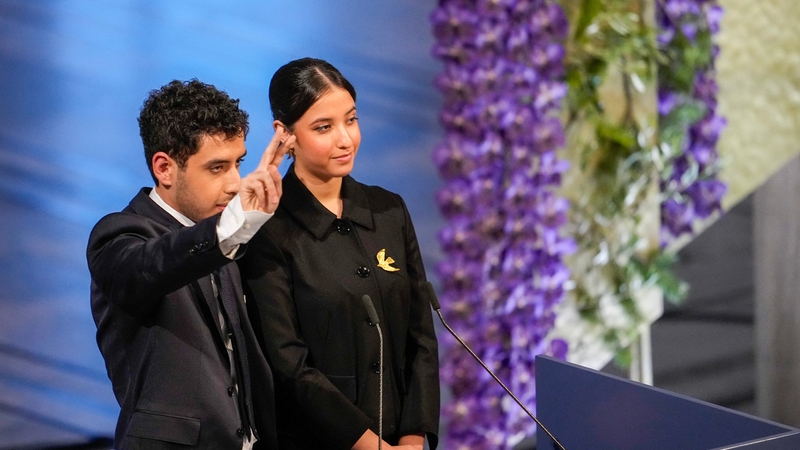
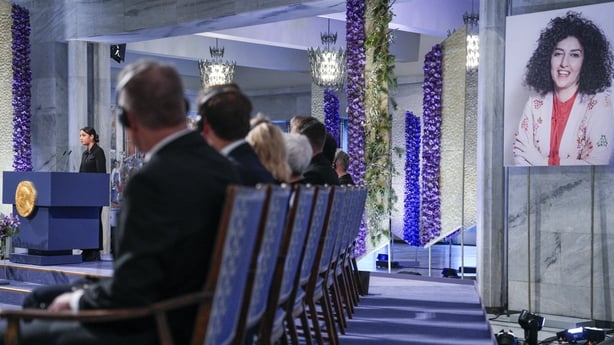
Imprisoned Nobel Peace Prize winner Narges Mohammadi denounced the "tyrannical and anti-women religious" government of Iran, in a speech delivered by her children who accepted the award.
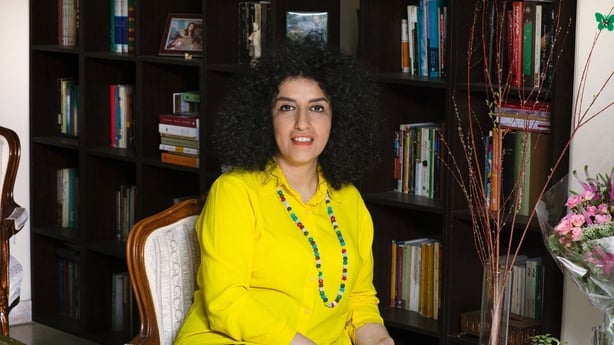
Ms Mohammadi, who has campaigned against the compulsory wearing of the hijab and the death penalty in Iran, has been held since 2021 in Tehran's Evin prison and was unable to receive the prestigious award in person.
Instead, her 17-year-old twins Ali and Kiani, attended Oslo City Hall today and received the award on her behalf and read out a speech that she managed to smuggle out of her cell.
According to her family, Ms Mohammadi is observing a hunger strike at the same time, in solidarity with the Baha'i community.
Representatives of Iran's largest religious minority say it is the target of discrimination in many areas of society.
Ms Mohammadi, who suffers from poor health, went on a hunger strike for several days in early November to obtain the right to be transferred to hospital without wearing a head covering.
She is one of the women spearheading the "Woman, Life, Freedom" uprising, which included months-long protests across Iran triggered by the death of 22-year-old Mahsa Amini.
Amini, an Iranian Kurdish woman, died on 16 September, 2022, while being held by Iran's religious police for allegedly breaching the Islamic republic's strict dress code for women.
'Priceless' freedoms
Ms Mohammadi's twins, who have been living in exile in France since 2015 and have not seen their mother for almost nine years, do not know if they will ever see her again.
Ali has faith. Kiana is doubtful.
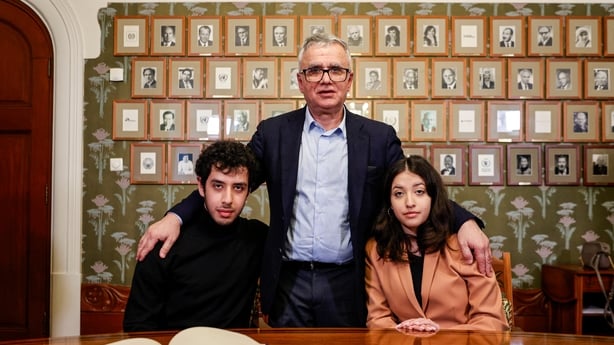
"The cause of 'Woman, Life, Freedom', freedom in general and democracy are worth sacrificing yourself for and giving your life for, because in the end these three things are priceless", Kiana told reporters at a press conference in Oslo yesterday.
"As for seeing her again one day, personally I'm rather pessimistic," she added, noting that the added attention her mother received for being awarded the Nobel prize was likely to make the Iranian authorities curtail her freedom further.
"Maybe I'll see her in 30 or 40 years but if not, I don't think I'll ever see her again. But that's OK because my mother will always be with me in my heart and with my family."
In contrast, Ali said he was "very, very optimistic", even if it probably won't happen "in two, five or 10 years".
"I believe in our victory", he told reporters, sitting next to his sister.
"Victory is not easy but it is certain," he said, quoting his mother.
Banned from leaving Iran
In October, the European Union awarded its top rights honour, the Sakharov Prize, to fellow Iranian woman Amini and the global movement her death triggered.
The "Woman, Life, Freedom" movement demands the end of Iran's imposition of a headscarf on all women and an end to the Muslim cleric-led government in Tehran.
Protests in Iran triggered by Amini's death have been severely repressed.
The Iran Human Rights group (IHR) says 551 demonstrators, including dozens of women and children, have been killed by security forces, and thousands have been arrested.
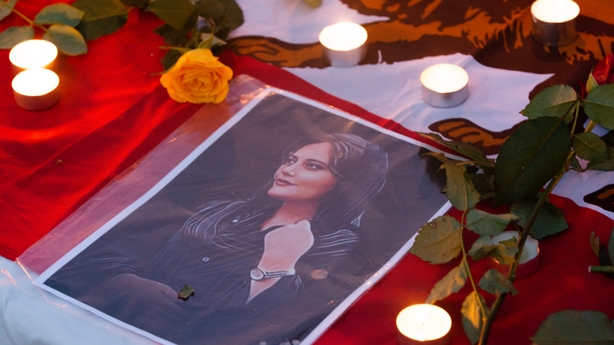
Yesterday, the lawyer for Amini's family said her parents and brother - who were due to receive the posthumous Sakharov Prize on Amini's behalf at a European Parliament ceremony on 13 December - have been banned from leaving Iran.
Narges Mohammadi is the fifth laureate in the more than 120-year history of the Nobel Peace Prize to receive the award while detained.
She follows Germany's Carl von Ossietzky, Myanmar's Aung San Suu Kyi, China's Liu Xiaobo and Belarus' Ales Beliatski.
The other Nobel prizes - in literature, chemistry, medicine, physics and economics - were due to be awarded later today at a ceremony in Stockholm.
