A Virgin Atlantic passenger jet flying from London to New York powered by pure sustainable aviation fuel (Saf) took off from London's Heathrow, as the aviation world seeks to showcase the potential of low carbon options to secure its future.
As the world de-carbonises, airlines are banking on fuel made from waste to reduce their emissions by up to 70%, enabling them to keep operating before electric and hydrogen-powered air travel becomes a reality in the decades to come.
The flight operated by a Virgin Boeing 787 powered by Rolls-Royce Trent 1000 engines, is the first time a commercial airline has flown long haul on 100% Saf.
It follows the successful transatlantic crossing by a Gulfstream G600 business jet using the same fuel last week.
Virgin Atlantic's billionaire founder Richard Branson, the airline's chief executive Shai Weiss, and Britain's transport minister Mark Harper are among the passengers on board.
The flight is scheduled to arrive at New York's John F Kennedy International Airport at 7.20pm.
There will be no paying passengers on board or cargo on what Virgin has dubbed Flight100, which comes days before the start of COP28 climate talks in Dubai.
Saf is already used in jet engines as part of a blend with traditional kerosene, but after successful ground tests, Virgin and its partners Rolls-Royce, Boeing, BP and others won permission to fly using only Saf.
Aviation accounts for an estimated 2-3% of global carbon emissions. Saf is key toward reducing those emissions, but it is costly, at about three to five times as much as regular jet fuel and accounts for less than 0.1% of total global jet fuel in use.
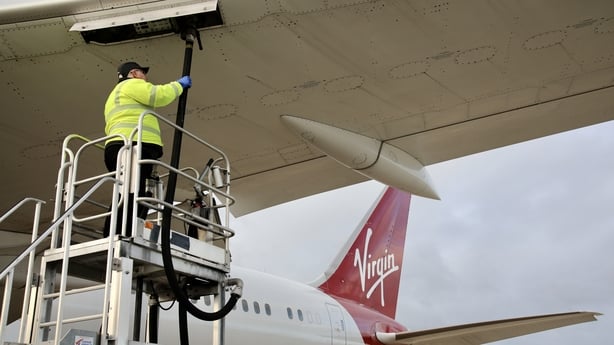
The fuel used to power the flight is mostly made from used cooking oil and waste animal fat mixed with a small amount of synthetic aromatic kerosene made from waste corn, Virgin Atlantic said.
Industry challenges
Many European airlines - including Virgin, IAG-owned British Airways, and Air France – have said they want to be using 10% Saf by 2030, and the industry's goal of "net zero" emissions by 2050 relies on that share rising to 65%.
Rolls-Royce's CEO Tufan Erginbilgic said Saf was the only solution to de-carbonise commercial flights in the medium term.
"I think on the big planes, I'm talking about commercial planes if you like, really the next 15-20 years solution is genuinely Saf. We are making our engines compatible with Saf, so that transformation actually takes place," he said after announcing his strategy for the aerospace engineer.
Yet the 2030 target looks challenging given Saf's small volumes and its high cost.
In October, the head of IAG warned that there was more than a 90% risk the industry would not meet the European Union mandate for Saf availability in 2025.
Campaigners say 'guilt-free flying' is a 'joke'
But campaign group Aviation Environment Federation (AEF) strongly disputed that claim.
AEF policy director Cait Hewitt said: "The idea that this flight somehow gets us closer to guilt-free flying is a joke.
"Saf represent around 0.1% of aviation fuel globally and will be very hard to scale up sustainably."
She accused the aviation sector of being "misleading" over the impact of using Saf on carbon emissions.
She added: "Hopefully, we'll have better technological solutions in future but, for now, the only way to cut CO2 from aviation is to fly less."
Under the DfT's Saf mandate, at least 10% of fuel used by airlines in the UK must be made from sustainable feedstocks by 2030.
Without UK Saf production, meeting the mandate will rely heavily on imports.
Mr Harper recently insisted the UK is "on track" to meet its target of having at least five commercial Saf plants in construction by 2025.
Jonathon Counsell, group head of sustainability at British Airways' parent company IAG, said: "Test flights prove that the aviation industry is technically ready to make the switch to Saf, but what we need now is action from governments to incentivise investment and get plants into construction."
Tim Alderslade, chief executive of trade body Airlines UK, said: "This is a hugely important milestone in the race to net zero for UK aviation and our congratulations go to the Virgin Atlantic team and their partners, together with the UK Government, for making it happen.
"We now need to make occasions like this the new normal, ensuring UK airlines are able to access enough affordable Saf this decade in order to meet the mandate, with as much of it as possible produced here in the UK.
"The last thing we want is higher fuel costs for UK passengers compared to the rest of Europe and the US, with worse sustainability outcomes and thousands of new jobs lost overseas."
Virgin said the engines on the flight would be drained of Saf and tested before it returns to service using regular fuel.