


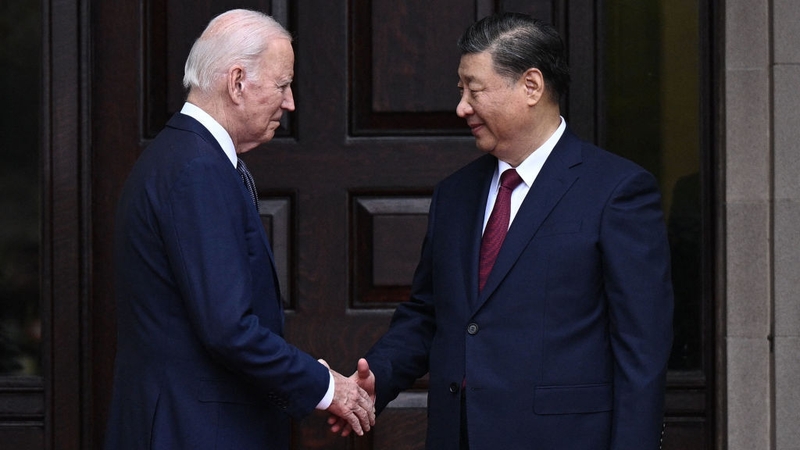
US President Joe Biden has met Chinese leader Xi Jinping for the first time in a year for talks that may ease friction between the two superpowers over military conflicts, drug-trafficking and artificial intelligence.
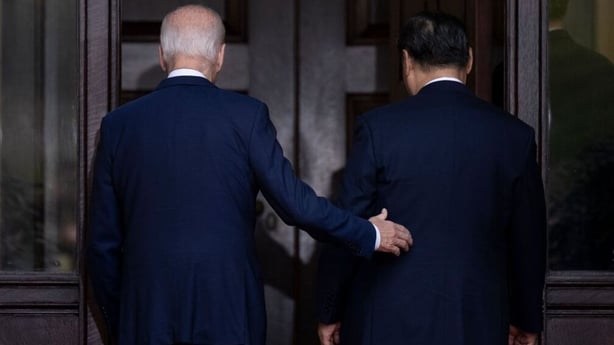
Mr Biden welcomed the Chinese leader at the Filoli estate, a country house and gardens about 48 km south of San Francisco, where they will move later for a summit of the Asia-Pacific Economic Cooperation (APEC) forum.
In opening remarks, Mr Biden said the US and China had to ensure that competition between them "does not veer into conflict" and manage their relationship "responsibly".
Mr Xi told Mr Biden a lot had happened since their last meeting a year ago in Bali.
He said: "The world has emerged from the Covid pandemic, but is still under its tremendous impacts. The global economy is recovering, but its momentum remains sluggish."
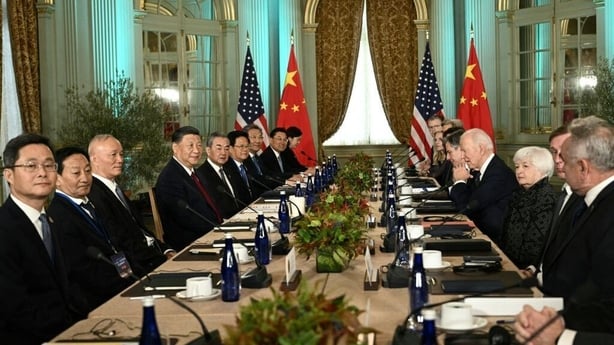
Mr Xi called the US-China relationship "the most important bilateral relationship in the world," and said he and Mr Biden "shoulder heavy responsibilities for the two peoples, for the world, and for history".
"For two large countries like China and the United States, turning their back on each other is not an option," he said.
"It is unrealistic for one side to remodel the other, and conflict and confrontation has unbearable consequences for both sides."
The leaders will be seeking to reduce friction between the countries, but deep progress on the vast differences separating them may have to wait for another day.
Officials on both sides of the Pacific have set expectations low as Mr Biden and Mr Xi are set to discuss Taiwan, the South China Sea, the Israel-Hamas war, Russia's invasion of Ukraine, North Korea and human rights, areas where the leaders have been unable to resolve long-standing disagreements.
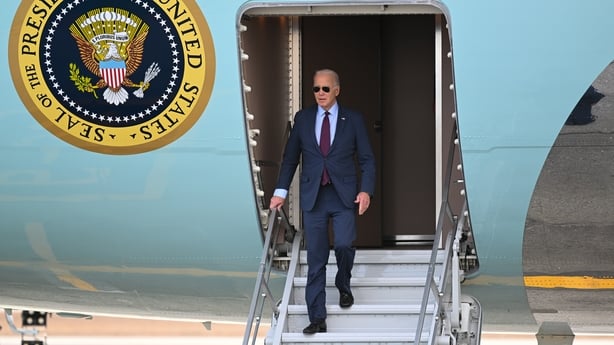
Mr Biden and Mr Xi arrived in San Francisco yesterday where they will both participate in the (APEC) summit.
Leaders from the 21-country group - and hundreds of CEOs in San Francisco to court them - meet amid relative Chinese economic weakness, Beijing's territorial feuds with neighbors, and a Middle East conflict that is dividing the US from allies.
Experts say Mr Xi will be looking for a smooth summit with Mr Biden to show those at home concerned about the economy and dwindling foreign investment that he can successfully handle relations between the world's two largest economies.
Efforts to carefully choreograph Mr Xi's visit may be upended in San Francisco despite efforts to drive homeless people from the streets.
The route from the airport to the conference site was lined with demonstrators for and against China's ruling Communist Party, an unusual sight for Mr Xi, who last visited the US in 2017.
The venue for the bilateral summit, far from the APEC conference location, offers the leaders a combination of security, serenity and remoteness.
Mr Biden has sought direct diplomacy with Mr Xi, betting that a personal relationship he has cultivated for a dozen years with the most powerful Chinese leader since Mao Zedong might salvage ties that are increasingly turning hostile.
Chong Ja Ian, a political science professor at the National University of Singapore, said the two sides are engaged in what Mao referred to during the Chinese civil war as "talk and fight, fight and talk".
"That is, to talk while building up forces," Mr Chong said.
During the meeting, Mr Biden was expected to press Mr Xi to use China's influence to urge Iran to avoid provocative action or encouraging its proxies to enter the fray in what, moves that could spread the Israel-Hamas conflict across the Middle East.
He is also expected to raise alleged Chinese operations to influence foreign elections, the status of US citizens that Washington believes are wrongly detained in China and human rights.
US officials expected concrete steps to restore staff-level conversations between the two countries on issues from military-to-military communications to reducing the flow of fentanyl, managing the growth of artificial intelligence technologies, and managing trade and climate.
Many of the chemicals used to make fentanyl come from China, US officials say.
Before the meeting, both countries backed a new renewable energy target and said they would work to reduce methane and plastic pollution, a renewal of climate cooperate suspended after former US Speaker of the House Nancy Pelosi visited Taiwan in 2022.
Mr Biden, 80, presides over an economy that has outperformed expectations and most rich nations after the Covid-19 pandemic. He is seeking a second term in office.
He has corralled the nation's traditional allies from Europe to Asia to confront Russia in Ukraine, although some have differences over the Israel-Hamas conflict.
Mr Xi, a decade Mr Biden's junior, has tightened control over policy, state leaders, the media and military and changing the constitution.
Recently, economic challenges have thrown the country off its three-decade growth trajectory.
Government officials across the region expect Beijing to test Washington in coming weeks, taking advantage of the US' perceived shift in focus on Ukraine and Israel as it pursues its own ambitions in the Indo-Pacific.
Mr Biden was expected to tell Mr Xi that US commitments in the Indo-Pacific are unchanged.
China has worried its neighbours in recent years with steps in the Taiwan Strait, South China Sea and East China Sea, areas of international dispute.
