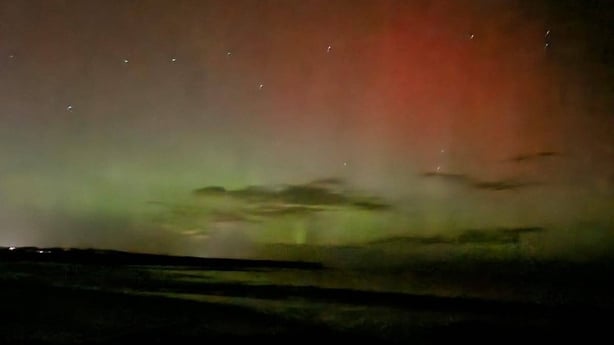
Stargazers across parts of Europe have been treated to stunning views of the Northern Lights, or aurora borealis.
Overnight, the light display lit up skies in dazzling colours over several countries, including Ireland, England, Scotland, Denmark and Norway, according to news reports, which added that some areas of England were already treated to the phenomenon on Saturday evening.
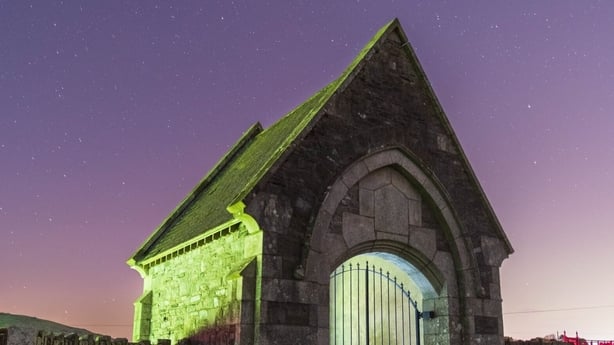
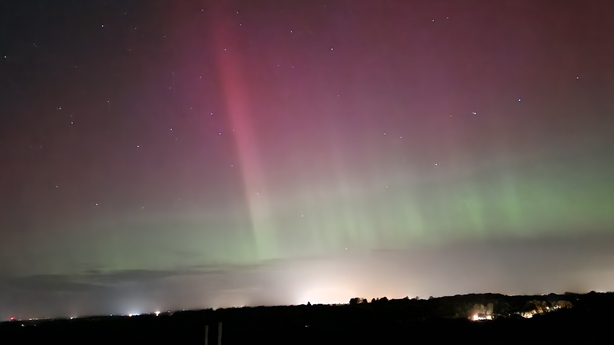
According to the UK Met Office, which had forecast the possible appearance of the Northern Lights over England, Scotland and Wales, they occurred due to a geomagnetic storm causing disruptions to the earth's magnetic fields.
The Met Office said countries on a similar latitude as the UK could also experience the natural light show.
Norwegian media reported that the phenomenon had been spotted along the country's western coast.
Other news reports said the spectacle had been observed as far east as Ukraine and even in Bulgaria, the first time the phenomenon had been observed there.
Professor Don Pollacco, department of physics at the University of Warwick, said the phenomenon was caused by "the interaction of particles coming from the sun, the solar wind, with the Earth's atmosphere - channelled to the polar regions by the Earth's magnetic field.
"It's actually a bit like iron filings and the field of a bar magnetic.
"The solar wind contains more particles when there are sun spots, as these are regions on the sun's surface where the magnetic field is interacting with the plasma in the sun, and the particles can be released.
"Once the particles are channelled into the Earth's atmosphere they interact with molecules and have distinctive colours (eg oxygen molecules produce green light, nitrogen red light etc) and patterns such as light emissions that look like curtains or spotlights.
"These shapes change quickly over timescales of minutes/seconds."