


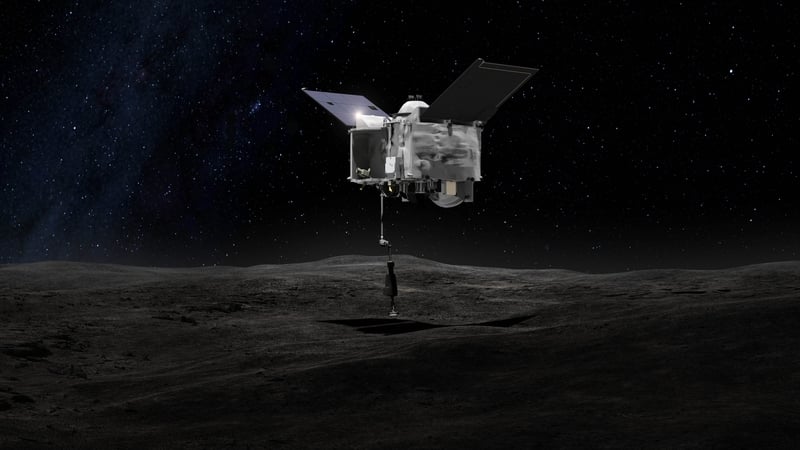
Nasa is expected to break new ground in space research with its Osiris-Rex mission.
The US space agency has brought home the largest asteroid sample ever returned to Earth, but what is the purpose of the mission?
Here is an explanation of why the development could be so important.
What is Osiris-Rex?
The Osiris-Rex spacecraft was launched by Nasa on 8 September 2016.
It collected a sample - roughly 250 grams - of rocks and dust from the surface of an asteroid, called Bennu, on 20 October 2020.
After further study of the asteroid, Osiris-Rex set off back to Earth with the sample on 10 May 2021.
It is Nasa's first mission to collect an asteroid sample.
When and where will the sample arrive back on Earth?
The capsule pierced the Earth's atmosphere traveling at about 44,500km/ph. At this pace, the compression of Earth's atmosphere produced enough energy to envelop the capsule in a superheated ball of fire.
A heat shield helped to regulate the temperature inside the capsule, keeping the sample safe at a temperature similar to that of Bennu's surface, Nasa said.
Parachutes brought the capsule's descent to a safe landing speed and at touchdown, the capsule slowed to about 18km/ph.
Just 13 minutes after entering the atmosphere, the capsule arrived on Earth for the first time in seven years.
The capsule landed in a US government test and training range near Salt Lake City in Utah this afternoon.
It was to be taken to a temporary "clean room" before being transported to Nasa's Johnson Space Centre in Houston, Texas tomorrow.
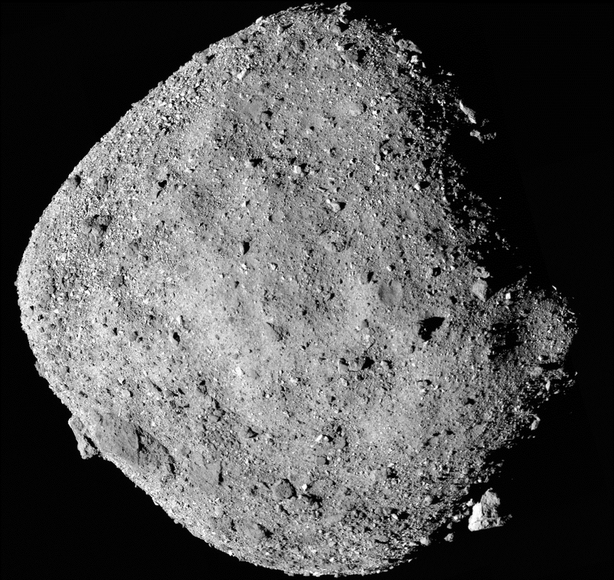
What is Bennu, and why is the asteroid being studied?
Scientists predict that Bennu formed from pieces of a larger asteroid in the asteroid belt between one and two billion years ago.
Bennu is relatively rich in organic molecules and appears to have been altered by liquid water in the distant past.
Scientists believe that asteroids like Bennu could have delivered these molecules and water through collisions with Earth, explaining why our planet now has an abundance of both.
Bennu's rocks are unlike any found on Earth because factors such as weather and erosion have changed the planet.
As the asteroid crosses into the Earth's orbit, it is also easier and quicker to send a spacecraft to Bennu and back than to the asteroid belt, which is located between the orbits of Mars and Jupiter.
How will the sample be studied?
Once the sample has been documented and stored at the Johnson Space Centre, portions of Bennu's rocks and dust will be distributed to scientists, other national space agencies and researchers around the world.
Up to a quarter of the sample will be distributed to 233 scientists on the Osiris-Rex team from 38 global institutions, including the University of Manchester and the Natural History Museum in London.
Some 4% will be given to the Canadian Space Agency and 0.5% to the Japanese state space agency, Jaxa.
Have other asteroid samples been returned to Earth?
Jaxa's Hayabusa mission was the first to return samples, when it carried particles from the Itokawa asteroid in June 2010.
The Japanese space agency then successfully carried out a follow-up mission, Hayabusa2, with a sample from the Ryugu asteroid in December 2020.
What will happen to Osiris-Rex after it returns the sample?
Around 20 minutes after releasing the sample capsule above Earth, Osiris-Rex will set out on a new mission called Osiris-Apex to explore asteroid Apophis, which it will reach in 2029.
