


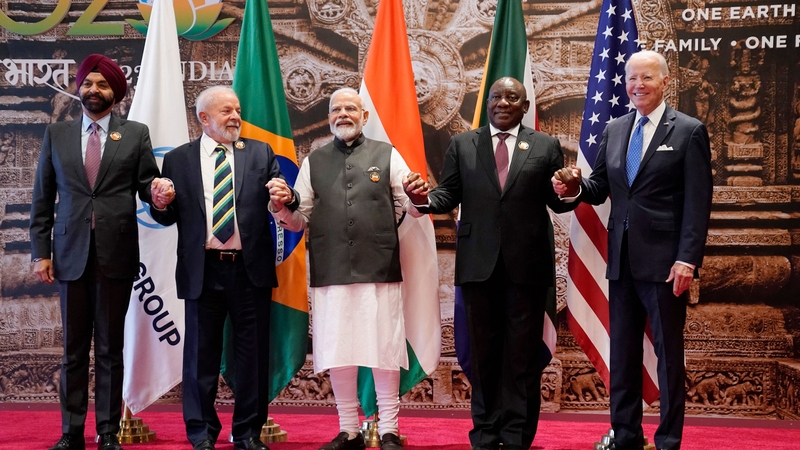
G20 leaders failed to commit to a phase-out of polluting fossil fuels, a requirement deemed "indispensable" just a day earlier by the United Nations to achieve a net-zero goal.
Group of 20 leaders have been meeting in the Indian capital New Delhi during what is likely the hottest year in human history.
Achieving net-zero carbon emissions by 2050 will require phasing out fossil fuels whose emissions cannot be captured, and dramatically increasing clean power, the UN's first progress report on meeting Paris Agreement climate goals said.
"Scaling up renewable energy and phasing out all unabated fossil fuels are indispensable elements of just energy transitions to net zero emissions," the first UN Global Stocktake said.
But while the G20 warned funds for climate transition must "substantially scale up", and they said they would back efforts to triple global renewable energy capacity by 2030, they did not mention the critical phase-out of all fossil fuels.
Instead their statement referred to "accelerating efforts towards phasedown of unabated coal power, in line with national circumstances and recognising the need for support towards just transitions".
G20 countries account for 85% of global GDP and a similar amount of global climate warming emissions, making action in the forum crucial to real progress.
But per capita coal emissions have risen by nine percent across the grouping since 2015, research showed this week, largely driven by India, Indonesia and China, despite transition efforts by some members.
Read more: Why is the G20 summit so important to India?
The group "will pursue and encourage efforts to triple renewable energy capacity", the leaders' statement said, recognising the importance of speeding up the development of technologies and policies to move to low-emission energy systems.
Wealthy nations have already failed to deliver on a pledge to provide $100 billion a year in climate finance to poorer nations by 2020.
"We commit to urgently accelerate our actions to address environmental crises and challenges including climate change," the statement added.
Earlier this morning, Brazilian President Luiz Inacio Lula da Silva told the summit that the planet was facing an "unprecedented climate emergency".
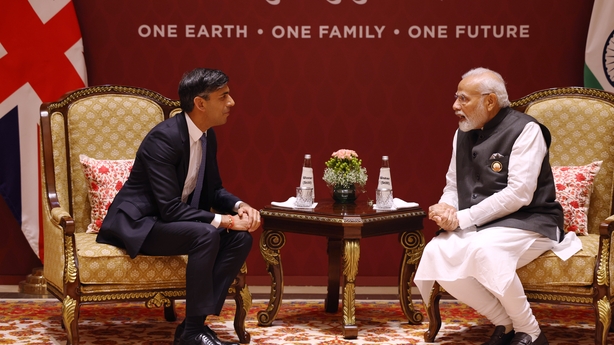
Summit's first day
Prime Minister Narendra Modi of host India inaugurated the two-day meeting by calling on members to end a "global trust deficit" and announced that the bloc was granting permanent membership to the African Union in an effort to make it more representative.
"Today, as the president of G20, India calls upon the entire world to first convert this global trust deficit into one trust and one confidence," he said. "It is time for all of us to move together."
At the start of the day, US President Joe Biden and other leaders were driven through deserted streets to a new, €280 million conch-shaped convention centre called Bharat Mandapam, opposite a 16th-century stone fort, for the summit.
Many businesses, offices and schools have been closed in the city and traffic restricted as part of security measures to ensure the smooth running of the most high-powered meeting to be hosted by the country. Slums have been demolished and monkeys and stray dogs removed from the streets.
Mr Biden will press for a higher level of climate action at the summit, a White House official said, as concerns grow about lack of consensus on cutting emissions.
Ukraine
The group is deeply divided over the war in Ukraine, with Western nations pushing for strong condemnation of Russia in the Leaders' Declaration to be issued at the end of the summit, while others are demanding a focus on broader economic issues.
The G20 sherpas, or country representatives, have reached a compromise on the language to be used in the communique, which will be presented to the leaders, the source with knowledge of the negotiations said.
No details were immediately available, but it could be similar to language in the declaration issued in Indonesia at the 2022 summit, which noted that while most nations condemned Russia for the invasion, there were also divergent views.
An earlier 38-page draft of the final statement left the "geopolitical situation" paragraph blank, while it had agreed on 75 other paragraphs covering issues ranging from global debt and cryptocurrencies to climate change.
Dominated by the West
Mr Modi, in his opening remarks, invited the AU, represented by Chairperson Azali Assoumani, to take a seat as a permanent member.
"This will strengthen the G20 and also strengthen the voice of the Global South," said a message on Modi's official account on social media platform X, formerly known as Twitter.
The summit is expected to be dominated by the West and it sallies. Chinese President Xi Jinping is skipping the meeting and has sent Premier Li Qiang instead, while Russia's Vladimir Putin will also be absent.
Mr Biden, German Chancellor Olaf Scholz, French President Emmanuel Macron, British Prime Minister Rishi Sunak, Saudi Arabia's Mohammed Bin Salman and Japan's Fumio Kishida, among others, are attending.
The summit had been seen as affording a venue for a possible meeting between Xi and Biden following months of efforts by the powers to mend ties frayed by trade and geopolitical tensions.
"It's incumbent upon the Chinese government to explain" why its leader would or would not participate, Jon Finer, the US deputy national security adviser, told reporters in Delhi.
He said there was speculation that China is "giving up onG20" in favour of groupings like BRICS, where it is dominant.
BRICS includes Brazil, Russia, India, China and South Africa, and has agreed to add another six new members - Saudi Arabia, Iran, Ethiopia, Egypt, Argentina and the United Arab Emirates - accelerating its push to reshuffle a world order it sees as outdated.
Struggling over language
Russia is being represented by Foreign Minister Sergei Lavrov, who has said he will block the final declaration unless it reflects Moscow's position on Ukraine and other crises.
Russia's 2022 invasion of Ukraine has left tens of thousands of dead, displaced millions and sown economic turmoil across the world.
Moscow denies committing atrocities during its conflict with Ukraine, which it terms a "special operation" to "demilitarize" its neighbour.
One source said a joint G20 declaration may or may not come to a unanimous agreement. It could have paragraphs stating the views of different countries, or it could record agreement and dissent in one paragraph.
According to another senior source in one of the G20 countries, the paragraph on the war on Ukraine had been agreed by Western countries and sent to Russia for its views.
In the absence of an agreement, India will have to issue a chair statement, which would mean that G20 for the first time in20 years of summits will not have a declaration.
A Leaders' Declaration "is by far the best way to record what has been agreed, so that countries can be held to account in the future by external parties, and so that government systems know what their leaders have signed up to and what they need to do internally", said Creon Butler, director for the global economy and finance programme at London's Chatham House.
