

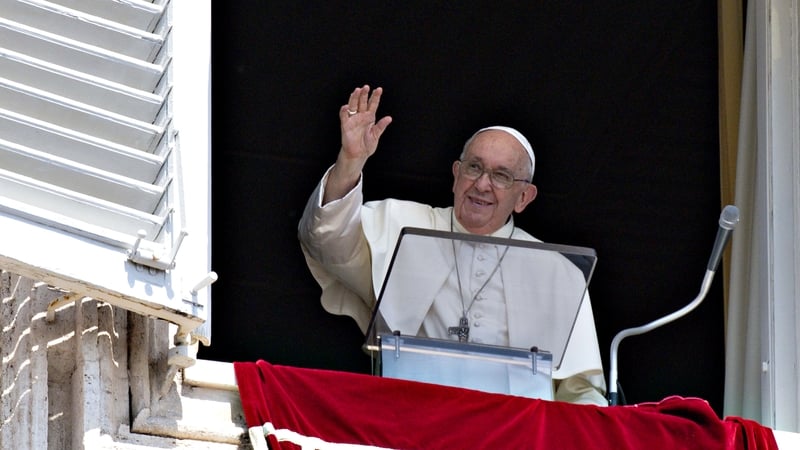
Pope Francis has lamented what he called a "reactionary" Catholic Church in the United States, where he said political ideology has replaced faith in some cases.
In the 10 years since his election, Pope Francis has been criticised by conservative sectors of the US Church who are opposed to reforms such as giving women and lay Catholics more roles and making the Church more welcoming and less judgmental towards some, including LGBT people.
Pope Francis made his comments on 5 August in a private meeting in Lisbon with members of the Jesuit order, of which he is a member, during his trip for World Youth Day.
They were published this morning by the Jesuit journal Civilta Cattolica.
In a question-and-answer session, a Portuguese Jesuit said that during a sabbatical in the United States, he was saddened that many Catholics, including some bishops, were hostile to the pope's leadership.
"You have seen that in the United States the situation is not easy: there is a very strong reactionary attitude. It is organised and shapes the way people belong, even emotionally," the pope responded.
Religious conservatives in the United States often have aligned with politically conservative media outlets to criticise the pope over a host of issues such as climate change, immigration, social justice, his calls for gun control and his opposition to the death penalty.
"You have been to the United States and you say you have felt a climate of closure. Yes, this climate can be experienced in some situations," Pope Francis said.
"And there, one can lose the true tradition and turn to ideologies for support. In other words, ideology replaces faith, membership in a sector of the church replaces membership in the church," he said.
The pope said his critics should understand that "there is an appropriate evolution in the understanding of matters of faith and morals" and that being backward-looking is "useless".
As an example, he said some pontiffs centuries ago were tolerant of slavery but the church evolved.
One of the pope's fiercest American critics, Rome-based Cardinal Raymond Burke, wrote in an introduction for a recent book that a meeting of bishops called by Pope Francis for this October to help chart the future of the Church risked sowing "confusion and error and division".
