


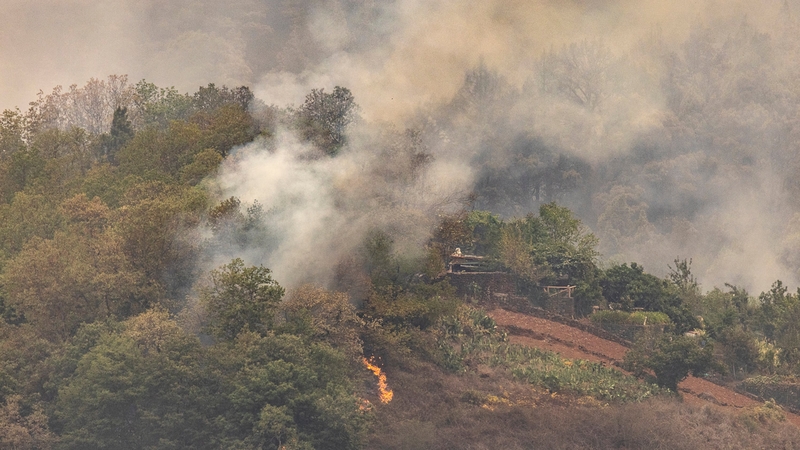
Firefighters are making gains in their battle against a vast wildfire on Tenerife after better-than-expected overnight weather helped them to keep the blaze from destroying homes on the island, regional officials have said.
The blaze broke out late Tuesday in a mountainous north eastern area, quickly morphing into the biggest-ever wildfire to strike the chain of islands.
With a perimeter of 84km it has burned through 11,600 hectares of land - almost 6% of Tenerife's overall surface area - forcing more than 12,000 people to flee their homes, the regional government said.
Despite concerns ahead of last night, things went "much better than expected", Canary Islands leader Fernando Clavijo said.
"We warned of a complex situation, with rising temperatures and wind... and it's true the night started very hard with many calls saying the fire was very close to people's homes," he told reporters early this morning.But the firefighters "worked very intensively" and got through the night without losing a single home to the blaze, he said, describing it as "almost a miracle".
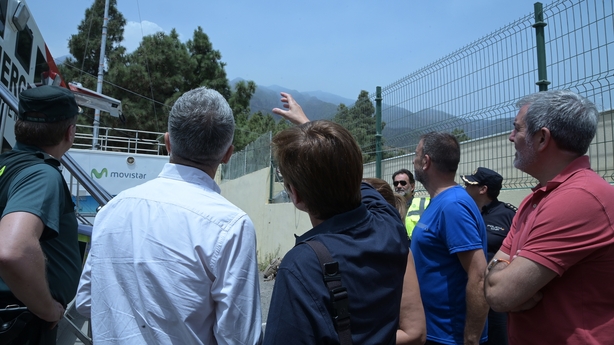
Montse Roman, technical head of the operation, said that overnight operations were "mainly focused on defending infrastructure and homes on the northern flank of the fire," confirming there had "not been any more evacuations or confinement orders".
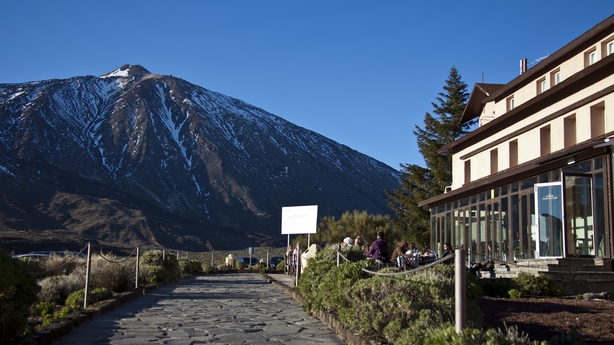
However, officials today ordered the evacuation of the luxury state-run Parador hotel next to Mount Teide volcano, Spain's highest peak, the emergency services said.
It was not immediately clear how many people were evacuated from the hotel, which is located in the middle of the Teide national park at 2km above sea level.
Some 610 people were today involved in the massive operation to battle the blaze and help those affected by it, with 20 aerial units backing up the firefighting efforts.
Yesterday the airborne units staged 930 sorties, dropping 1.5m litres of water onto the flames, the emergency services said.
'It will ruin us'
As the fire spread down the mountainside towards the northern town of La Matanza de Acentejo yesterday afternoon, Candelaria Bencomo Betancor, a farmer in her 70s, looked on in anguish.
"The fire is close to our farm, we've got trucks, vans, chickens, everything... it's a business that is going well but if the fire comes, it will totally ruin us," she told AFPTV, on the verge of tears.
"They have to do something because the fire is right there."
So far, the fire has affected 11 municipalities on Tenerife, the largest of the seven Canary Islands, with the emergency services saying air quality was affected across much of the island "due to the smoke generated by the fire".
Pedro Martinez, who is in charge of firefighting efforts, said the blaze was "behaving like a sixth-generation wildfire" -- a term referring to a mega forest fire, and efforts to tackle the flames were being hampered by the huge clouds of smoke and the wind.
The blaze has generated a vast pillar of smoke that now stretches some eight kilometres into the air, rising far above the summit of Mount Teide.
Spanish Prime Minister Pedro Sanchez is expected to visit the area tomorrow.
Last year, Spain suffered more than 500 blazes that destroyed more than 300,000 hectares, making it the worst-hit country in Europe, according to the European Forest Fire Information System (EFFIS).
So far this year, it has had 340 fires, which have ravaged almost 76,000 hectares, EFFIS figures show.
