


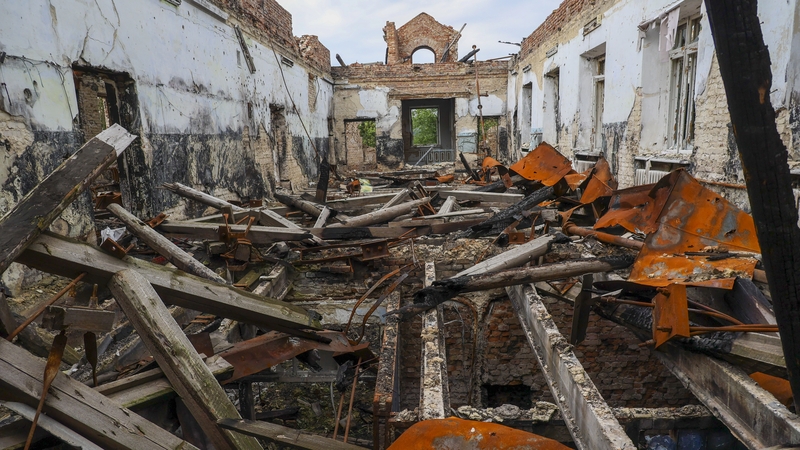
Ukrainian troops are advancing in all directions of their counter-offensive against occupying Russian forces, a senior defence official said.
Since the start of the counter-offensive this month, Ukraine says it has regained control over clusters of villages in the southeast although Russia still holds swathes of territory in the east, south and southeast.
"If we talk about the entire frontline, both east and south, we have seized the strategic initiative and are advancing in all directions," Deputy Defence Minister Hanna Maliar told Ukrainian television.
Russia, which began its full-scale invasion in February 2022, has not acknowledged the Ukrainian gains and has said Ukraine's military are suffering heavy casualties.
Ms Maliar said Ukrainian troops were moving "confidently" on the flanks around the devastated eastern city of Bakhmut, which is held by Russian forces, and the main fighting was going on around the city.
In the south, Kyiv's forces were moving with mixed success and mainly levelling the frontline, she said.
"In the south, we are moving with varying success, sometimes there are days when it is more than a kilometre, sometimes less than a kilometre, sometimes up to two kilometres," she said.
She noted that the effectiveness of the counter-offensive should be evaluated by "a lot of different military tasks" and not just by advances and the liberation of settlements.

"Therefore, all these tasks are being carried out and only the military can assess this correctly and accurately, and according to their assessment, everything is going according to plan," she said.
President Voldoymyr Zelensky has described the counter-offensive as proceeding more slowly than desired, but that Kyiv would not be pressured into speeding it up.
Ukrainian officials have also said the "main event" of the counter-offensive has yet to start, and that Ukraine has not yet sent its main troop reserves into combat.
Russia will be 'stronger' after Wagner revolt - Lavrov
Russian Foreign Minister Sergei Lavrov said that Moscow will emerge from the aftermath of a recent armed insurrection by the Wagner mercenary group "stronger" than before.
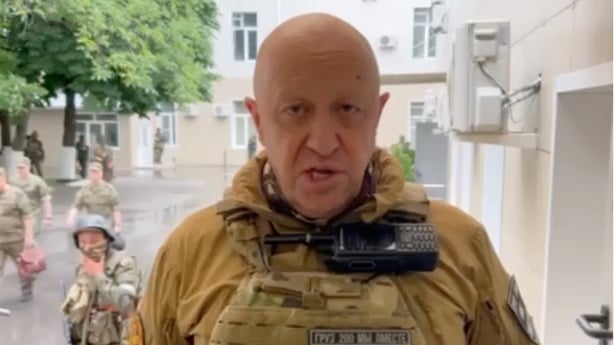
"Russia has always overcome all its problems... it comes out stronger and stronger. It will be the same this time, too. This process has already begun," Mr Lavrov told journalists during a briefing in Moscow, after the rebels marched on the capital last week to oust the country's military leadership.
The revolt, led by mercenary chief Yevgeny Prigozhin, posed the most serious threat to President Vladimir Putin's decades-long rule and spurred Kremlin efforts to disband the private military outfit.
The Wagner group played a key role in the capture of several east Ukraine towns, including Bakhmut, after a mass recruitment drive in Russia.
Answering a question from foreign media, Mr Lavrov said: "Thank you for your concern about our national interests, but you shouldn't be worried."
New evidence of Ukrainian use of banned landmines
Human Rights Watch (HRW) said that it uncovered new evidence of the indiscriminate use of banned anti-personnel landmines by Ukrainian forces against Russian troops.
The group called on Ukraine's government to follow through with a commitment made earlier this month to not employ such weapons, to investigate their suspected use and to hold accountable those responsible.
"The Ukrainian government's pledge to investigate its military's apparent use of banned anti-personnel mines is an important recognition of its duty to protect civilians," HRW arms director Steve Goose said in a statement.
HRW said it shared its findings with the Ukrainian government in a May letter and received no response.
In 2005 Ukraine ratified a 1997 international treaty banning such mines and mandating the destruction of stocks of the weapons.
Russia did not join the treaty and its use of anti-personnel mines "violates international humanitarian law... because they are inherently indiscriminate", the report said.
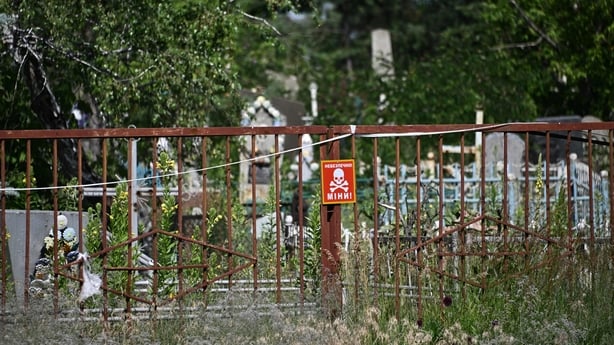
Anti-personnel mines are detonated by a person's presence, proximity or contact and can kill and maim long after a conflict ends.
Since Russia's February 2022 invasion, HRW has published four reports documenting the use of 13 types of anti-personnel mines by Russian troops that killed and injured civilians.
The new report is a follow-on to a January report that Ukrainian soldiers fired rockets that scattered thousands of PMF-1 mines in Russian-occupied areas in and around the eastern city of Izium between April and September 2022, when Kyiv's forces recaptured it.
The latest report said that fresh evidence of Ukrainian forces' use of anti-personnel mines came from photographs posted online by an individual working in eastern Ukraine that showed warhead sections of Uragan 220mm rockets.
Those rockets each indiscriminately disburse 312 PFM-1S anti-personnel mines, said the report.
Analysis of handwriting on one warhead determined that the first word was Ukrainian for "from", while a second Latin alphabet word related to an organization in Kyiv, which the report did not identify.
