


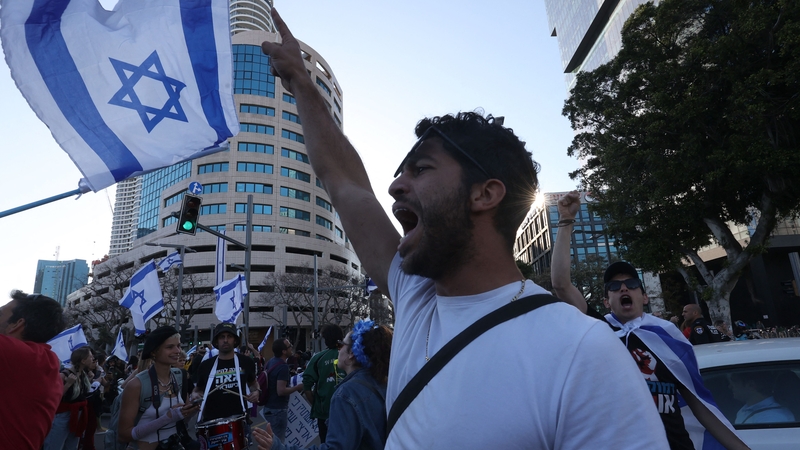
Israeli protesters returned to the streets on Thursday to rally against proposed judicial reforms, after Prime Minister Benjamin Netanyahu rejected a compromise plan touted by the country's president.
The reforms, several provisions of which have already been adopted by parliament, are "the end of democracy", read a placard brandished by demonstrators in Tel Aviv.
"I am afraid that we will become a religious state, that the laws of Judaism will come first and the democratic freedom that we have will not be there anymore," Liat Tzvi, a researcher at Tel Aviv University, told AFP.
Demonstrators blocked a key road in the coastal city, an AFP reported said.
Demonstrators also gathered in Jerusalem and the northern city of Haifa to denounce the overhaul that would, among other things, allow lawmakers to scrap supreme court rulings with a simple majority vote.
Some opposition leaders have said they would attend another rally planned for Thursday evening in Tel Aviv.
Since Netanyahu's hard-right government announced the reforms in January, the month after taking office, massive demonstrations have regularly taken place across Israel.
Opponents of the package have also accused Netanyahu, who faces a string of corruption allegations which he denies, of trying to use the reforms to quash possible judgements against him.
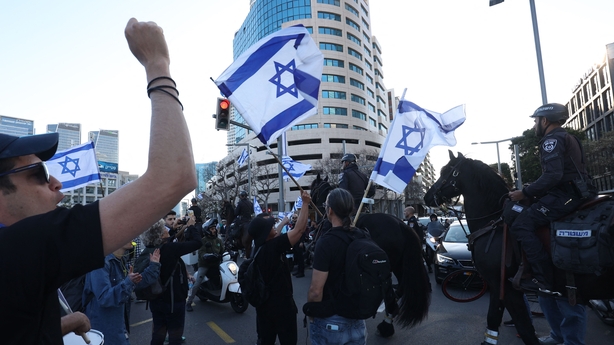
President Isaac Herzog on Wednesday presented a proposed compromise on the reforms, but it was immediately rejected by the government.
Netanyahu later told reporters: "As for the president's compromise, I think any attempt to reach an agreement and a dialogue is certainly welcome."
"But what the president is proposing has not been accepted by the representatives of the ruling coalition," he added shortly before departing for a state visit to Germany.
"Key points in his programme only perpetuate the existing situation and do not bring the required balance between the powers."
Speaking in Berlin, Netanyahu put on a defiant front, arguing his plans merely sought to bring Israel's democracy "in line with what is common and acceptable in just about every Western democracy".
He also hit out at "slanders and falsifications" against his own and his coalition's intentions.
"Israel is being constantly... maligned. I'm supposed to be some... potentate who's abolishing democracy and all this nonsense," he charged at a press conference, standing next to Scholz, adding, "this is absurd, it's preposterous".
'Civil war' threat
Netanyahu's coalition, which includes ultra-Orthodox and extreme-right parties, says the reforms are needed to limit judicial overreach, but protesters say they threaten Israel's liberal democracy by weakening key checks and balances.
Ten consecutive weeks of nationwide demonstrations have followed, with critics also alleging the proposed changes aim to protect Netanyahu as he fights corruption charges in an ongoing court battle.
With the strife far from easing, Herzog warned late on Wednesday that "anyone who thinks that a genuine civil war, with human lives, is a line that we could never reach, has no idea what he is talking about.
"It is precisely now, in the State of Israel's 75th year of independence, that the abyss is within touching distance. Today, I say to you what I told them: civil war is a red line.
"I will not allow it to happen," he said, adding he was convinced the majority of Israelis want a compromise.
The changes proposed by the coalition would allow lawmakers to override Supreme Court decisions that strike down legislation with a parliamentary majority, and then deny the court the right to review such a move.
It would also make it harder for the Supreme Court to strike down legislation it deems to contravene Basic Laws, Israel's quasi constitution.
In Berlin, several hundred protesters also turned out at the Brandenburg Gate, a short distance from the chancellery where Netanyahu and Scholz held talks.
'Normal guest'
The controversy in Israel puts Germany in an uncomfortable position.
The two nations forged strong diplomatic ties in the decades after World War II, with Berlin committed to the preservation of the Israeli state in penance for the Holocaust.
Successive German governments have described Israel's national security as a crucial foreign policy priority.
Government spokesman Steffen Hebestreit on Monday said Netanyahu is the "elected prime minister of Israel and therefore also a normal guest in Germany".
But amid the row in Israel, in carefully worded statements, German leaders have voiced their worries.
On the eve of talks with Netanyahu, German President Frank-Walter Steinmeier said he planned to raise the reforms with the Israeli prime minister.
Israel is the "only democracy in the whole region, a country with a strong constitutional state", he said. "What I would like to see is that what we have admired about Israel... is preserved."
