

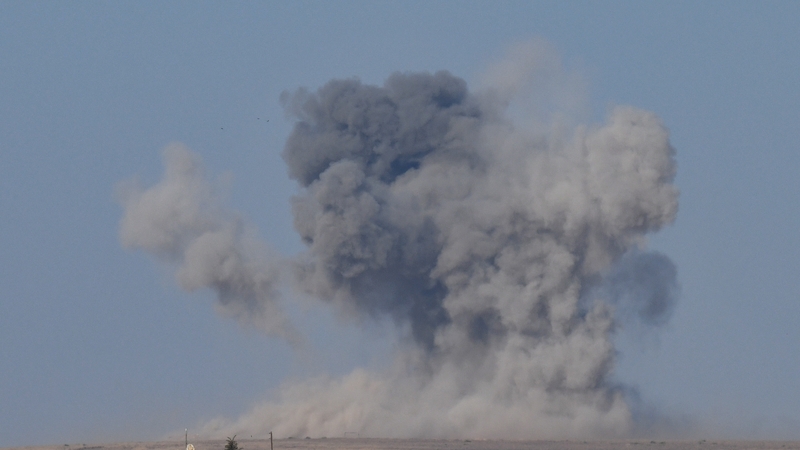
Turkey has announced it had carried out air strikes against the bases of outlawed Kurdish militants across northern Syria and Iraq, which it said were being used to launch "terrorist" attacks on Turkish soil.
The overnight raids in northern and northeastern Syria killed at least 31 people, said the British-based monitoring group the Syrian Observatory for Human Rights. The raids were mainly against positions held by Syrian Kurdish forces.
The offensive, codenamed Operation Claw-Sword, comes a week after a blast in central Istanbul killed six people and wounded 81, an attack Turkey has blamed on the Kurdistan Workers' Party (PKK).
The PKK has waged a bloody insurgency there for decades and is designated a terror group by Ankara and its Western allies. But it has denied involvement in the Istanbul explosion.
"Air Operation Claw-Sword was successfully carried out, within the scope of our strategy to eradicate terrorism at its source and eliminate terror attacks against our people and security forces from northern Iraq and Syria," said a defence ministry statement.
The strikes targeted PKK bases in northern Iraq's mountainous regions of Kandil, Asos and Hakurk, and bases of the Kurdish People's Protection Units (YPG), in Ayn al-Arab (called Kobane in Kurdish), Tal Rifaat, Jazira and Derik regions in Syria, the ministry said.
Ankara considers the YPG to be a PKK-affiliated terror group.
In all, 89 targets including shelters, bunkers, caves, tunnels, ammunition depots, so-called headquarters and training camps belonging to the militants "were destroyed", the ministry said, adding "many terrorists were neutralised".
"All our planes safely returned to their bases after the operation," it added.
Defence Minister Hulusi Akar was seen in a video image briefing President Recep Tayyip Erdogan, who gave the order for the latest operation.
Syria's government said the raids had killed a number of its soldiers.
Last Sunday's Istanbul bombing was the deadliest in five years, reviving bitter memories of a wave of nationwide attacks between 2015 and 2017.
Those attacks were attributed mostly to Kurdish militants or Islamic State (IS) group jihadists - but no one has claimed responsibility for the Istanbul attack.
