


Haiti has decided to request military assistance from the international community to help with a humanitarian crisis caused by a blockade of the country's main fuel port which has led to crippling shortages, a Haitian official said on Friday.
Haiti has ground to a halt since a coalition of gangs blocked the Varreux fuel terminal last month. The lack of gas and diesel has crippled transportation and forced businesses and hospitals to halt operations.
It has also led to a shortage of bottled water, just as the country confirmed a new outbreak of cholera, the spread of which is controlled through hygiene and clean water.
"It was decided in the Council of Ministers last night ...to request military assistance to the international community to deal with such an unbelievable humanitarian crisis," a spokesman for Prime Minister Ariel Henry wrote in a text message.
The news was first reported by the Miami Herald. It was not immediately evident which nations would receive such a request.
The United Nations has not received an official request from the Haitian government, UN spokesman Stephane Dujarric said on Friday.
"That being said, we remain extremely concerned about the security situation in Haiti, the impact it's having on the Haitian people, on our ability to do our work, especially in the humanitarian sphere," Dujarric told reporters.
The US State Department and the White House did not immediately respond to requests for comment.
Canada's foreign ministry on Friday said that 19 member countries of the Organization of American States, which is meeting in Peru, jointly affirmed solidarity with Haiti.
The statement said those countries were committed to helping Haitians "overcome the complex security challenges facing the country."
Humanitarian corridor
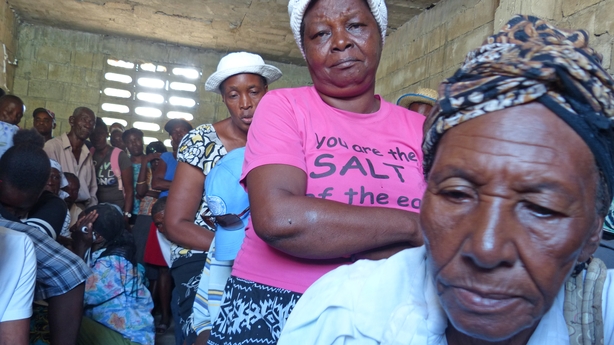
The United Nations has warned of a possible explosion of cholera cases in crisis-wracked Haiti.
The international body called for the creation of a humanitarian corridor to ease a blockage of the Haiti's main fuel import terminal.
Haiti announced on Sunday its first cases of cholera in three years, with seven people dead of the disease.
At least 11 cases have been confirmed, and there are another 111 suspected cases, but the real numbers could be much higher, said Ulrika Richardson, UN resident and humanitarian coordinator for Haiti.
Speaking from Haiti via video, she said that for now, the cases seem to be limited mainly to the capital Port-au-Prince.
"With the current conditions in Haiti, and if not all the good conditions are met, we are actually in for quite an exponential if not explosive increase of cholera cases," she said.
"One could even say that perhaps the conditions are there for a perfect storm, unfortunately."
Ms Richardson said "the numbers (of infected) could be much higher".
Tests were underway abroad to determine whether it was the same strain of cholera as the one that killed more than 10,000 people from 2010 to 2019.
'They need our continuing support'
Top US diplomat Antony Blinken, in Peru for a meeting of the Organisation of American States, said, "We commend the efforts of the Haitian National Police, who have been working tirelessly to try to keep the peace."
"But they need our help. They need our continuing support."
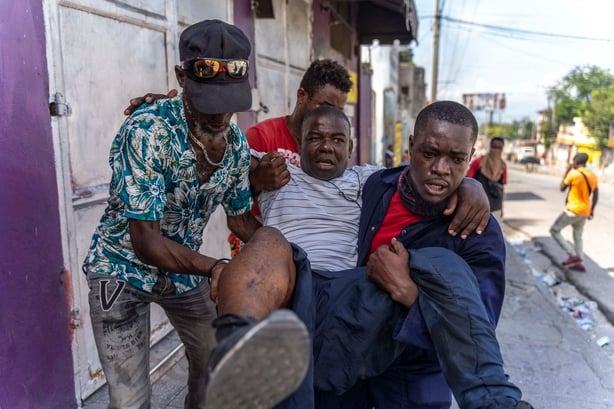
In a television address on Wednesday night, Prime Minister Ariel Henry had appealed for international "friends of Haiti" to help deal with the armed gangs that he said have taken the country "hostage".
Speaking at a Security Council meeting in late September, Haiti's UN envoy Helen La Lime said that the new violence - five years after the departure of UN peacekeepers - is testing the Haitian police, which receives UN support to strengthen its capacity.
China has called for an embargo on the transfer of small arms to gangs in Haiti. The United States and Mexico, which drafted a resolution in July calling on states to ban the transfer of small arms, said they are working on a new text.
A new meeting on Haiti is scheduled for 21 October.
