


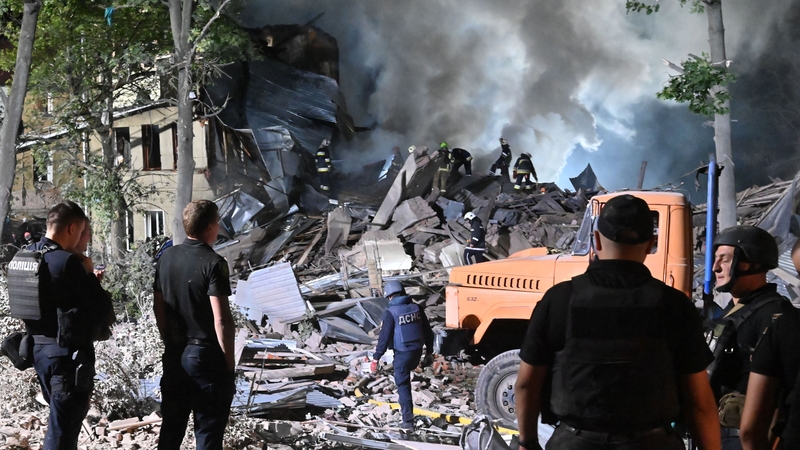
A total of 17 people were killed and 42 were injured in two separate Russian attacks on the major northeastern Ukrainian city of Kharkiv, the regional governor has said.
Three civilians were killed and 17 wounded in a pre-dawn rocket strike, the local emergency service said. That followed a Russian attack on Kharkiv on Wednesday, in which the emergencies service initially said 12 people were killed.
Governor Oleh Synehubov said more bodies had been discovered as rescuers picked their way through destroyed houses.
"As of now, 17 people have died in Kharkiv ... and 42 people have been injured," he wrote on Telegram, describing the attacks as "an act of terrorism".
Mr Synehubov also said two people were killed on Thursday in a rocket attack on the town of Krasnohrad in the Kharkiv region.
President Volodymyr Zelensky described Wednesday's attack on Kharkiv, Ukraine's second-largest city, as a "devious and cynical strike on civilians with no justification".
"We cannot forgive. We will avenge it," he said.
Russia denies deliberately targeting civilians in what it calls a "special military operation" in Ukraine.
They discussed ways to find a political solution to the war and address the threat to global food supplies and risk of a disaster at Europe's largest nuclear power plant, which has been taken over by Russian forces.
The war has forced millions to flee, killed thousands and deepened a geopolitical rift between the west and Russia, which says the aim of its operation is to demilitarise its neighbour and protect Russian-speaking communities.
"Russian forces have achieved only minimal advances, and in some cases we have advanced, since last month," Ukrainian presidential adviser Oleksiy Arestovych said in a video.
"What we are seeing is a 'strategic deadlock'."
The head of the Kharkiv region Oleg Synegubov said Moscow's forces had launched eight missiles from Russian territory at around 4.30am local time this morning, striking across the city.
"Three people died, including a child. Eight people, including two children, were rescued," the emergency services said.
Mr Synegubov posted images from the scene of one strike showing the smouldering remains of several burnt-out buildings and wreckage of destroyed vehicles nearby.
In separate strikes on the town of Krasnograd south west of Kharkiv, bombardments that damaged residential buildings left two dead and two more injured, he said.
"Kharkiv. 175 days of horror. Daily terror, missile strikes on residential areas and civilians," a senior presidential aide, Mykhaylo Podolyak, wrote on social media.
The south district of the Operational Command of the Ukrainian armed forces said Ukrainian forces killed 29 "occupiers" near the town of Bilohirka, northeast of Kherson, as well as destroying artillery, armoured vehicles and a military supply depot.
Reuters was not able to independently confirm the battlefield reports.
Fighting around the Russian-occupied Zaporizhzhia nuclear power plant has raised fears of a catastrophe and Mr Guterres has said he wants a demilitarised zone established.
Ukraine's foreign minister, Dmytro Kuleba, said he had spoken to the director general of the International Atomic Agency, who was ready to lead a delegation to the plant.
"I emphasised the mission's urgency to address nuclear security threats caused by Russia's hostilities," he said on Twitter.
In our call, IAEA Director General @rafaelmgrossi informed me that, responding to Ukraine's invitation, he is ready to lead an IAEA delegation to the Zaporizhzhia nuclear plant. I emphasized the mission’s urgency to address nuclear security threats caused by Russia’s hostilities.
— Dmytro Kuleba (@DmytroKuleba) August 18, 2022
Russia and Ukraine have exchanged accusations of shelling near the plant but the Russian ministry said its forces had no heavy weapons at the plant or in nearby districts.

A series of blasts at military bases and ammunition depots in the past week in Crimea, the Black Sea peninsula annexed by Russia in 2014, has suggested a shift in the conflict, with Ukraine apparently capable of striking deeper into Russian-occupied territory.
Russia blamed saboteurs for the attacks, while Ukraine has not officially taken responsibility but has hinted at it.
Ukrainian military intelligence said in a statement that after the recent explosions in Crimea, Russian forces had urgently moved some of their planes and helicopters deeper into the peninsula and to airfields in Russia.
Reuters could not independently verify the information.
If confirmed, it would mark one of the most prominent sackings of a military official in a war in which Russia has suffered heavy losses of men and equipment.
Meanwhile, Russia's Defence Ministry said three MiG-31E warplanes equipped with Kinzhal hypersonic missiles have been relocated to its Kaliningrad region, Interfax reported.
RIA cited the ministry as saying that the MiG jets would be on round-the-clock duty.
Kaliningrad, a Russian Baltic coast exclave located between NATO and European Union members Poland and Lithuania, became a flashpoint after Lithuania moved to limit goods transit to the region through its territory, with Russia promising retaliation.
More grain ships leave
Crimea provides the main supply route for Russian forces in southern Ukraine, where Kyiv is expected to launch a counter-offensive in coming weeks.
The Black Sea Fleet has also blockaded Ukraine's ports since the beginning of the war, trapping vital grain exports that are only now starting to move again, and sending global food prices soaring.
Three more ships with exports left Ukraine's Black Sea ports yesterday, a monitoring group said, bringing the number of vessels to leave Ukraine under a UN-brokered grain export deal to 24.
The government in Kyiv has said it hoped to increase the monthly volume of sea exports to three million tonnes in the near future to clear a backlog of 18 million tonnes of grains leftover from last year's harvest and start selling new crops.
