

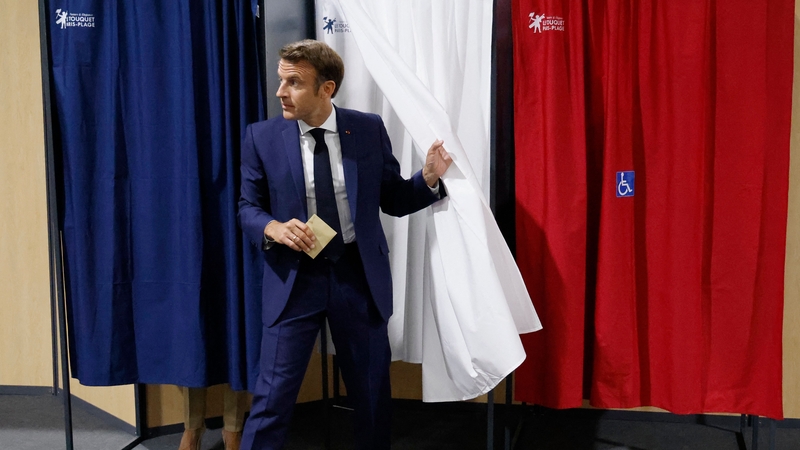
French President Emmanuel Macron's centrist alliance has won the first round of lower house elections yesterday by a razor-thin margin over the left bloc of Jean-Luc Melenchon, although it is likely to extend its lead in next weekend's second-round runoff.
Mr Macron's 'Ensemble!' alliance of centrist parties won 25.75% of the popular vote, according to the interior ministry's final tally, while Mr Melenchon's NUPES bloc came in second with 25.66%.
With rampant inflation driving up the cost of living and eroding wages, Mr Macron has struggled to build on his re-election in April, with Mr Melenchon casting him as a free-marketeer more intent on protecting the wealthy than hard-up families.
France's progressive-leaning Le Monde newspaper said this morning that its own tally showed the left bloc had won the nationwide popular vote, and some leftist politicians said the official result had undercounted their vote.

Extrapolating from earlier figures, four polling firms projected that Ensemble would win 225-295 seats in the decisive second round of voting next Sunday, possibly short of a majority of 289 but comfortably the biggest group.
"We have a week ahead of us to mobilise," Prime Minister Elizabeth Borne told reporters.
"One week to convince, one week to obtain a powerful and clear majority."
Ensemble was "the only political grouping capable of getting a majority," she said.
NUPES, a newly unified alliance of leftists, Socialists, Greens and Communists, was projected to win 150-220 seats, a major breakthrough that would make them the biggest opposition force in the National Assembly.
"It's a very serious warning that has been sent to Emmanuel Macron," political scientist Brice Teinturier told France 2 television, noting how support for the president's party had fallen since the last election in 2017.
"A majority is far from certain," he added.
If Mr Macron's coalition does fall short, it is expected to be forced into messy bill-by-bill deals with right-wing parties in parliament, or he will have to try to poach opposition or independent MPs to his side.
Under France's constitution, the president has exclusive control over foreign and defence policy, but needs a majority in parliament to pass domestic legislation.
'First test'
Yesterday's vote followed presidential elections in April in which Mr Macron secured a second term, beating far-right leader Marine Le Pen with pledges to cut taxes, reform welfare and raise the retirement age.
Putting behind their divisions, the French left has united behind Mr Melenchon, a hard-left veteran with a radically different programme, including lowering the retirement age, hiking the minimum wage by 15% and creating wealth taxes.
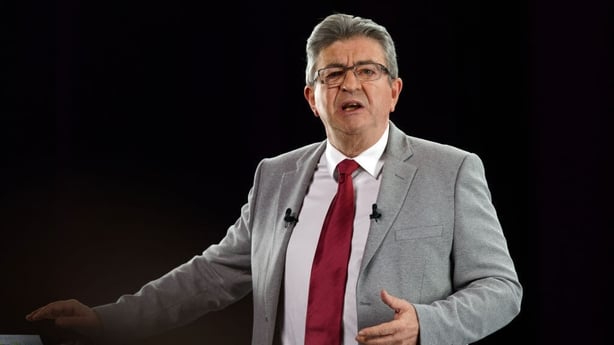
"The NUPES has passed the first test it faced in magnificent fashion," Mr Melenchon told reporters in a statement afterwards, calling on supporters to "pour out" next Sunday.
He called for the support in particular from the working classes and young people, adding that Mr Macron's allies were "beaten and defeated".
Turnout hit a record low, with 52.49% of registered voters opting to stay home, and abstentionism particularly high in working-class areas.
Ms Le Pen looked certain to be re-elected as an MP representing a former mining town of northern France, Henin-Beaumont, with her National Rally party appearing on course to increase their representation.
After winning 18.68% of the popular vote, it was on track to secure 5-45 seats in the new parliament next weekend, compared with eight currently.
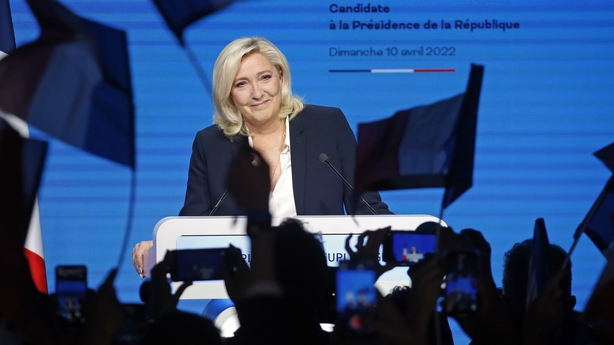
More than 15 MPs would give the far-right a formal group in parliament, meaning it would have more time to speak and put issues on the agenda as well as extra resources.
Defeated far-right presidential candidate Eric Zemmour was eliminated last night after standing in a constituency around Saint-Tropez in southern France.
No honeymoon
While Mr Macron and his European Union allies were relieved by victory against Ms Le Pen in April, the last weeks have offered no honeymoon for the 44-year-old head of state.
Energy and food prices are soaring, while disorder and the tear-gassing of English fans at the Champions League final in Paris on 28 May have led to recriminations.
His new Disabilities Minister Damien Abad has also faced two rape accusations - which he has vehemently denied - while new Prime Minister Borne has yet to make an impact.
Mr Macron is set to make a public appearance at an arms fair in Paris this morning, kicking off what promises to be an intense week of campaigning from all sides.
He and allies have sought to portray Mr Melenchon as an old-style tax-and-spend leftist whose anti-EU and anti-NATO policies pose a danger to the country.
Mr Melenchon accuses Mr Macron of planning to undermine France's cherished public services and is promising strong environmental policies and "harmony with nature".
