


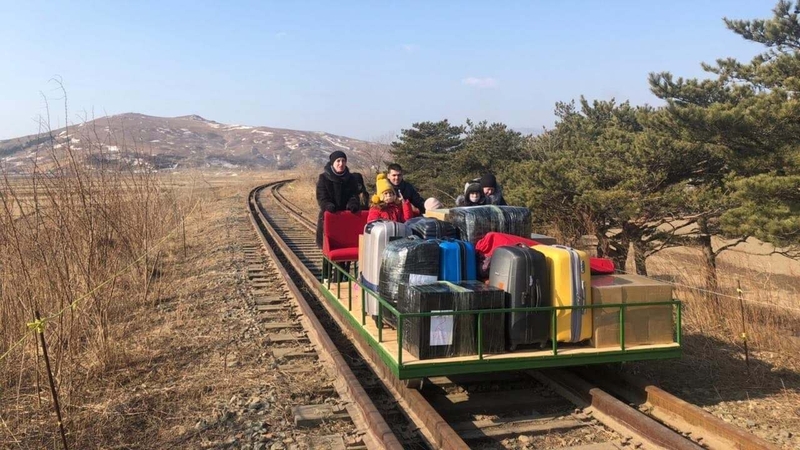
Eight Russian diplomats and family members, the youngest of them a three-year-old girl, have left North Korea on a hand-pushed rail trolley due to Pyongyang's coronavirus restrictions.
Video posted on Russia's foreign ministry's verified Telegram account showed the scene as the trolley, laden with suitcases, was pushed across a border railway bridge by Third Secretary Vladislav Sorokin.
The group waved and cheered as they made the final approach towards their homeland, the culmination of an expedition that began with a 32-hour train trip from Pyongyang, followed by a two-hour bus ride to the border.
"It took a long and difficult journey to get home," the ministry said in the post yesterday, then described how and why the group left on the trolley.
"Finally, the most important part of the route - walking on foot to the Russian side," it said.
"To do this, you need to make a trolley in advance, put it on the rails, place things on it, seat the children - and go."
Mr Sorokin was "the main 'engine' of the non-self-propelled railcar", it said, and had to push it for more than a kilometre.
Once on Russian territory they were met by foreign ministry colleagues and were taken by bus to Vladivostok airport.
"Don't leave your own behind", the ministry added as a hashtag.
This is how a group of Russian diplomats and their family had to get back to #Russia from North Korea because travel links have been cut by COVID for the past year. Russia's foreign ministry says they had to push the cart about a kilometer. pic.twitter.com/nLoU1rNU6V
— Patrick Reevell (@Reevellp) February 25, 2021
North Korea imposed a strict border shutdown in January last year to try to protect itself from the coronavirus that first emerged in neighbouring China and has gone on to sweep the world.
The shutdown has cancelled all flights in or out of the nuclear-armed, sanctions-hit country, and cross-border trains.
With staff and supplies unable to enter, the restrictions have severely hampered the activities of diplomats and aid workers, and several Western embassies have pulled out their entire staff.
But Russia has close relations with the North and maintains a significant diplomatic presence.
Stalin's Soviet Union played a key role in the North's foundation after it and the US decided to split the peninsula into two zones either side of the 38th parallel following the World War II surrender of Korea's colonial overlord Japan.
Russia still has a grand embassy in a prime spot in central Pyongyang, close to the North Korean leadership compound.
The group that left on the trolley were being repatriated home.
