


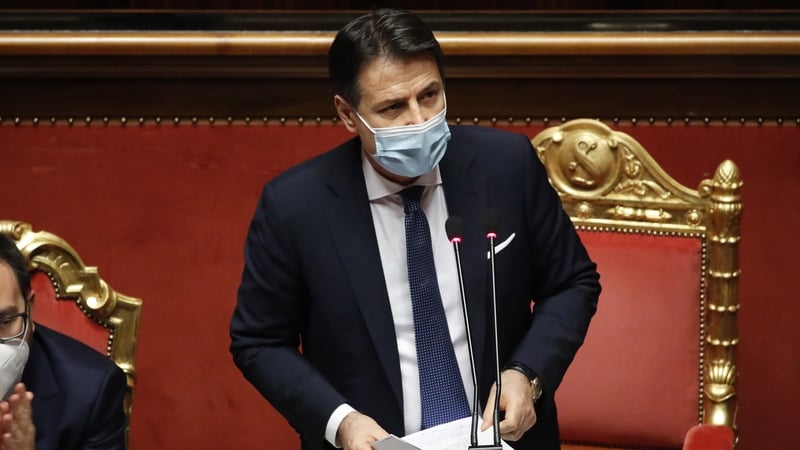
Italian Prime Minister Giuseppe Conte has handed in his resignation to the head of state, opening the way for formal consultations on how to overcome the political crisis, the president's office said.
President Sergio Mattarella will start consultations with party leaders tomorrow afternoon, his office said in a statement, adding that Mr Conte had been asked to stay on in a caretaker capacity as the talks continued.
Mr Conte lost his absolute majority in the upper house Senate last week when a junior partner, the Italia Viva party headed by former premier Matteo Renzi, quit in a row over the government's handling of the coronavirus crisis and economic recession.
If President Mattarella thinks Mr Conte might get the necessary backing to pull together a new administration, he will give him a few days to try to finalise a deal and draw up a new cabinet.
However, if he fails, the president will have to come up with an alternative candidate deemed capable of piecing together a workable coalition.
If all else fails, he will have to call elections, two years ahead of schedule.
Mr Conte is a lawyer with no direct political affiliation, but is close to the largest party in parliament, the anti-establishment 5-Star Movement.
He first came to power in 2018 after 5-Star formed an unexpected coalition with the far-right League. When that pact unravelled a year later, he stayed on as head of a new administration involving the 5-Star and centre-left Democratic Party (PD).
The deepening crisis is playing out against the backdrop of the coronavirus pandemic, which has killed more than 85,000 Italians - the second highest death toll in Europe after Britain and the sixth highest in the world.
The health crisis has triggered the worst recession in Italy since World War II and the government has been struggling to draw up a plan on how best to spend some €200 billion of European Union funds to help the economy recover.
Three regions have been ordered back into near-lockdown as new cases spike and a national vaccination programme was dealt a blow when pharma giant Pfizer said on 15 January it would delay shipments of jabs.
The ruling parties are keen to avoid snap elections, which opinion polls suggest would lead to victory for the centre-right coalition comprising Silvio Berlusconi's Forza Italia and Matteo Salvini's far-right League party.
