


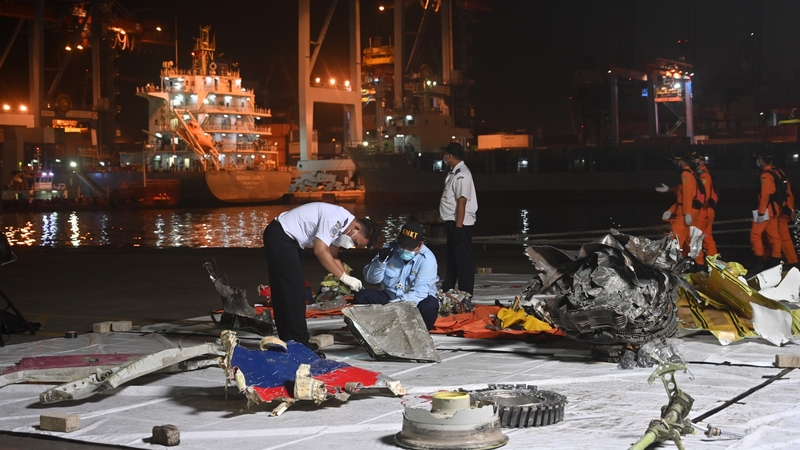
The crew of an Indonesian passenger jet that crashed off Jakarta at the weekend with 62 people aboard did not declare an emergency or report technical problems before it suddenly plunged into the sea, an investigator said today.
Authorities have so far been unable to explain why the 26-year-old plane crashed just four minutes after takeoff, but say they've pinpointed the location of the black boxes.
A recording of conversations with air traffic control pointed to routine exchanges, and there was no communication as the Sriwijaya Air Boeing 737-500 plunged about 10,000 feet (3,000 metres) in less than a minute before slamming into the Java Sea, said National Transportation Safety Committee investigator Nurcahyo Utomo.
"It's like a normal conversation and nothing suspicious," he told AFP.
"There's no talk of an emergency or something like that."
The preliminary data suggested it was "most likely" the plane was intact when it hit the water Saturday, he added.
"But we don't know at this stage" what caused the crash, said the investigator.
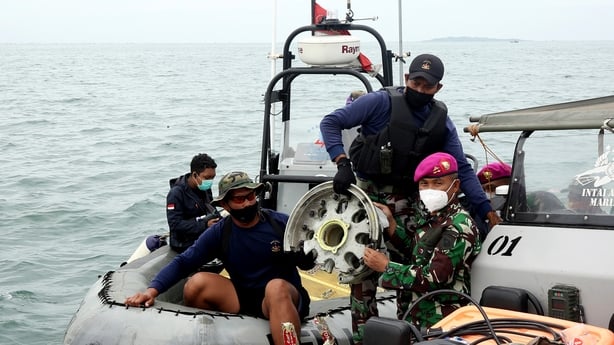
Divers were searching the waters off Jakarta today for black boxes from the jet, as investigators took up the grim task of identifying victims' remains.
Authorities yesterday said they had located the recorders from the Sriwijaya Air plane that crashed shortly after take-off on Saturday with 62 people on board. Now the task is retrieve them.
Retrieving the boxes, cockpit voice and flight data recorders, will likely help explain why the Boeing 737-500 plunged about 3,000 metres in less than a minute before slamming into the Java Sea.
The plane's captain, Afwan, a 54-year-old father of three, who like many Indonesians goes by one name, was a former air force pilot with decades of flying under his belt, according to local media.
Some of the 2,600 personnel working in the recovery effort involving dozens of boats and helicopters are hauling body parts, twisted piece of wreckage and passengers' clothing from shallow waters about 23 metres deep.
Underwater photos supplied by Indonesia's navy showed a sea floor littered with wreckage.
Footage released by the Indonesian Navy showed divers searching for the black boxes of Sriwijaya Air flight SJ 182 among suspected debris from the downed flight. The flight plunged into the sea on Saturday, January 9, with 62 people on board. I Read more: https://t.co/SWk9Jn1VZG pic.twitter.com/Oi9s31twLN
— RTÉ News (@rtenews) January 11, 2021
Body bags filled with human remains are being taken to a police hospital where investigators hope to identify victims by matching DNA from their remains to living relatives.
Rapin Akbar, who gave a blood sample to the hospital, had five relatives on board including an older sister, a nephew and his wife and their seven-month-old baby.
They were flying back to Pontianak, the city on Indonesia's section of Borneo island which had been flight SJ182's destination, about 90 minutes away.
"(My nephew) had planned to go back to Pontianak on Sunday but changed his mind and decided to fly on Saturday instead," he said.
"He called me to say the flight was delayed and sent me a picture of their baby. It was (their) first."
All 62 passengers and crew aboard the half-full flight were Indonesian. The count included ten children.
Despite the name, black boxes are usually bright orange with reflective stripes, and all commercial planes are obliged to have them on board.
They are built to survive at vast depths and in extreme heat, and are fitted with a beacon which can emit a signal for one month.
The devices record information about the speed, altitude and direction of the plane as well as flight crew conversations. Black box data help explain nearly 90% of all crashes, according to aviation experts.
Sriwijaya Air, which flies to destinations in Indonesia and Southeast Asia, has said little about the plane, which was previously flown by US-based Continental Airlines and United Airlines.
The Indonesian carrier has not recorded a fatal crash since it started operations in 2003.
Meanwhile, 11 people were killed, including a six-year-old boy, and scores more were missing after deadly landslides hit Indonesia's West Java province.
Torrential rains triggered the disaster in the town of Sumedang, where a second landslide buried residents and a rescue team that had been searching for the initial victims, said a rescue agency spokeswoman.
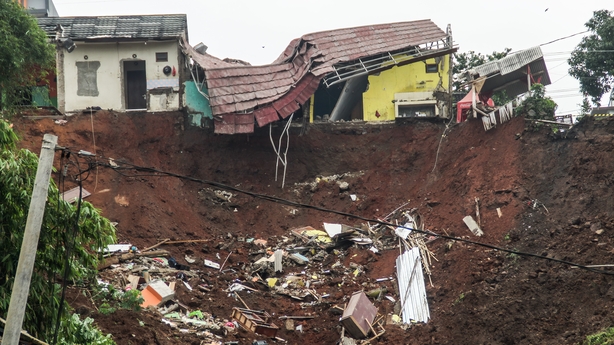
"We're still documenting how many are missing after the second landslide because there were many people who joined the original rescue effort," she said.
At least one survivor was seriously injured, while 11 people were confirmed dead, she said.
Fatal landslides and flash floods are common across the Indonesian archipelago, where seasonal downpours are frequent and relentless.
In September last year, at least 11 people were killed in landslides on Borneo island while a few months earlier, landslides in Sulawesi killed dozens.
Indonesia's disaster agency has estimated that 125 million people - nearly half the country's population - live in areas at risk of landslides.
