

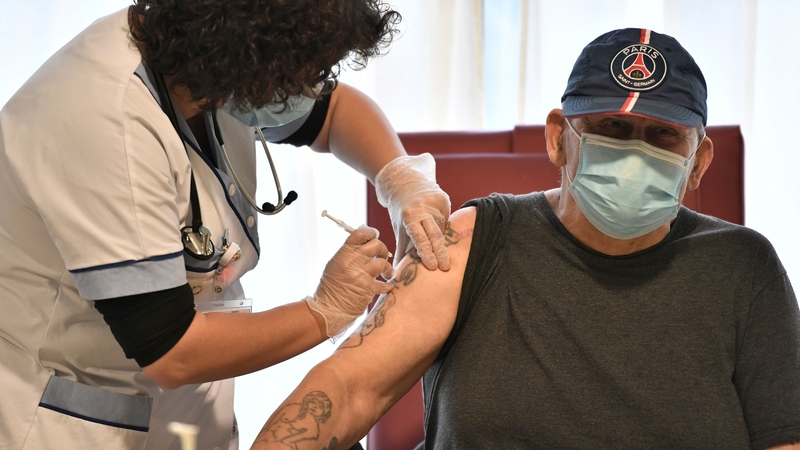
France's European Affairs Minister has said the country will not fail in its Covid-19 vaccination campaign, after coming under fire for the slow start of its roll-out compared with its European neighbours.
Minister Clement Beaune told France's LCI television that the vaccination campaign was just beginning in the country.
France, which is primarily targeting the most vulnerable people in nursing homes for the first phase of the campaign, administered doses to about 140 people yesterday.
That was well below the 42,000 who received shots in Germany, for instance.
Yesterday the French health ministry reported 26,457 new coronavirus infections, up sharply from 11,395 on Tuesday, and a level unseen since 18 November.
France saw the number of persons hospitalised for the disease decline by 183 to 24,593 over 24 hours.
The number of people in Intensive Care Units for the disease were also down 14 over 24 hours at 2,661.
Speaking before the data were released, government spokesman Gabriel Attal said France was not planning local lockdown measures to contain the spread of Covid-19 for now, although he dampened hopes for a quick reopening of cultural attractions and said curfews could be tightened.
The government was keeping a close eye on some 20 French departments where cases were rising at a quicker pace, and Mr Attal confirmed that curfews could be brought forward to 6pm instead of 8pm in some areas if needed.
Czech hospitals halt non-urgent care
The Czech Republic reported a record high 16,939 daily cases of Covid-19 for the past 24 hours, the Health Ministry has said.
The central European country of 10.7 million people has been one of the hardest hit in Europe relative to its population size, with its total number of detected cases reaching 718,661.
Deaths have reached 11,580 deaths by today, up 151 from the day before. Some of the new deaths were assigned to yesterday and others to previous days.
The country had slightly relaxed restrictions on business after a previous peak of cases and hospitalisations in November, but has had to tighten again this month.
As of Sunday, a 9pm curfew has been in place, and shops selling non-essential goods closed. Schools are expected to reopen after Christmas break next week only for the first two grades.
Yesterday the Health Ministry ordered hospitals to stop taking in patients for planned procedures and raise capacities for Covid-19 patients, including intensive care.
The number of people with Covid-19 in hospitals was at 5,893 as of yesterday, including 845 in intensive care, the ministry reported.
That was still below the November peak of 8,164 but the numbers have risen by a fifth over the past week.

Tokyo tops 1,000 daily virus cases with new emergency warning
Tokyo reported over 1,000 new coronavirus infections today, a new record, as local and government officials warned that a state of emergency might be needed to tackle spiking cases.
Japan's Jiji news agency reported that Prime Minister Yoshihide Suga had called emergency talks with ministers on the virus situation later today.
"We are still compiling precise figures today. It has been reported to me that it will be above 1,000 and reach somewhere around 1,300," Tokyo Governor Yuriko Koike told reporters.
"For the coronavirus, there is no year-end and no new year holiday. In this winter season, we are seeing the coronavirus spread and it is an extremely serious situation," she warned.
Japan has seen a comparatively limited outbreak compared to some parts of the world, with fewer than 3,500 deaths since it recorded its first case of the virus in January.
It has also avoided the harsh lockdown measures used in some countries, though the government imposed a "state of emergency" in the spring, calling on businesses to close and asking people to stay at home.
That measure carried no penalty for non-compliance and was lifted after several weeks when cases fell.
Infections stayed low during the summer, but in recent weeks a spike has alarmed officials and medical professionals, prompting calls for a new state of emergency, which the government has been reluctant to implement for fear of the economic fallout.
If cases continue to rise, the city "may have no choice but to request" the central government implement a new state of emergency, Ms Koike warned yesterday.
Yasutoshi Nishimura, the minister in charge of the coronavirus response, also warned yesterday that a state of emergency would be needed to "protect the lives of the Japanese people" if infections continue to spike.
"The medical system will not be able to survive", he said in a video message.
Mr Suga, who took office this autumn after the resignation of Shinzo Abe, has been criticised for his government's response to the third wave of infections, including backing a controversial programme promoting domestic travel.
The programme has been suspended over the new year, when many Japanese travel to visit family, and government officials have urged people to stay home to help suppress the new wave.
Medical professionals have for weeks been warning the country's healthcare system is stretched beyond capacity. Earlier this week, the country's former transport minister Yuichiro Hata became the first senior politician to die after contracting the virus.
