


By Yvonne Murray in Beijing
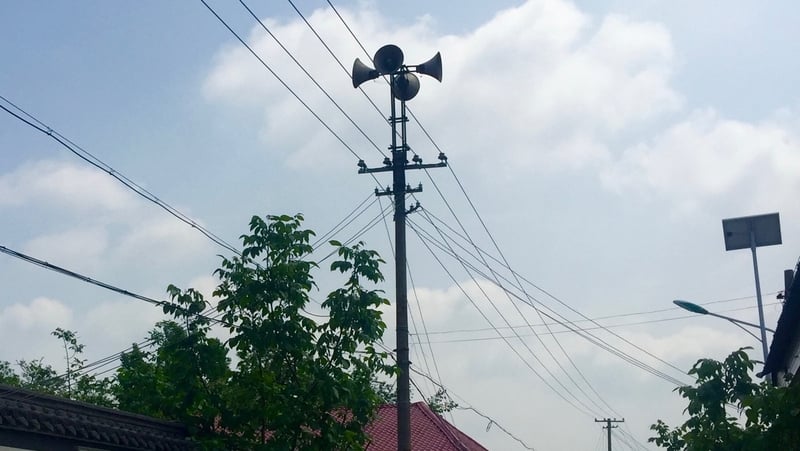
In the Chinese countryside, the dawn chorus is punctured by the crackle of the village loudspeaker.
"This is a service platform to spread practical agricultural knowledge and benefit people," it announces over an undulating music bed.
These communal radio broadcasts were a fixture of the Mao era, but many fell silent as China’s economy developed and citizens chose to get their news from the TV or internet.
But now the loudspeakers are back; blasting out their news and propaganda three times a day – early in the morning, at lunchtime and again in the evening.
They are being promoted as part of a government drive to educate the rural population on modern agricultural practices, but serve the twin purpose of encouraging ideological loyalty to the Communist Party.
I visited the small village of Jin Zhuang surrounded by wheat and cornfields, in the Hebei Province - the first of 21 provinces to be hooked up to the new loudspeaker system.
As I arrived, five officials from the provincial propaganda department were there to welcome me. It soon became clear that this was going to be a carefully stage-managed visit.
"The system is mostly automatic," said Ji Quanfu, who is the village’s main announcer, as he showed me the radio broadcasting room at the Jin Zhuang village committee headquarters.
Most of the content comes from the provincial government’s agricultural institute and is provided in downloadable form onto the new system.
"The content includes local news, weather, information about farming," he said, "and also government policies and regulations."
As I set off to speak to other villagers to find out their views on the loudspeaker system, the five propaganda department officials were in hot pursuit.
"For your own safety," they said, although it was unclear what potential countryside dangers they were protecting me from.
In the local shop, an 80-year-old woman came in to buy a bag of fresh tofu for her lunch.
"I remember hearing the speakers when I was little," she said. "I liked to listen," she added.
But then, she began to talk about the past and the propaganda officials started to look uncomfortable.
"As an educated youth, I had no choice but to move to the countryside," she said.
During the Mao era, millions of young city dwellers were forced to leave the towns and cities to go and work the land, under a policy to have them "remoulded through hard labour."
President Xi Jinping himself is from the "sent-down youth" generation. He spent seven years living in a cave in rural Shaanxi Province.
"You couldn’t refuse the government," the old lady added.
As she then began to complain about the time her government subsidy was cut, the propaganda officials intervened.
"This lady is too old," one said. "You should consider her physical condition – let her go and eat her lunch," he added.
"Why don’t you find some young people to talk to?" his colleague said.
We need your consent to load this rte-player contentWe use rte-player to manage extra content that can set cookies on your device and collect data about your activity. Please review their details and accept them to load the content.Manage Preferences
A younger man for me to interview was duly found on the street.
"The loudspeaker gives us farmers information on when to plant, water our crops and spray pesticides," he said. "I think it’s very useful," he added as the propaganda officials hovered in the background.
"Times used to be very hard for farmers in the past," he said. "Now I think we are much better off."
The Chinese countryside was once a place of abject hardship. The Maoist policies of farm collectivisation and forced production quotas in the Great Leap Forward led to a devastating famine, in which millions of Chinese people starved to death.
The chaos and brutality of the Cultural Revolution then followed.
Throughout this time, the loudspeakers were a propaganda tool to keep the Communist Party at the centre of village life.
"Every commune had them in all public spaces," said Dr Isabella Jackson, assistant professor in Chinese History at Trinity College Dublin. "It was a good way of conveying a message – propaganda, news, policies."
"There might also be entertainment, like Peking Opera or literature that would reflect good communist themes," she said.
"People did complain about the content of the programmes," she said. "But because you couldn’t switch off - even if people didn’t enjoy them, they were still exposed to them."
"It had a huge impact on daily life in the countryside," she added.
But in this modern era of smartphones and internet connectivity, why are the loudspeakers being brought back?
"We are seeing a return to a lot of techniques and approaches to politics that were used under Mao," Dr Jackson said. "I wouldn’t go so far as to compare the current president Xi Jinping to Mao – he’s a very different character leading a very different country.
"But it is moving in a more authoritarian direction. There’s less tolerance for dissent.
"There’s an increased use of obvious propaganda techniques - the promotion of communist values and the promotion of Xi Jinping and his thinking."
Back in Jin Zhuang, I met the village director, Ji Shuanzhong, in the village HQ committee room.
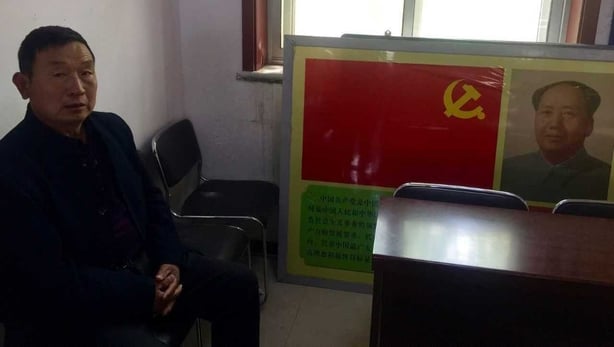
A large, old picture of Chairman Mao sat propped up at the back of the room lined with wooden tables. A propaganda official quickly pushed it to one side.
"Don’t take a photograph of that, that’s old" he said.
"Here - photograph the picture of the Oath of Admission to the Party instead."
On the wall hung dozens of gold plaques – awards for various honours, including ‘model party branch’, hygienic village’ and ‘beautiful village’.
"The original intention was mainly for propaganda," Mr Ji said about the new loudspeaker project introduced into Jin Zhuang in 2012 – the year Xi Jinping became General Secretary, "and to provide the farmers with a good service".
"Xi Jinping has given great support to agricultural policies," he said. "He was an educated youth who worked as a farmer. He knew the hardships of the people," he added.
What about people who do not want to listen to radio broadcasts in their public spaces?
"There isn’t anyone who doesn’t want to listen," he said, laughing.
During the interview, a propaganda official sat directly behind me, in Mr Ji’s eyeline – gesturing to keep the village director firmly on message.
Finding out what villagers of Jin Zhuang really thought of the loudspeakers proved impossible, as the propaganda officials continued to keep close watch.
Their job, after all, is to make sure only positive messages about government projects appear in the foreign press.
The Chinese countryside today might be a very different place to that during the worst excesses of Maoism, but the Communist Party’s desire for ideological control seems as strong as ever.
