


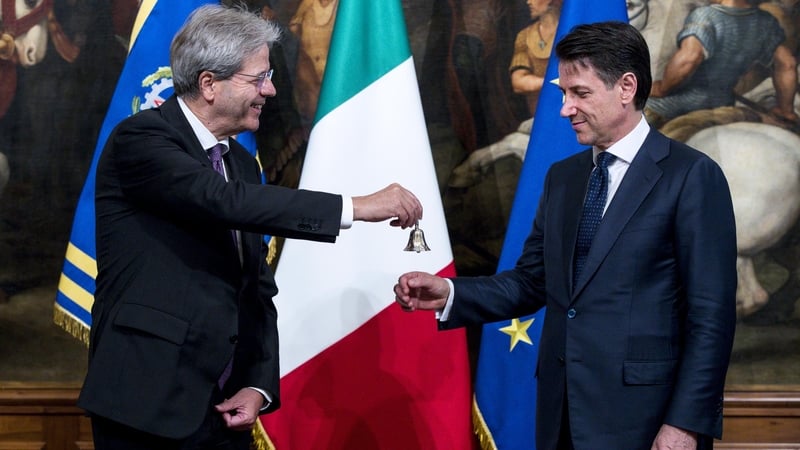
Italy's president has sworn in Giuseppe Conte as prime minister of western Europe's first anti-establishment government whose aim is to cut taxes, boost welfare spending and overhaul European Union rules on budgets and immigration.
Mr Conte, a 53-year-old law professor, must now win confidence votes in parliament next week.
The parties backing Mr Conte - the far-right League and the radical Five Star Movement - have solid majorities in both houses.
Mr Conte's first attempt to form a government was blocked by Italian President Sergio Mattarella on account of 81-year-old eurosceptic economist Paolo Savona being put forward as finance minister.
The newly chosen minister Giovanni Tria is in favour of Italy's continued membership of the eurozone.
Italy's two populist parties - the Five Star Movement and the League - agreed to form a coalition government yesterday after the approval of its new cabinet list, ending the months-long political standoff in the country.
Mr Conte's cabinet line-up includes Five Star Movement leader Luigi Di Maio and League chief Matteo Salvini who will serve as deputy prime ministers.
Mr Di Maio will also serve as economic development and labour minister, and Mr Salvini as interior minister.
"We'll try hard to achieve the political goal in the deal," Mr Conte said.
"We'll work with determination to improve the living quality of all Italians," he added.
Mr Conte's first attempt to assemble an M5S-League coalition government collapsed on Sunday.
Carlo Cottarelli, a former official with the International Monetary Fund (IMF), was then appointed interim prime minister by Mr Mattarella to form a technocrat cabinet on Monday.
Mr Cottarelli relinquished his mandate on Thursday to make way for Mr Conte after the two parties agreed to form a coalition government.
Read more:
Rome alone? Five key questions for the euro
