


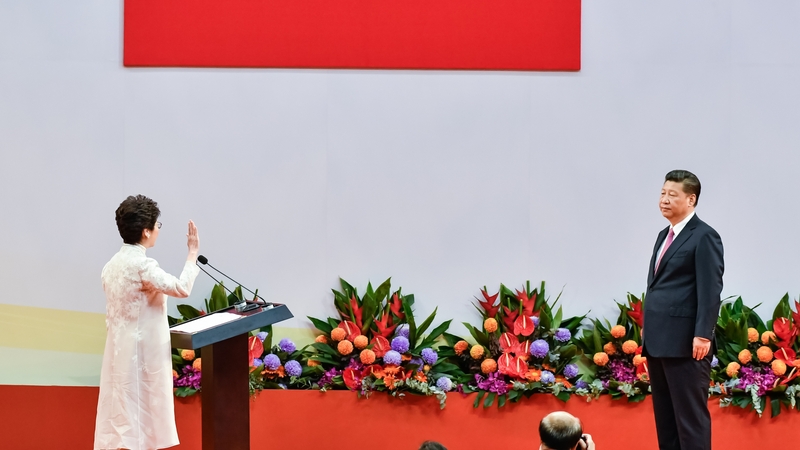
Chinese President Xi Jinping swore in Hong Kong's new leader with a stark warning that China will not tolerate any challenge to its authority in the divided city as it marked the 20th anniversary of its return from Britain to China.
A massive deployment of police blocked roads and prevented protesters from getting to the harbour-front venue close to where two decades earlier, the last colonial governor, Chris Patten, tearfully handed back Hong Kong to Beijing at a rain-soaked ceremony.
"Any attempt to endanger China's sovereignty and security, challenge the power of the central government ... or use Hong Kong to carry out infiltration and sabotage activities against the mainland is an act that crosses the red line and is absolutely impermissible," Mr Xi said.
We need your consent to load this rte-player contentWe use rte-player to manage extra content that can set cookies on your device and collect data about your activity. Please review their details and accept them to load the content.Manage Preferences
His sweeping speech touched upon the "humiliation and sorrow" China suffered during the first Opium War in the early 1840s that led to the ceding of Hong Kong to the British.
Hong Kong has been racked by demands for full democracy and, more recently, by calls by some pockets of protesters for independence, a subject that is anathema to China.
Mr Xi's words were his strongest yet to the city at a time of heightened social and political tensions and concerns over what some in Hong Kong perceive as increased meddling by China in the city's affairs.
Hong Kong returns to Chinese sovereignty @rtenews reports on the reactions and celebrations #OnThisDay 1997 Watch https://t.co/2t6DYcSySQ pic.twitter.com/sZ4Hu1UxQ1
— RTÉ Archives (@RTEArchives) July 1, 2017
Under Hong Kong's mini-constitution, the Basic Law, the financial hub is guaranteed wide-ranging autonomy and freedoms for "at least 50 years" after 1997 under a "one country, two systems" formula praised by Mr Xi.
But China's refusal to grant universal suffrage to Hong Kong triggered nearly three months of street protests in 2014 that at times erupted into violent clashes and posed one of the greatest populist challenges to the central government in decades.
Mr Xi was addressing a packed hall of dignitaries and mostly pro-China establishment figures, speaking for more than 30 minutes, after swearing in Hong Kong's first female leader, Carrie Lam.
"I will, as I always have ... firmly take actions in accordance with the law against any acts that will undermine the country's sovereignty, security and development interests," Ms Lam said after she was sworn in along with her cabinet.
A small group of pro-democracy activists near the venue were attacked by a group of men who smashed up some props in ugly scuffles while surrounded by more than 100 police.
Nine democracy protesters were bundled into police vans while several pro-China groups remained, cheering loudly and waving red China flags.
The activists, in a later statement, said the assailants had been "pro-Beijing triad members".
Other protesters unfurled a massive yellow banner, with the words "I want real universal suffrage", on the waterfront of Hong Kong's Victoria Harbour, but were later taken away by police.
