


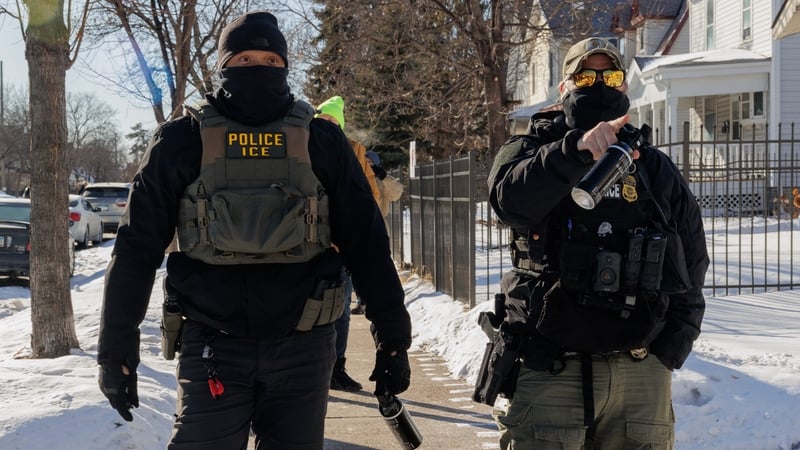
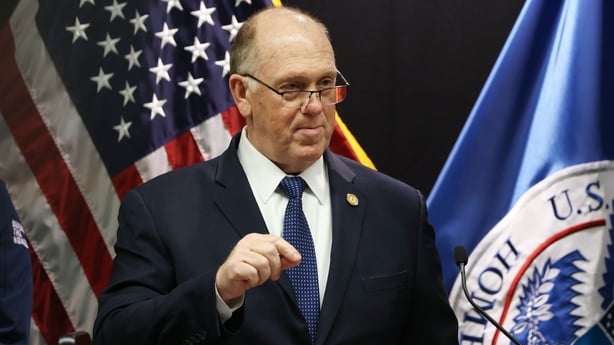
US President Donald Trump's border czar Tom Homan has said that federal agents would focus on "targeted, strategic enforcement operations" in Minneapolis, marking a shift in the aggressive tactics that have drawn national outrage.
Mr Homan, newly installed as commander of Mr Trump's immigration enforcement surge in Minneapolis, also said he intended to reduce the 3,000-strong force of agents deployed to the city after what he said were productive meetings with Minnesota Governor Tim Walz, Minneapolis Mayor Jacob Frey and other local leaders.
"We can do better," he said at a press conference today. "We made some significant gains, significant coordination and cooperation, and you're going to see some massive changes occurring here in this city."
His appearance suggested a continued de-escalation from Mr Trump's administration, which has been under intensifying political pressure to recalibrate its approach in Minneapolis after two US citizens were shot dead by federal agents.
A newly issued internal memo from a high-ranking Immigration and Customs Enforcement (ICE) official directs federal officers to refrain from any unnecessary communication and engagement with "agitators" so as to avoid "inflaming the situation".
The directive also orders ICE officers to only target immigrants who have records of criminal charges or convictions, a departure from earlier tactics that included randomly stopping people on the street to demand documented proof of legal US residence or citizenship.
Mr Homan pushed for more access to Minnesota jails for ICE agents so they can pick up immigrants living in the country illegally when they are released from local custody, arguing that it would lessen the need for more disruptive street sweeps.
"More agents in the jail means less agents on the street," he said.
Mr Homan affirmed that demonstrators had the right to protest but asked them to remain peaceful.
Some Trump officials have dismissed the waves of protesters in Minneapolis as paid agitators, without any evidence.
The memo and Mr Homan's words contrasted with tough talk coming from Mr Trump and some of his senior officials yesterday.
A day after sounding a conciliatory tone in his public remarks, the Republican president took to his Truth Social platform yesterday to warn that Minneapolis Mayor Jacob Frey, a Democrat, was "playing with fire" by continuing to insist that city authorities would play no role in enforcing federal immigration laws.
We need your consent to load this rte-player contentWe use rte-player to manage extra content that can set cookies on your device and collect data about your activity. Please review their details and accept them to load the content.Manage Preferences
US Attorney General Pam Bondi said federal agents had arrested 16 people yesterday in Minnesota for allegedly assaulting, resisting or impeding federal law enforcement.
"Nothing will stop us from continuing to make arrests and enforce the law," Ms Bondi wrote.
A federal judge in Minneapolis said yesterday that ICE was flouting the law by ignoring dozens of federal court orders during this month's surge.
While cancelling a contempt of court hearing for acting ICE chief Todd Lyons - after the agency belatedly complied with an order to release a wrongly detained Ecuadorean man – US District Judge Patrick Schiltz cited at least 96 federal court orders he said ICE has violated in 74 cases.
"This list should give pause to anyone - no matter his or her political beliefs - who cares about the rule of law," Judge Schiltz wrote in his ruling. "ICE has likely violated more court orders in January 2025 than some federal agencies have violated in their entire existence."
The guidance contained in the internal ICE memo seemed to reflect a change playing out on the streets of Minneapolis. Observers and activists, closely tracking ICE actions, said that immigration raids had slackened somewhat on Tuesday before ramping up again yesterday, though in a more tailored manner.
Mr Trump himself said on Tuesday he was looking to "de-escalate a little bit," and dispatched Mr Homan to take over the operation from Gregory Bovino, the Border Patrol official whose aggressive tactics drew widespread criticism and legal challenges.
Minnesota's Twin Cities of Minneapolis and St. Paul have been in a state of upheaval since Mr Trump ordered some 3,000 heavily armed ICE and Border Patrol agents to the area weeks ago to conduct a deportation drive dubbed Operation Metro Surge.
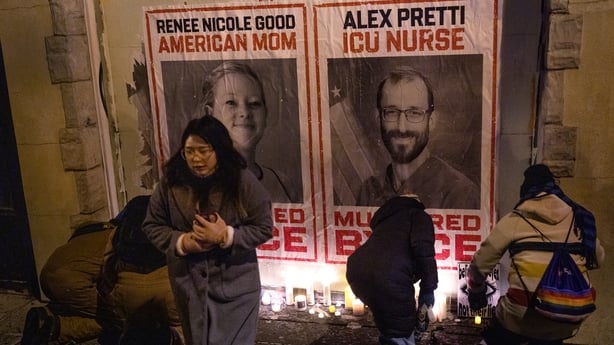
Tensions escalated after Renee Good, a 37-year-old mother of three, was shot dead behind the wheel of her car by an ICE agent on 7 January, sparking demonstrations in the Twin Cities and in communities large and small across the country.
But public outrage deepened after Saturday's fatal shooting of an intensive care nurse, Alex Pretti, also 37, during another encounter between immigration agents and activists who confronted them to record and protest ICE activity.
In both cases, Trump administration officials immediately defended the federal agents involved in the shootings, denouncing both Ms Good and Mr Pretti as "domestic terrorists" who they said were threatening to harm law enforcement.
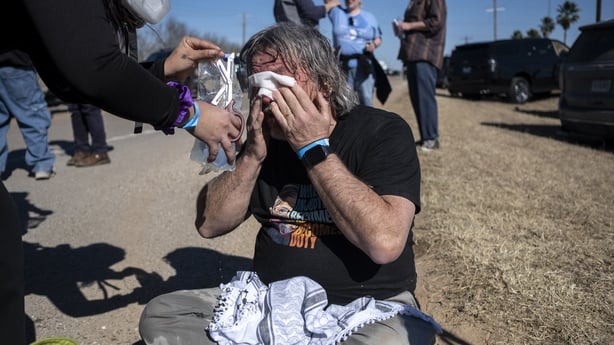
Multiple video recordings of the two incidents that have since gone viral on the internet plainly contradict the notion that either Ms Good or Mr Pretti posed a danger to immigration officers or others.
While some administration officials immediately accused Mr Pretti of planning to "massacre" officers, citing the handgun he was carrying, video verified by Reuters showed Mr Pretti held only a phone in his hand when Border Patrol agents pushed him to the ground.
Video also showed that an agent found Mr Pretti's gun near his waist and removed it seconds before another agent shot Mr Pretti in the back while he was being restrained. Mr Pretti had a permit to legally carry a firearm.
