


US President Donald Trump has threatened to use the Insurrection Act to put an end to protests over federal immigration raids in the northern state of Minnesota.
Here is a look at what the law and its previous use:
The Insurrection Act allows for domestic deployment of the US military for civilian law enforcement purposes such as conducting searches and making arrests.
President Trump has threatened to invoke it in response to protests against his mass deportation drive not only in Minnesota but also in other Democratic-ruled states - California, Illinois and Oregon.
Intermittent and sometimes violent protests have occurred in the states after targeted "surges" of federal agents, including from Immigration and Customs Enforcement (ICE).
"If the corrupt politicians of Minnesota don't obey the law and stop the professional agitators and insurrectionists from attacking the Patriots of ICE, who are only trying to do their job, I will institute the INSURRECTION ACT," Mr Trump said in a Truth Social post.
Posse Comitatus Act
Using the US military domestically to conduct law enforcement activities is normally barred by another law, the 1878 Posse Comitatus Act.
The Insurrection Act allows a president sidestep the Posse Comitatus Act to suppress "armed rebellion" or "domestic violence" and use the armed forces "as he considers necessary" to enforce the law.
Past use of law
The Insurrection Act has been invoked by US presidents about 30 times but rarely in recent history, according to the Brennan Center for Justice at the New York University School of Law.
It was enacted in 1792 but the current version dates to 1807.
First US president, George Washington, used it to put down state rebellions against federal authority.
President Abraham Lincoln relied upon it at the start of the 1861-65 Civil War.
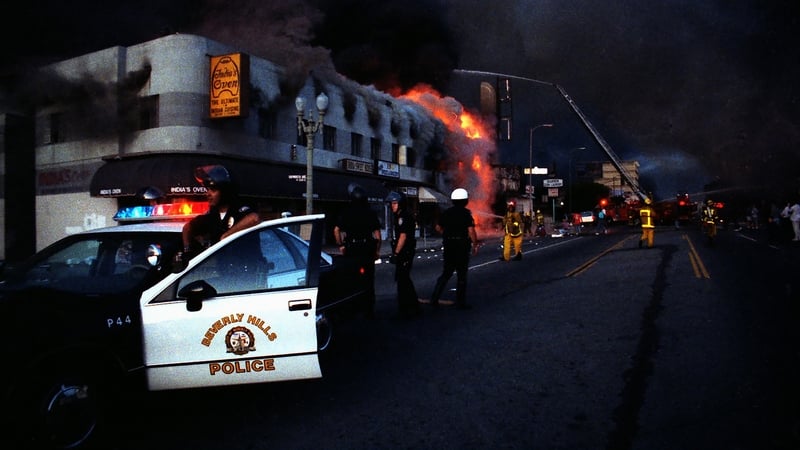
The Insurrection Act was most recently invoked by president George HW Bush at the request of California's Republican governor to help put down riots in Los Angeles in 1992 that followed the acquittal of police officers involved in the beating of Rodney King, a black motorist.
It was used by president Lyndon Johnson in 1968 to quell riots that broke out in Washington and other cities following the assassination of civil rights leader Martin Luther King Junior.
National Guard deployments
President Trump separately relied on a seldom-used law - known as Title 10 - to send National Guard troops to Los Angeles last year against the wishes of California's Governor Gavin Newsom, a Democrat.
Title 10 allows the use of the National Guard in times of "a rebellion or danger of a rebellion" against government authority, but does not give the troops the powers to perform domestic law enforcement duties.
Mr Trump's bid to deploy the National Guard to another city, Chicago, suffered a setback last month.
The Supreme Court ruled that he had "failed to identify a source of authority that would allow the military to execute the laws in Illinois".
It was a rare rebuff for the president by the country's top court, where conservatives hold a 6-3 majority.
