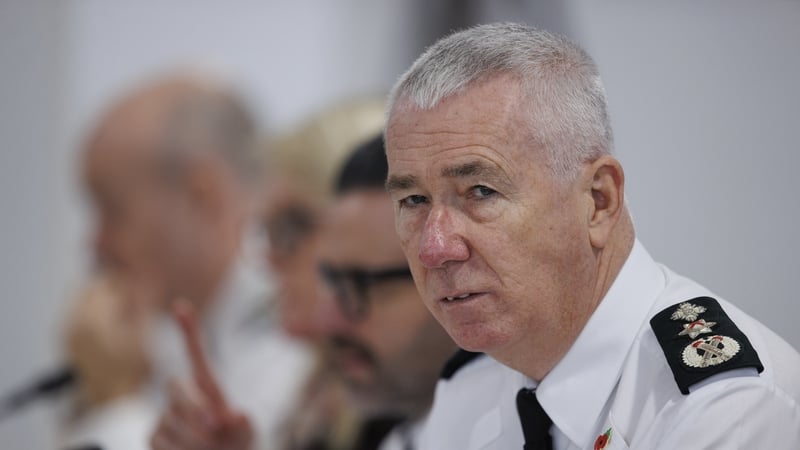

The Chief Constable of the PSNI Jon Boutcher has said the British Government should officially name the IRA agent known as Stakeknife to help combat nationalist distrust in policing.
Mr Boutcher made the comments on the day police in Northern Ireland launched a new recruitment campaign after concerns have been raised about the proportion of Catholic officers in the PSNI.
It is widely known that former West Belfast man Freddie Scappaticci was the British army agent within the IRA codenamed 'Stakeknife'.
Mr Boutcher reinforced that view at a meeting of the Northern Ireland Affairs Committee at Westminster.
He told MPs that Operation Kenova, a 7-year police investigation into the agent's activities, had established that Scappaticci had told his wife and a female associate that he was Stakeknife.
The investigation concluded that Stakeknife, a senior member of the IRA's internal security unit, was personally linked to 14 murders of people he abducted, tortured and then killed after he labelled them informers.
But its report could not name him as a British Government policy referred to as ‘Neither Confirm Nor Deny’ (NCND) means agents working for the state cannot be officially identified even after their death.
Mr Iain Livingstone, who replaced Mr Boutcher as head of the investigation, told the committee it would be in the public interest to officially name Stakeknife to demonstrate that agents working for the state have to operate within strict limits.
"If it doesn't apply in the case of the agent Stakeknife, I don't think it will ever apply," he said.
"And I think there are dangers in that, because I think sources need to know there are limits on how you can conduct yourself; and grotesque murdering terrorism, torture and criminality certainly goes past those limits."
"Help me get Catholic officers into the PSNI"
The PSNI Chief Constable said changing the policy would also help build trust in policing within the nationalist community.
"The nationalist community see this as a continuation of what's always happened - protection of wrongdoing by the state," he said.
"I can say categorically, the families I've spoken to, I've explained how much the state did to protect their loved ones, but in this instance, we got it wrong.
"To help society move forward, to help me get Catholic officers into the PSNI, we need to start making some difficult choices."
In Belfast this afternoon, the PSNI launched a new recruitment drive, with a starting salary of £35,000 after a 22-week training course.
The 2021 census revealed that almost 46 per cent of people living in Northern Ireland are either Catholic or brought up Catholic.
But just under a third of the 6,300 police officers are from a Catholic background.
A quarter of a century after the PSNI replaced the RUC, policing in Northern Ireland remains a highly contentious and political issue, with the continuing debate over how best to deal with the legacy of the Troubles a constant reminder of the many controversies of the past.
The PSNI says it needs help from people in leadership positions in the nationalist community to help increase that figure.
"Our legitimacy as a police service has undoubtedly, over the 25-year period, taken knocks owing to our association with events in the past, the legacy of the past," said PSNI Deputy Chief Constable Bobby Singleton.
"There's no doubt that it's had an impact in terms of contemporary perceptions of policing.
"We really need people across our entire society when it comes to this issue. We need people to stand up and to say that they will encourage them in coming forward to join the police in the first instance and we also need to support them when they're in the police service. Regrettably, at times in the past that support hasn't always been consistent," he said.
The PSNI says it needs to increase the number of serving officers by up to 1,800 over the next three years to bring the number to its target of 7,000.
Read more:
Fallout over 2003 publication of Stakeknife's identity
Top IRA agent Stakeknife protected by British handlers, report finds