Stormont Health Minister Robin Swann has told the UK Covid-19 Inquiry that confidential proposals on public health measures were routinely leaked from Executive meetings to the media in order to influence the decisions taken.
The inquiry has been taking evidence in Belfast for the past fortnight.
The Ulster Unionist MLA was a well-regarded minister in charge of a crucial department throughout the pandemic.
Mr Swann told the inquiry that other parties tended to avoid the health department, but that his party had actively chosen it when ministerial positions were being allocated.
He said it had been a "challenging position" to be the sole UUP minister at the Executive, but that it had also allowed him to be more independent when it came to taking decisions.
"It was a lonely position at times, it was a challenging position at times but I believed at the time that I had the support of my ministerial colleagues to do the things we had to do," he said.
Ms Dobbin asked Mr Swann if he believed his ministerial colleagues were under political pressure external to being in the Executive.
He said: "I do believe that in regards to ministers coming from those bigger parties, those bigger groupings had to look to party structures and party guidance.
"Other ministers holding party leadership positions had to be conscious of what was going on elsewhere which I felt I was unencumbered by that.
"Sinn Féin did take a look and keep an eye on what was happening in the Republic of Ireland and, likewise, the DUP were focused on what was happening in Westminster."
Mr Swann said he believed some ministers were constrained from acting outside of party interests due to constant leaks to the media, adding that it became so common it was "tolerated rather than challenged".
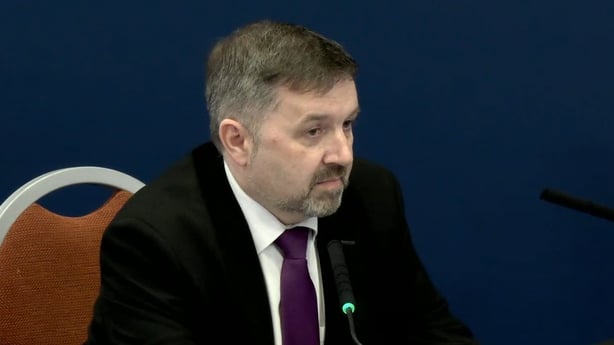
He said leaks from Executive meetings were a huge issue.
Mr Swann said at meetings where some of the most robust measures were due to be decided there was almost a "live feed" of discussions around the table.
He said the lack of confidentiality hampered ministers' willingness to speak candidly.
Position papers were also routinely provided to the media in advance of meetings in order to set the tone at the Executive.
"One of my largest frustrations with regard to how executive papers were handled, when they were leaked, because I often felt that it was deliberate to condition the conversation that was to be had at the Executive.
"There was already a narrative established in the media to either support or mostly undermine the recommendations that were actually coming to the Executive before those decisions could be made across the five parties."
His evidence prompted the chair of the inquiry Heather Hallett to ask whether a ban on the use of mobile phones at Executive meetings had been considered.
Mr Swann explained that Executive meetings were taking place remotely and not all the participants would have their cameras on so it was difficult to establish who might have been responsible for the leaking.
"There were recommendations made by the head of the civil service at one stage even that while ministers were on they should have their cameras on at all times, not just when they were speaking," he said.
Mr Swann said an internal inquiry had been considered at one point but to the best of his knowledge had not been carried through.
He said the problem was "so endemic that it became tolerated rather than challenged".
'Under-valued state'
Mr Swann also told the inquiry that opportunities to improve the resilience of the health system in Northern Ireland ahead of the pandemic were lost because Stormont was suspended for three years.
He said that health workers were in a "fragile, under-valued state" even before Covid-19 had struck Northern Ireland in 2020.
A three-year political impasse had collapsed the powersharing institutions until they were restored in January 2020.
Mr Swann told the inquiry that his immediate challenge on assuming office then had been dealing with industrial action by nurses.
He said: "That had broken down relationships across health and social care.
"It had also had a dramatic effect on the morale of our health staff and health workers in regards to what needed to be done."
Mr Swann said three years of non-recurrent single-year budgets for health between 2017 - 2020 had meant reform of services had not been possible.
He said: "If we had had a minister in place through 2017- 2020 and the strategic direction, the funding, we could have had some of those opportunities, those transformational pieces of healthcare in place.
"So when it came to the steps we needed to take during lockdown, we could have had some green-site hospitals already established in Northern Ireland, where we could have designated those for the procedures we needed to do that were normal red-flag emergency procedures, while designating other hospitals to be Covid centres."
"We didn't have the opportunity to do that", he said, adding "so there was a lot of opportunity lost".
He added: "The fragility just wasn't how we were able to react, it was that lack of investment in our core service, that lack of investment in our healthcare workers and that had been 10 years in the making."
Later Mr Swann was questioned closely about the Department of Health's role in Stormont's response to the pandemic.
The inquiry heard there had been concerns in late March 2020 about the flow of information from the department to the rest of the Executive about the scale of the emerging crisis.
The then deputy first minister Michelle O'Neill had raised it with the then head of Northern Ireland's civil service David Sterling suggesting the Health department was acting in quite a "unilateral" way.
She and then first minister Arlene Foster were concerned that they were not in control of the response to the pandemic.
Mr Swann rejected a suggestion that his department saw the rest of the Executive as a "thorn in its side".
In a subsequent communication with departmental officials he referred to that remark as a "parting dig" by Ms O'Neill.
"By this stage I'd an open and honest enough relationship with the First and Deputy First Minister, if they had these concerns I only wish they'd come to me and said," Mr Swann said.
Mr Swann was critical of Sinn Féin ministers who had attended a large funeral for veteran republican Bobby Storey in June 2020.
While no prosecutions were taken forward, Mr Swann said many considered it a "blatant breach" of regulations.
He also had hard words for DUP ministerial colleagues who had insisted on a cross-community voting mechanism which allowed them to veto the extension of restrictions in November 2020.
Both had undermined public confidence in the Executive response to the pandemic and to adherence with Covid-19 regulations.
"People looking for a rationale not to follow restrictions were given one," he said.
Additional reporting PA