

The relationship between the UK and Ireland is "strong enough to deal with" a dispute over new legacy laws, according to the Secretary of State for Northern Ireland has said.
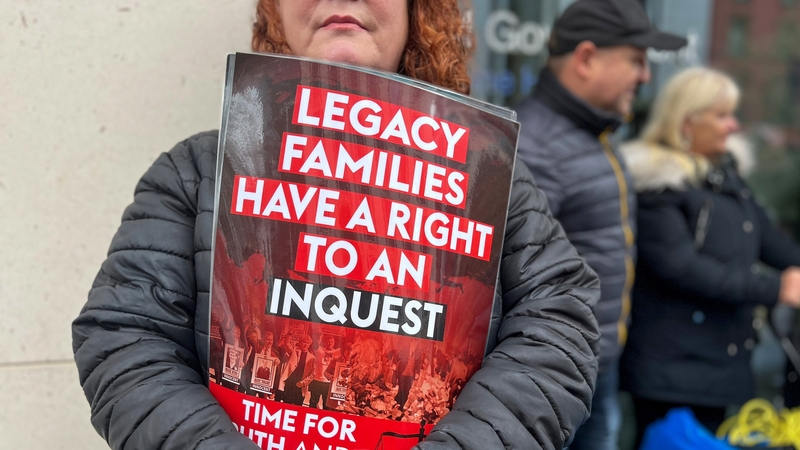
From Wednesday, responsibility for dealing with hundreds of unresolved cases will pass to a new body, the Independent Commission for Reconciliation and Information Recovery (ICRIR).
The Legacy Act includes a limited form of immunity from prosecution for Troubles-related offences to those who cooperate with the new body.
The legislation has been opposed by all Northern Ireland political parties as well as victims’ organisations while the Irish Government launched a case against the UK at the European Court of Human Rights.
In addition, a judge at Belfast High Court ruled that the provision for conditional immunity was not compliant with the European Convention on Human Rights (ECHR).
The UK government is appealing that finding.
Northern Ireland Secretary Chris Heaton-Harris discussed the row with Tánaiste and Minister for Foreign Affairs Micheál Martin at a British-Irish Intergovernmental Conference (BIIGC) in London today.
Mr Martin said he "understands" the UK government’s "concerns" about Ireland’s case over the law.
He said the Irish Government took the decision to take the action "reluctantly".
Speaking to reporters at the BIIGC, he said: "Equally, I hope that they understand our concerns and our sense of how we got to this point.
"My Government and every Irish government will always defend the central importance of the European Convention of Human Rights to the Good Friday Agreement – the ECHR is integral to the Good Friday Agreement."
Mr Martin said that Ireland has a "desire to do right by the victims".
Asked if the Irish Government would cooperate with the the ICRIR, he said Ireland was awaiting the outcome of legal challenges against the laws, including its own case.
He said: "We intend to have further meetings with victims’ groups in terms of where they see the situation now.
"Our ultimate objective is to do right by the victims and the families of the victims.
"As I meet more and more groups, there are younger generations coming through. So this isn’t going away, so to speak.
"Many of the younger generations of families are very determined to carry on the campaigns and to get resolution, so all of us - and we may have differences in approach - but I think all of us share a genuine desire to do right by the victims and the families of the victims."
Mr Heaton-Harris said that Ireland and the UK are "bound to" have various political debates.
"But I’d like to think our relationship is strong enough to deal with all of those issues," he added.
He defended the establishment of the ICRIR as a move in "an important direction" and said the new body would have a "huge budget".
Mr Martin said there was discussion at the BIIGC about a number of legacy issues including the Dublin-Monaghan bombings and the killings of Sean Brown and Pat Finucane.
He added that the Irish Government would fully cooperate with the UK’s Omagh bombing inquiry, amid calls for tandem public inquiries in both jurisdictions.
UK govt operated 'practice of impunity' during Troubles - report
The British government operated a "widespread, systematic and systemic practice of impunity", protecting security forces from sanction during the Troubles, a report by an international expert panel has found.
Convenor of the panel Gisle Kvanvig said it reviewed existing reports such as inquests, coroners reports and ombudsman's reports, so they placed an emphasis on only looking into publicly available and official documents.
Speaking on RTÉ's Morning Ireland, he said: "Amongst the 54 [killings which had suspected or proven state involvement], there are also people that were killed by paramilitaries and this had to do with how we approached it because we had to develop a method for how to assess these cases."
Mr Kvanvig said they were looking for investigations that were properly conducted so they could establish a baseline for what to expect at the time and then they could measure other cases against that baseline and that is why they looked at both paramilitary and non-paramilitary killings.
He said among the key failings is that you would not link forensics to the suspects, or when you were interviewing suspects you would not pursue certain lines of inquiry.
"You would do all the basic investigative stuff, but you would not form the key ones," Mr Kvanvig said.
We need your consent to load this rte-player contentWe use rte-player to manage extra content that can set cookies on your device and collect data about your activity. Please review their details and accept them to load the content.Manage Preferences
He said the 'Tea and Sandwich Agreement' was an agreement between the police and the military in Northern Ireland not to investigate the cases which was in place in the very early 1970s for a few years and at that point, no investigations were conducted.
When the killing happened "the soldiers would be invited, that's where the tea and sandwiches comes from - it was a chat about what happened and then nothing was pursued after that conversation".
The panel also found that the RUC Special Branch conducted a number of investigations.
"There seems to have been an emphasis on collecting intelligence rather than pursuing professional investigations, so the way that it looks is that the Special Branch for instance would not share certain key information with the team of investigators that were looking into the killing and that's one of the main findings," Mr Kvanvig said.
He said they do not have the reasons for it but it could have been a way to protect informers.
Mr Kvanvig said that when they set out to do their work, they were looking for plausible explanations for why investigations were not conducted, whether it was a resource problem, if it was too dangerous to conduct them or if there were other obstructions.
However, he said there was nothing to that effect in the official documents they looked at.
