


A solicitor representing families of those who died in the Omagh bombing has said the terms of reference for an independent investigation into the atrocity will allow it to look at all "relevant material".
The UK government set out the terms of reference yesterday for the public inquiry into whether the August 1998 attack could have been prevented.
Twenty-nine people, including a woman pregnant with twins, died in the dissident republican bombing.
The British government has called on the Irish Government to establish a similar investigation to look at all elements of the cross-border attack - the single biggest atrocity of the Troubles.
Solicitor John Fox, who represents 15 of the bereaved families, said the terms of reference address many of the issues raised and allow the inquiry to focus on issues that arise within the Republic of Ireland.
"The inquiry is to look at matters that touch on the preventability of the Omagh bomb," Mr Fox said, including four areas that "have come to light" through judicial review proceedings.
These "include intelligence that may have been known leading up to the Omagh bomb, both before and after the Good Friday Agreement.
"There were attacks ... all carried out by dissident republicans, who were using the same phones, for example, that were used in the Omagh bomb," Mr Fox told RTÉ's Morning Ireland.
There are also details of informants giving information to RUC officers and informants in the Republic passing on information to gardaí, he said.
We need your consent to load this rte-player contentWe use rte-player to manage extra content that can set cookies on your device and collect data about your activity. Please review their details and accept them to load the content.Manage Preferences
Tánaiste and Minister for Foreign Affairs Micheál Martin has pledged the Government will cooperate with the inquiry, but he said he did not think it made sense to have two investigations into the attack on both sides of the border.
Mr Fox said he believed the cooperation of the Irish Government should provide the ability to "compel witnesses within the Irish State, the ability to compel documents of national security within the Irish State, the ability to explore all the matrixes which occurred in the Irish State regarding this bomb".
A lot of the "evidential nature" surrounding the attack has arisen within the Irish State, Mr Fox added, as he described how the bomb was prepared and driven from south of the border, where the car used was also stolen.
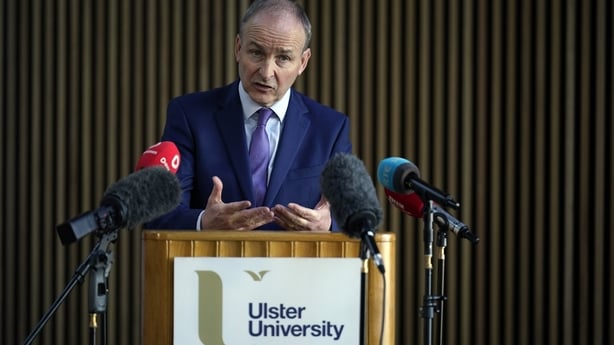
Speaking during a visit to Ulster University in Belfast yesterday, Mr Martin denied that the Irish Government has not done enough to pursue those responsible for atrocities during the Troubles.
"There is no amnesty in the Republic and there never has been an amnesty given in the Republic," he said in clear reference to the UK's contentious legacy laws.
"Gardaí and the Director of Public Prosecutions are independent of government.
"No direction has ever been given to either not to pursue cases that arose from the Troubles and not to prosecute, those are the facts.
"In respect of in and around Omagh, people were convicted in the Republic and imprisoned.
"More broadly speaking, in terms of the inquiry ... we have been seeking the terms of reference for quite some time so that we could then respond.
"We have made it very clear that we would be fully co-operative with any such inquiry.
"In our view, one inquiry is optimal, two separate inquiries to me doesn’t make sense because there would be clear overlap and duplication and maybe crossing each other.
"We have mechanisms, we have changed the law in the Republic on a number of occasions to facilitate the provision of information that the Republic may have in respect of certain crimes."
Mr Martin added: "Our view is, we’ll see the terms of reference and then we’ll work to ensure that we contribute to that inquiry".
A 'guarantee full participation'
The father of one of those murdered in the Omagh atrocity, said he welcomed the Irish Government's commitment to cooperate fully with the UK public inquiry, but wanted to see what form it would take.
That inquiry has power to compel documents and witnesses, but it only applies to the UK jurisdiction.
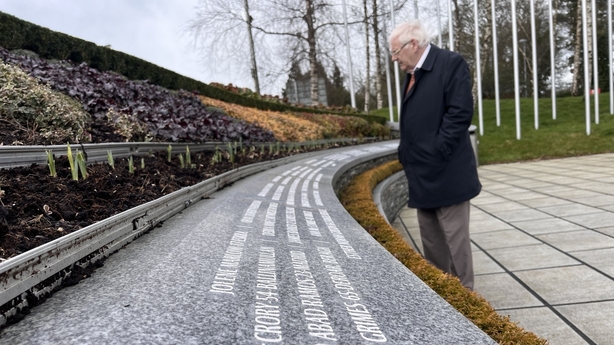
Michael Gallagher's son Aidan was killed in the explosion.
Mr Gallagher said the only credible option was for Dublin to guarantee that key witnesses, including Irish intelligence officers, would appear in person to give evidence and be available for cross-examination.
If that could not be achieved a separate public inquiry in the Republic would still be necessary.
"We just have to see how that cooperation is going to work because what we don't want is somebody coming up from Dublin asking the inquiry what information they need, going back down to get it from the person and then coming back up.
"As long the government can guarantee full participation by the people that could benefit the inquiry and their work directly."
Additional reporting: Conor Macauley, PA
