


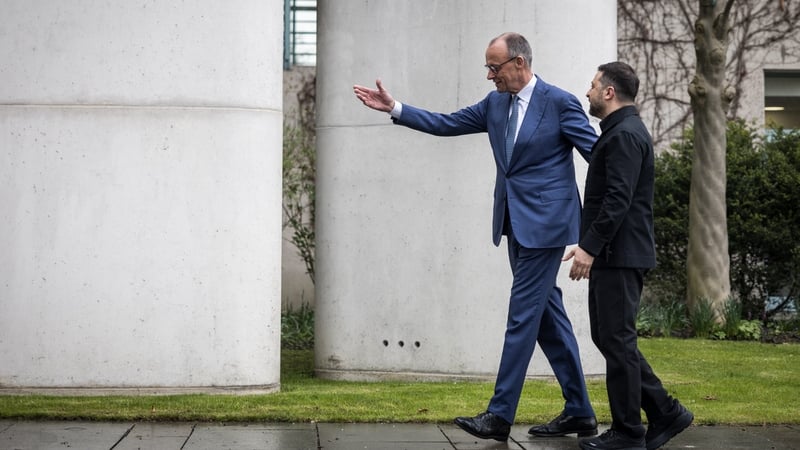
Ukrainian President Volodymyr Zelensky has said the pipeline carrying Russian oil through Ukraine to Hungary and Slovakia that was damaged in attacks by Moscow would reopen by the end of April.
"As for the oil pipeline, as we promised, it will be repaired by the end of April - not completely, but enough for it to function," Mr Zelensky told reporters in Berlin.
The status of the pipeline had been a major source of tension between Mr Zelensky - who wants all EU countries to stop buying Russian energy - and Hungary's outgoing Prime Minister Viktor Orban.
Mr Orban - who maintained good ties with Russian President Vladimir Putin despite the invasion of Ukraine - suffered a painful election defeat on Sunday, bringing an end to his 16-year rule.
Conservative Peter Magyar, a former government insider and political newcomer has promised "system change".
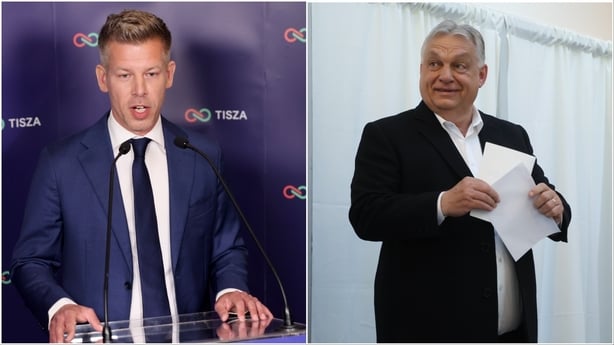
Mr Orban made Ukraine a central campaign issue, portraying Kyiv as "hostile" to Hungary.
But his successor Mr Magyar, despite promising a new era in Hungarian politics, also opposes sending EU military aid to Ukraine or offering Kyiv a fast-track route to join the 27-nation bloc.
Mr Zelensky called for talks with Mr Magyar, whom he congratulated on Sunday evening hours after polls closed.
"We are ready for a meeting. Whenever the new prime minister is ready," Mr Zelensky said in a press conference alongside German Chancellor Friedrich Merz.
Merz and Zelensky sign drone and defence cooperation accords
Germany and Ukraine have agreed defence cooperation plans including a deal on drone production that Mr Zelensky said could become one of the largest of its kind in Europe.
The accords, signed during his visit to Berlin by Mr Zelensky and Defence Minister Mykhailo Fedorov, underline the growing stature of Ukraine's defence industry after more than four years of a war marked by rapid innovation in drone technology.
"No defence industry has become more innovative than Ukraine's," Mr Merz told a news conference in Berlin.
"Through our support, we are strengthening both German and European defence capabilities and our industrial base."
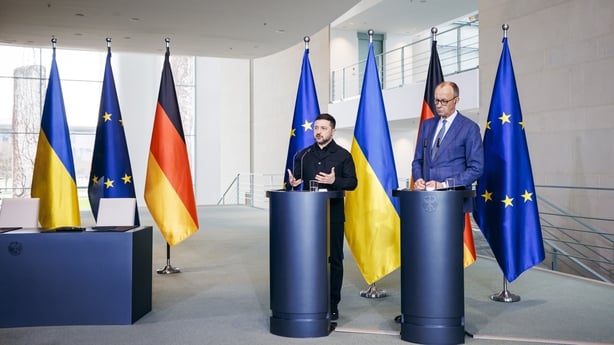
Germany is Europe's largest provider of military aid to Kyiv. It has delivered around €55 billion since Russia's invasion of Ukraine in 2022, and has set aside €1.5bn in the current budget.
Much of the support has been used to fund purchases of US weapons. Germany's defence ministry said it would pay for hundreds of patriot air defence missiles from US defence group Raytheon and launchers for IRIS-T air defence systems from Germany's Diehl Defence.
Mr Zelensky said teams from both countries were still working on the scope and details of the drone agreement, which builds on existing cooperation between German and Ukrainian companies.
"Germany is a major partner of ours, so I am confident that we will have one of the largest - indeed the largest - agreements of this kind at least in Europe," he said.
Germany's defence ministry said the project would create a joint venture to supply thousands of drones to the Ukrainian military. Berlin also agreed to invest several hundred million euros to finance so-called deep strike capabilities.
US efforts to negotiate an end to the war have stalled since the start of the war with Iran, but Mr Merz said Europe's involvement in any agreement with Moscow was "indispensable".
He said a meeting of national security advisers was being organised and that the US would be invited to participate.
