


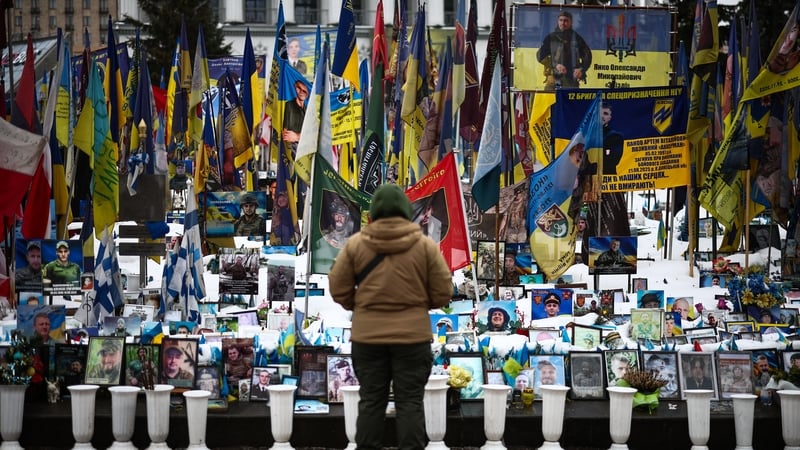
Leaders of the G7 global powers, including US President Donald Trump, have reaffirmed their "unwavering support for Ukraine" in a statement on the fourth anniversary of Russia's invasion.
It marks the first joint declaration by G7 leaders on Ukraine since Mr Trump's return to the White House a year ago, noted France, which holds the G7 presidency this year.
"We express our continued support for President Trump's efforts to achieve these objectives by initiating a peace process and bringing the parties to direct discussions. Europe has a leading role to play in this process, joined by other partners," the leaders of the United States, Britain, France, Germany, Italy, Canada and Japan said.
They also noted their support for the so-called Coalition of the Willing which has offered security guarantees to Ukraine in the event of a ceasefire, adding "that only Ukraine and Russia, working together in good faith negotiations, can reach a peace agreement".
Moscow had hoped to take Kyiv in days when it launched its invasion on 24 February 2022.
Watch: Volodymyr Zelensky marks four years of war in Ukraine
Instead, four years later, hundreds of thousands have been killed, millions forced to flee and much of eastern Ukraine has been destroyed.
In the midst of another winter of combat, the G7 said it has provided financial support along with "critical equipment" in recent weeks such as generators and turbines to aid the country's energy supplies.
Since January, "more than half a billion euros of new pledges were made to the Ukraine Energy Support Fund to purchase equipment to repair and protect the Ukrainian energy system," the statement said.
The United States has been pushing to end the conflict, mediating talks between the two sides this year in Geneva and Abu Dhabi, but they remain at odds over the issue of territory.
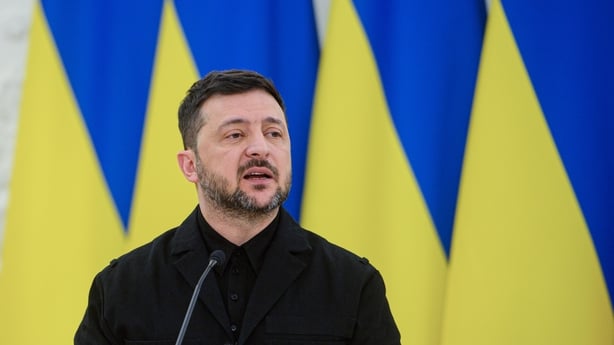
Ukrainian President Volodymyr Zelensky marked the four-year anniversary by accusing Russian counterpart Vladimir Putin of trying to take over Ukraine, saying he had failed to achieve this and other war goals.
In a video address today, Mr Zelensky said that Ukraine was ready to do "everything" it could to secure a strong, lasting peace.
Talks between the two sides, relaunched last year by the United States, have so far failed to halt the fighting, which has devastated the country and left it facing a mammoth reconstruction task.
"Putin has not achieved his goals. He did not break the Ukrainians. He did not win this war. We have preserved Ukraine, and we will do everything to achieve peace - and to ensure there is justice," Mr Zelensky said.
"We want peace. Strong, dignified, and lasting peace," he said, adding that any agreement "must not simply be signed, it must be accepted by Ukrainians".
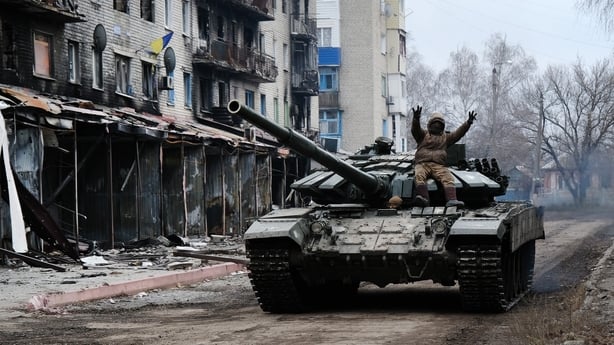
The war has also recalibrated how European countries view their own national security, pushing the continent's governments to boost spending on defence and leading to an enlarged NATO - Sweden and Finland joined the military alliance in 2023.
President Zelensky met European Commission President Ursula von der Leyen and European Council President António Costa in Kyiv this afternoon.
In a video posted to social media ahead of the meeting, Ms von der Leyen said she wanted to reaffirm that Europe stood "unwaveringly with Ukraine, financially, militarily, and through this harsh winter".
"And to send a clear message to the Ukrainian people and to the aggressor alike: we will not relent until peace is restored. Peace on Ukraine's terms."
This week, the European Union had intended to announce a 20th package of sanctions against Russia, but that plan has been stalled by Hungary, which opposes further sanctions against Moscow, as well as a new €90bn loan from the EU intended to keep Ukraine financially afloat for the next two years.
Taoiseach Micheál Martin said that said opposing the loan would amount to backing the country's surrender to Russian aggression and that it was "extremely important" to show solidarity with Ukraine.
But such temporary delays are unlikely to unnerve Ukrainians, who guard the survival of their country as strongly today as during the early hours of 24 February 2022.
Mr Putin had expected a swift victory when he ordered the start of his "special military operation" at 4.15am that morning.
Ukrainian intelligence later reported his intention was to execute the democratically elected leadership of Ukraine and install a pro-Russian government.
However, Russia’s attempt to capture Kyiv faltered. By the summer of 2022, Russian troops had retreated to the east, and were routed in Kherson and Kharkiv.
Hopes of a spectacular Ukrainian victory were short-lived. Mr Putin ordered a partial mobilisation, violently suppressed opposition at home, and turned Russia into a war economy.
After four years of fighting, Russia still occupies about one-fifth of Ukrainian territory but its advances remain slow, incremental and are measured in small settlements, not big cities.
Drone superiority counts for more than infantry formations or artillery strength.
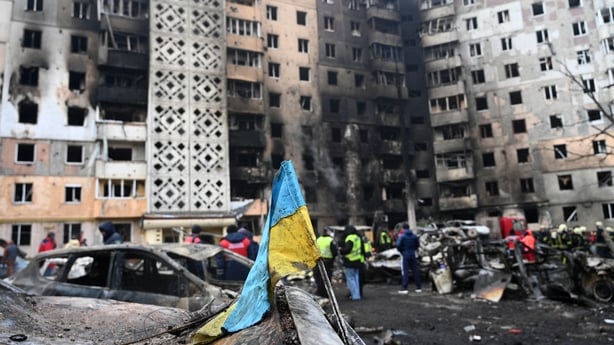
Residents of Ukraine’s big cities and towns have been subjected to increasing barrages of Russian drone and missile attacks for much of their past year.
This winter has been the toughest of the war so far for Ukrainians, whose country’s energy infrastructure has been pummelled by Russian drone and missile attacks.
Resulting power and heating outages have meant that millions of Ukrainians have had to endure freezing temperatures inside their homes.
Russia’s four-year invasion has caused extensive destruction and damage to Ukrainian cities and towns, which could take a generation to rebuild when the fighting eventually ends.
The World Bank now estimates that the cost of reconstructing the country stands at close to €500bn.
Read more:
Zelensky: 'Putin has not achieved his goals'
Zelensky calls on EU to set date for Ukraine to join
Additional reporting: Liam Nolan and Tony Connolly in Kyiv
