


The European Parliament has approved a €90 billion loan for Ukraine, providing a financial lifeline to the country four years into Russia's invasion.
MEPs voted by 458 to 140 in favour of the loan, intended to cover two-thirds of Ukraine's financial needs for 2026 and 2027 and backed by the EU's common budget - after plans to tap frozen Russian central bank assets fell by the wayside.
"Support for Ukraine rests on a small number of countries and most if it comes from Europe," centrist MEP Nathalie Loiseau said ahead of the vote.
"It is our honour - and it's in our interest because our security is at stake," she said.
Under the scheme, Ukraine will be able to spend €60bn of the loan on desperately-needed weapons to fight off Russia's invasion, with the rest earmarked for general budget support.
The EU has said Ukraine would only need to pay back the money once Russia pays for the damages President Vladimir Putin's invasion has wrought.
The EU will cover interest costs, expected to hover around €3bn per year, through the EU budget.
"This is Putin's war. Make Russia pay," Karin Karlsbro, who steered the file through parliament, said.
Member states reached a deal last week on the conditions for the loan, paving the way for Ukraine to get the funds it needs in the coming months.
The European Commission is pushing for a first disbursement in April.
Read more:
EU support for Ukraine 'critically important' - Klitschko
Latest Ukraine stories
A key point was how much weaponry Ukraine can buy from outside the EU or from its own industry - with Ukraine pushing to be allowed to buy weapons from wherever it needs.
France was seeking limits on purchases from outside the EU, while other countries had argued to open it up more to close partners such as Britain, Canada and Norway.
Under the compromise deal, Ukraine can use the loan to buy certain arms from countries beyond the EU if producers in the bloc cannot provide them quickly enough.
That should mean Ukraine can use the funds to buy some weaponry from the United States, such as key Patriot air defence missiles.
And EU ambassadors agreed that firms from key allies like Britain that have provided considerable support for Ukraine could be eligible for a greater share of the funds.
But that would depend on those countries being willing to cover a "fair and proportionate" share of the borrowing costs of the loan - whose exact level is yet to be negotiated with the countries concerned.
Ten of Ireland's 14 MEPs voted in favour of the proposal.
Sinn Féin has previously outlined its opposition to providing ongoing funding to Ukraine in this way, with the party's Spokesperson on Finance, Pearse Doherty, telling the Dáil last week that Ireland also has a housing and cost of living crisis, and that there are other ways to continue to support Ukraine.
The Sinn Féin position has been criticised by other Irish MEPs today, including Fianna Fáil's Barry Andrews who tweeted: "Sinn Féin go full me féin, as people in Kyiv freeze".
Fine Gael's Regina Doherty said in her view the party's position was "shameful, hypocritical and completely out of touch".
Military aid to Ukraine dropped 14% in 2025
Military aid to Ukraine hit its lowest level in 2025 as the US pulled funding, leaving Europe almost alone in footing the bill and averting a complete collapse, the Kiel Institute said.
Ukraine's allies allocated €36bn in military aid in 2025, down 14% from €41.1bn the previous year, according to Kiel, which tracks military, financial and humanitarian assistance pledged and delivered to Ukraine since Russia's full-scale invasion.
Military aid in 2025 was even lower than in 2022, despite the invasion not taking place until 24 February that year.
US aid came to a complete halt with President Donald Trump's return to the White House in early 2025.
Washington provided roughly half of all military assistance between 2022 and 2024.
European countries have thus made a significant effort to plug the gap, increasing their collective allocation by 67% in 2025 compared with the 2022-2024 average.
Without that effort, the US cuts could have been even more damaging, the institute argued.
However, the think tank points to "growing disparities" among European contributors, with Northern and Western European countries accounting for around 95% of military aid.
The institute calculated that Northern European countries (Denmark, Estonia, Finland, Iceland, Latvia, Lithuania, Norway, and Sweden) provided 33% of European military aid in 2025, despite accounting for only eight percent of the combined GDP of European donor countries.
Russian strike on Ukraine kills father and three children
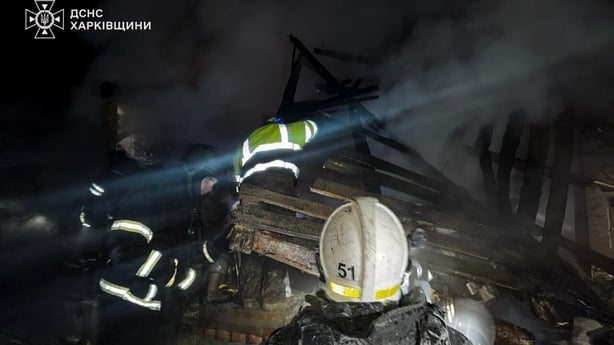
A Russian drone strike killed three small children and their father in a town west of Ukraine's second-largest city of Kharkiv, Ukrainian officials said.
Russia attacked Ukraine with 129 drones overnight, the Ukrainian air force said, adding that of these 112 were shot down or neutralised.
According to the Kharkiv Regional Prosecutor's Office, a drone hit a residential building housing a family of five in the town of Bohodukhiv late last night.
"As a result of the strike, the house was completely destroyed and engulfed in flames, and the family was trapped under the rubble," it said on the Telegram messaging app.
The children's pregnant mother was rescued, the prosecutors said.
The family evacuated from a nearby village a few days ago, Ukrainian police said.
Regional Governor Oleh Syniehubov, writing earlier on Telegram, said two boys aged one and a two-year-old girl, died along with a 34-year-old man.
Kharkiv, which lies some 30km from the country's northeastern border, and the surrounding region have been a repeated target of Russian air attacks.
Both Russia and Ukraine deny targeting civilians in the war, which started with Russia's full-scale invasion in February 2022.
Additional reporting Fiachra Ó Cionnaith
