


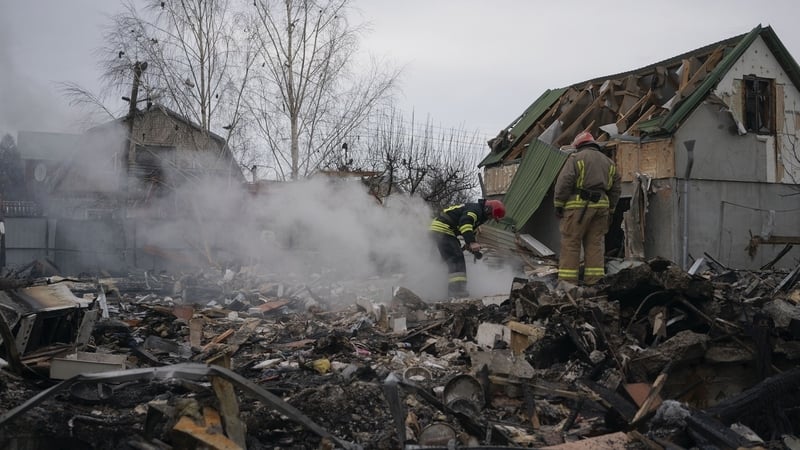
US President Donald Trump has said his Russian counterpart Vladimir Putin has agreed to halt attacks on Kyiv and other cities for a week, as Moscow's strikes leave Ukraine facing its toughest winter since the start of the war.
Russian strikes on Ukraine's power infrastructure have left millions with disrupted light, heating and water supplies in freezing temperatures, pushing the war-battered country towards a humanitarian crisis.
"Because of the cold, extreme cold... I personally asked President Putin not to fire on Kyiv and the cities and towns for a week during this," Mr Trump told a cabinet meeting at the White House.
"It's extraordinary. It's not just like cold, it's extraordinary cold. Record setting cold, over there too, they are having the same, it's a big pile of bad weather," added Mr Trump, comparing it to a current cold snap in Washington.
"They've never experienced cold like that. And I personally asked President Putin not to fire into Kyiv and the various towns for a week. And he agreed to do that, and I have to tell you, it was very nice."
Watch: Trump says Putin has agreed not to strike Kyiv for a week
There was no immediate reaction from the Kremlin but Mr Trump - whose summit in Alaska with the Russian leader last August ended without a breakthrough - said he trusted Mr Putin to honor the agreement.
"I have to tell you, people said, 'don't waste the call. You're not going to get that.' And he did it," said Mr Trump.
"And we're very happy that they did it, because on top of everything else, that's not what they need is missiles coming into their towns and cities."
Ukraine's state weather agency forecast a drastic dip in temperatures to as low as minus 30C in the coming days as authorities race to restore services.
Ukrainian President Volodymyr Zelensky said he expected the implementation of the agreement by Russia not to fire on Kyiv and other cities for a week.
Mr Zelensky said the days to come would show whether Moscow would abide by such an agreement.
"Our teams discussed this in the United Arab Emirates. We expect the agreements to be implemented," Mr Zelensky wrote in English on the X social media platform.
"De-escalation steps contribute to real progress toward ending the war."
Speaking immediately afterwards in his nightly video address, Mr Zelensky expressed his thanks to Washington for the initiative, which he described as halting Russian strikes on energy targets.
"Thanks to the American side for their efforts in ensuring a stop to strikes on energy (targets) at this time and let's hope that America succeeds in ensuring this," he said.
"We shall see what the real situation is with our energy facilities and cities in the days and nights to come."
'A lot of progress'
Mr Trump said there had been "a lot of progress" in US-brokered talks between Kyiv and Moscow to end Russia's invasion of its pro-Western neighbour, which will soon enter its fifth year.
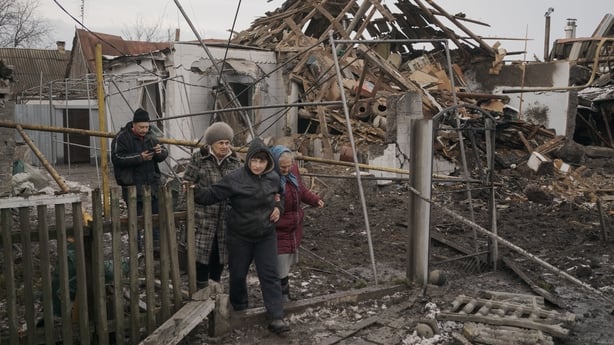
Meanwhile, Russian attacks have killed six people in central and southern Ukraine, regional authorities and emergency services have said.
In Ukraine's southern Zaporizhzhia region, "Russian shelling killed a 62-year-old man and women aged 26 and 50," Ukraine's state emergency service said.
In the neighbouring Kherson region, Russian bombardment killed a 46-year-old man and a 39-year-old woman, according to regional governor Oleksandr Prokudin.
A Russian attack on Kryvyi Rig, President Volodymyr Zelensky's hometown, killed one elderly woman, the head of the city's administration said.
Diplomatic efforts to end the nearly four-year war have accelerated in recent weeks, though both sides remain at odds over the key issue of territorial control once the war ends.
The next talks are expected to take place in Abu Dhabi on Sunday.
Separately, Ukraine is working with Elon Musk's SpaceX to stop Russia from guiding drones using the firm's Starlink internet system, the defence minister has said, after Kyiv said it had found Starlinks on long-range drones used in Russian attacks.
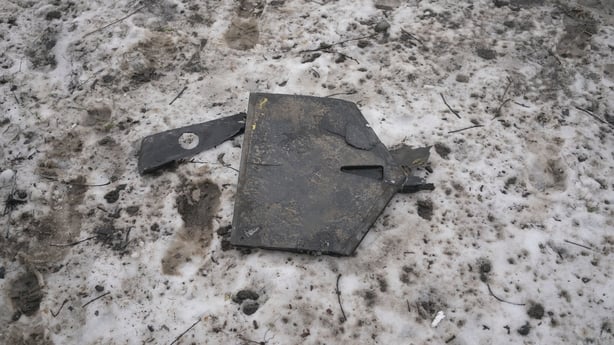
A Ukrainian official has posted pictures this week on social media of the wreckage of long-range Russian drones with Starlink terminals attached, and said Russia may have used Mr Musk's system to guide drones that hit a Ukrainian passenger train on Tuesday.
"We are grateful to SpaceX President Gwynne Shotwell and personally to Elon Musk for the quick response and the start of work on resolving the situation," Ukraine's Defence Minister Mykhailo Fedorov wrote on the Telegram messaging app.
"Western technology must continue to help the democratic world and protect civilians, rather than being used for terrorism and destroying peaceful cities."
SpaceX did not immediately reply to a Reuters request for comment. Mr Musk turned on Starlink service over Ukraine in 2022 after Kyiv pleaded for help in the first days following Russia's full-scale invasion.

Despite Mr Musk's subsequent clashes with Ukrainian officials over his views on the war, Ukraine's military still relies on tens of thousands of Starlinks for battlefield communication and for piloting some drone missions.
They are favoured for their stable connection on the battlefield and for their resistance to enemy signal jamming.
In a social media post in February 2024, SpaceX said it does not sell or ship Starlink to Russia, and "does not do business of any kind with the Russian Government or its military".
The US-based Institute for the Study of War said it had seen reports of Russia using Starlink-equipped Shahed long-range drones beginning in September 2024.
'Hundreds' of Starlink-equipped drones
Serhiy Beskrestnov, a newly appointed adviser to Minister Fedorov, drew attention to the issue over the past week by posting pictures on social media of the wreckage of long-range Russian drones, including Shaheds, with Starlink terminals.
On Tuesday, Mr Beskrestnov said that Shahed drones manually flown by pilots, possibly through Starlink, had attacked a passenger train in northeastern Ukraine.
That attack killed five people and was denounced by Kyiv as an act of terrorism.
Mr Beskrestnov said there had been "hundreds" of cases where Starlink-enabled Russian drones had attacked Ukraine.
"The complexity of this process lies in the fact that Starlink cannot be suppressed by means of electronic warfare, and even their position in flight cannot be detected by reconnaissance equipment," he wrote, adding that the way to solve the issue was therefore through SpaceX.
