


Ukraine's capital Kyiv has only about half the electricity that it needs as it faces its most severe wartime energy crisis following waves of Russian attacks on its infrastructure.
Kyiv Mayor Vitali Klitschko said the city requires 1,700 megawatts of electricity to power the services for its population of 3.6 million.
He said the current energy crisis was the most difficult challenge facing the capital in the nearly four years since Russia's invasion in February 2022.
"It's the first time in the history of our city that, in such severe frosts, most of the city was left without heating and with a huge shortage of electricity," he said in an interview at his office in Kyiv.
Mr Klitschko said Ukraine's international partners had rushed in additional generators and repair teams had worked round-the-clock to restore heating following a Russian strike last week knocked out supplies to 6,000 apartment buildings.
Around 100 buildings remain without heating.
Schools in Kyiv will close until next month, Mr Klitschko announced today, citing "difficult conditions" after the Russian strikes.
"Starting 19 January, schools in the capital city will be closed for break until 1 February," he said on Telegram.
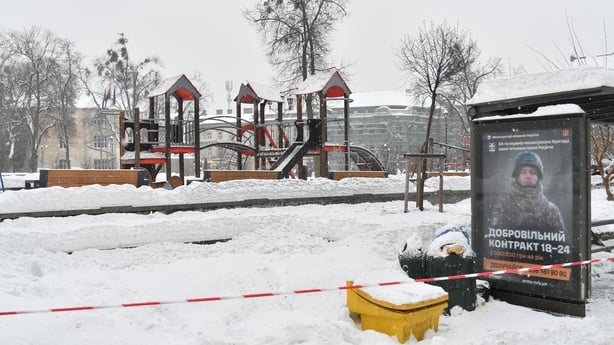
Kyiv authorities also announced the intensity of street lighting would be reduced to one fifth of its capacity to save energy.
International aid agencies said children across Ukraine risk hypothermia in freezing temperatures as emergency stocks of power generators run low following Russian attacks on energy infrastructure.
The UN children's agency UNICEF said it faced a race against time to help restore water and heating services that have been pounded in missile and drone attacks.
"Children and families are in constant survival mode," UNICEF Country Representative for Ukraine Munir Mammadzade told reporters in Geneva.
Mr Mammadzade said people were trying to stay safe from strikes on high-rise buildings while temperatures sank to around -18C at night.
Some families are stuffing their windows with soft toys to block out the freezing cold, UNICEF said.
Mr Zelensky said this week he would declare a state of emergency in the energy sector.
Energy Minister Denys Shmyhal said Ukraine had fuel reserves for more than 20 days.
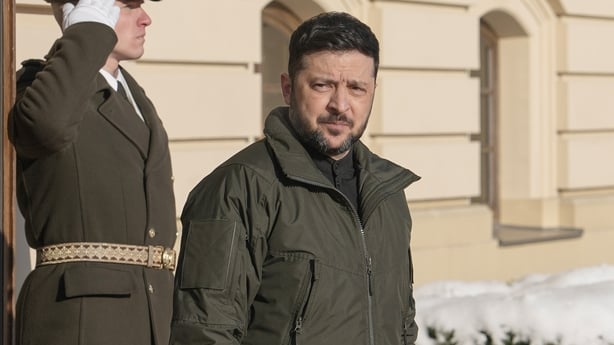
Kyiv and frontline regions face the harshest conditions, with thousands of homes in the capital as well as in Dnipropetrovsk, Kharkiv, Odesa and frontline towns left without electricity or heating for days on end.
"Without heat, people are at high risk for hypothermia, frostbite and respiratory illnesses," said Jaime Wah, Deputy Head of Delegation in Kyiv for the International Federation of Red Cross and Red Crescent Societies, adding that unpredictable power cuts disrupted the water supply and healthcare provision.
"It's unbearable to live in apartments with no heating or electricity. Families (in Kyiv) are resorting to consider leaving the city."
Pre-positioned stockpiles of sleeping kits, generators and repair materials for buildings are running low because of the increasing need and limited funding.
UNICEF said it was providing high-capacity generators to support heating and water supplies to hospitals and schools, but called for more funding.
Ukrainian delegation en route to US for talks
The energy crisis comes as a Ukrainian delegation is en route to the US for talks on security guarantees and a post-war recovery package, President Volodymyr Zelensky said, expressing hope the documents could be signed on the sidelines of the World Economic Forum (WEF) in Davos next week.
During the talks, Kyiv's team also hopes to get clarity from the US on the Russian stance toward US-backed diplomatic efforts to end the war, Mr Zelensky told a news conference in Kyiv alongside Czech president Petr Pavel.
"I think we have worked well with the American side, we are just not on the same side on some issues," Mr Zelensky said of the negotiations with Washington.
"Ultimatums are not, in my view, a workable model for democratic relations between countries," Mr Zelensky said, without specifying to what he was referring.
Washington has pushed Ukraine to agree to a peace framework that it will then present to Moscow, while Kyiv and its European allies have sought to ensure that Ukraine will not be attacked again by Russia in future.
US President Donald Trump said earlier this week that he may meet Mr Zelensky at the WEF, a meeting which the Ukrainian leader has publicly sought.
Mr Zelensky said that Ukraine had completed its part of the work on the documents outlining a "prosperity package" to unlock money for Ukraine's costly post-war recovery, as well as on US security guarantees designed to stop a future Russian attack.
Ukrainian officials have said the country will need $800bn (€688bn) for its post-war reconstruction.
Mr Trump, who has often criticised Mr Zelensky, said on Wednesday that Russia was ready for a peace deal and that he saw the Ukrainian leader as the obstacle to peace, an assessment which stands in stark contrast with that of European allies.
Mr Zelensky said Russia was stalling peace efforts, and cited Moscow's recent strikes on Ukraine's energy system as proof of Moscow's real intentions.
"Each of these strikes against our energy sector and our cities quite clearly shows Russia's real interests and intentions: they are not interested in agreements, but in the further destruction of Ukraine," he posted on social media after the news conference.
At the news conference, Mr Zelensky also pushed for more air defence ammunition to protect Ukraine's power grid.
He said that until a new aid package had arrived this morning, several air defence systems had been left without missiles.
"We need to fight for these (aid) packages with blood, with people's lives," he told reporters.
