


Russia fired a powerful hypersonic missile overnight at a target in Ukraine near the border with NATO member Poland, in what Kyiv has called a new threat to European security that demanded a global reaction.
Moscow said it had fired the Oreshnik missile in response to what it has described as an attempted drone attack on one of President Vladimir Putin's residences last month, which Ukraine has denied and the US has said did not happen.
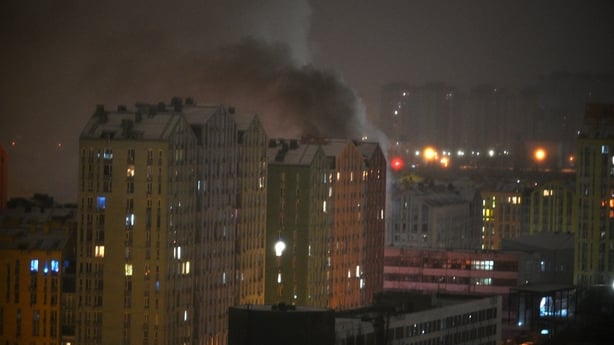
It was only the second time Russia has fired the Oreshnik at Ukraine, and came amid a night of air attacks that Ukrainian authorities said also killed four people in Kyiv, knocked out power in the city and damaged the Qatari embassy there.
The Oreshnik, designed to project power across Europe and which Moscow says is impossible to intercept, is capable of carrying nuclear warheads, although there was no suggestion it had done so.
"Such a strike close to EU and NATO border is a grave threat to the security on the European continent and a test for the transatlantic community," Foreign Minister Andriy Sybiha said on X.
"It is absurd that Russia attempts to justify this strike with the fake 'Putin residence attack' that never happened," he added.
"Putin uses an IRBM near EU and NATO border in response to his own hallucinations - this is truly a global threat. And it demands global responses."
Kyiv has called Moscow's allegation that it attacked Mr Putin's residence in the Novgorod region of northern Russia on 29 December "an absurd lie" to sabotage peace talks.
US President Donald Trump has said he does not believe it happened, although something else happened in the area.
The Oreshnik hit the Lviv region in western Ukraine, around 60km from the Polish border.
Moscow said it hit a drone factory and energy infrastructure. Ukrainian officials said it hit unspecified infrastructure.
"Russia's reported use of an Oreshnik missile is a clear escalation against Ukraine and meant as a warning to Europe and to the US," EU foreign policy chief Kaja Kallas said on X.
"EU countries must dig deeper into their air defence stocks and deliver now. We must also further raise the cost of this war for Moscow, including through tougher sanctions."
Watch: Footage of fires in Kyiv following a Russian airstrike
Kyiv mayor calls for temporary evacuation after Russian strikes
Russian strikes have cut heating to half of the Ukrainian capital, prompting the mayor to issue an exceptional call for residents to temporarily leave the city with temperatures at -8C and set to drop further.
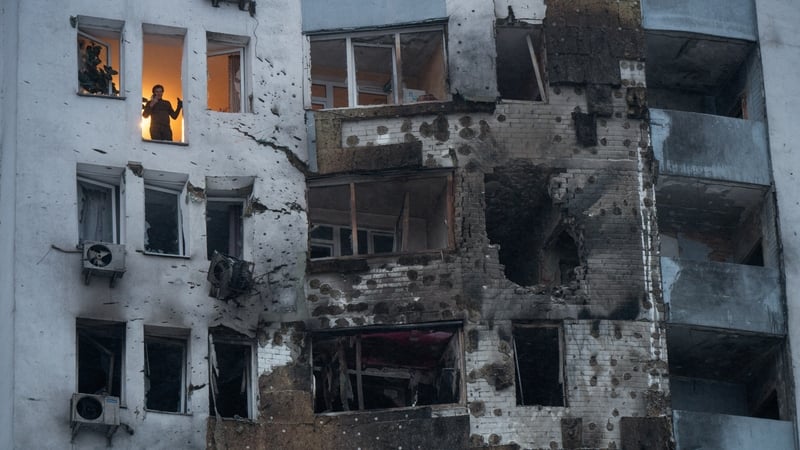
Four people were killed in the capital in a massive missile and drone attack that ripped open apartment blocks.
AFP journalists in Kyiv saw residents running for shelter as the air raid siren echoed and heard Russian drones exploding into residential buildings and missiles whistling over the capital.
"A clear reaction from the world is needed. Above all from the United States, whose signals Russia truly pays attention to," Ukrainian President Volodymyr Zelensky wrote on social media.
"Russia must receive signals that it is its obligation to focus on diplomacy, and must feel consequences every time it again focuses on killings and the destruction of infrastructure," he added.
Mr Zelensky said 20 residential buildings in Kyiv had been damaged, adding that a Russian drone had damaged the Qatari embassy building.
Around half of all apartment blocks in the capital were left without heat due to "due to damage to the capital's critical infrastructure caused by a massive enemy attack," Kyiv's Mayor Vitali Klitschko said.
He called on "residents of the capital who have the opportunity to temporarily leave the city for places with alternative sources of power and heat to do so."
AFP journalists at train and bus stations in the capital saw no signs of large crowds or panic.
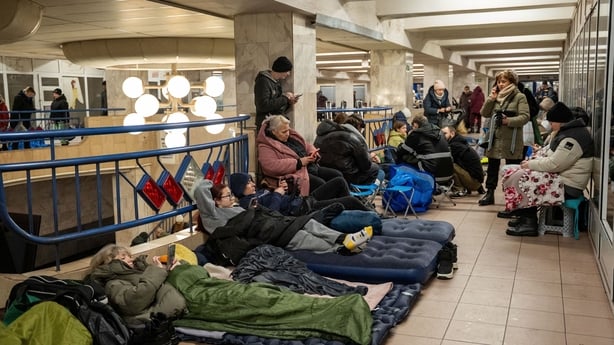
Nina, 70, who lives in one of the buildings hit, told AFP she was angry that the world was talking about a possible deal to end the conflict at a time when Russia was launching such deadly barrages.
"Where is Europe, where is America? It doesn't hurt them the same way," she said.
Her neighbour, 58-year-old Kostiantyn Kondratchenko fought the second-floor blaze from a drone hit with a hose used to water flowers, he said.
The barrage is just the latest to batter Ukraine as diplomats wrangle for a breakthrough in what has been Europe's deadliest conflict since World War II.
Russia, which launched its full-scale invasion in February 2022, has shown no sign of slowing down its ground offensive or aerial bombardments.
While Mr Zelensky has said an agreement between Kyiv and Washington for US security guarantees was "essentially ready for finalisation", German Chancellor Friedrich Merz acknowledged a ceasefire deal was still "quite far" given Russia's position.
Russia baulked after European leaders and US envoys announced this week that post-war guarantees for Ukraine would include a US-led monitoring mechanism and a multinational force.
In its first response after a summit in Paris, Russia called the plan "dangerous" and "destructive".
Key territorial issues are also unresolved.
Russia, which occupies around 20% of Ukraine, has insisted on full control of the Donbas region as part of any settlement, a term Kyiv rejects.
Read more: What is Russia's Oreshnik missile and why use it now?
