


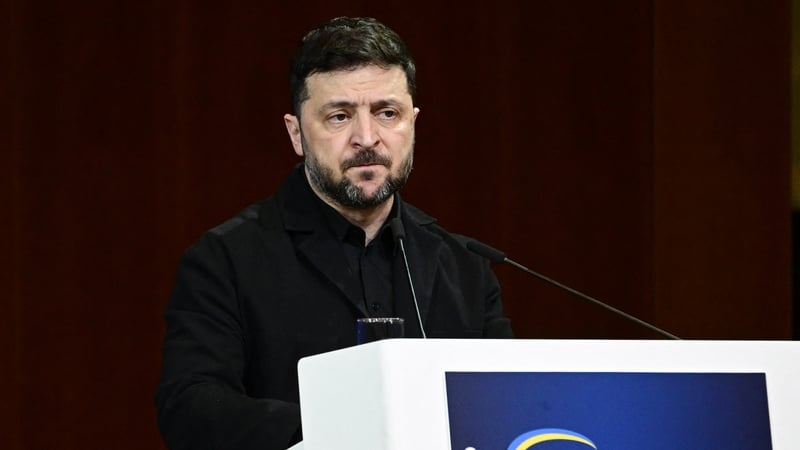
Ukrainian President Volodymyr Zelensky has said that talks in Berlin with US President Donald Trump's envoys on ending the war with Russia were "not easy" but brought "real progress" on the question of security guarantees.
Mr Zelensky met for a second day with Mr Trump's special envoy Steve Witkoff and the president's son-in-law Jared Kushner for talks aimed at ending the war that started with Russia's 2022 full-scale invasion, building on a proposal initially put forward by Mr Trump.
"These conversations are always not easy, I'll be honest with you. But it was a productive conversation, with a lot of details, really a lot," Mr Zelensky said at a German-Ukrainian Business Forum.
Real progress has been achieved during two days of talks on ending Russia's war in Ukraine, Kyiv's negotiator Rustem Umerov has said.
"Over the past two days, Ukrainian-US negotiations have been constructive and productive, with real progress achieved," Mr Umerov said on social media, adding: "We hope we will reach an agreement that will bring us closer to peace by the end of the day."
"There has been sufficient dialogue on the territory, and I think that, frankly speaking, we still have different positions," Zelensky told reporters.
An upbeat German Chancellor Friedrich Merz said the talks had created the "chance for a real peace process" and praised the US for offering "substantial" security guarantees.
From Washington, Mr Trump said he would hold a phone call later with Mr Zelensky and a group of European leaders set to meet in Berlin, among them UK Prime Minister Keir Starmer and French President Emmanuel Macron.
Speaking this evening, Mr Trump said that an agreement aimed at ending Russia's war in Ukraine is closer than ever.
"I think we're closer now than we have been ever," he said.
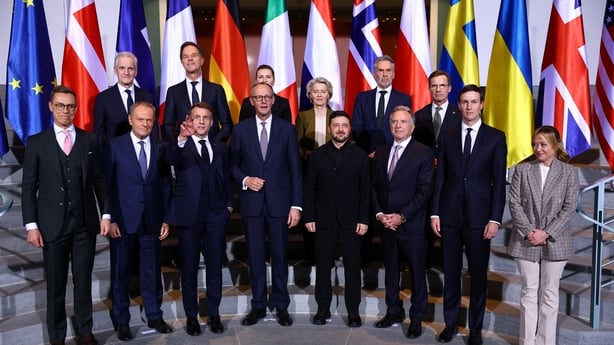
US officials described the hours of talks in Berlin as positive and said Mr Trump in his call would seek to push forward the deal.
The US officials warned Ukraine must accept the deal, which they said would provide security guarantees in line with NATO's Article Five - which calls an attack on one ally an attack on all.
"The basis of that agreement is basically to have really, really strong guarantees - Article Five-like - also a very, very strong deterrence" in the size of Ukraine's military, a US official said on condition of anonymity.
"Those guarantees will not be on the table forever. Those guarantees are on the table right now if there's a conclusion that's reached in a good way," he said.
Mr Zelensky said about the talks with the US side that "these conversations are always not easy" but that it had been "a productive conversation".
An official briefed on the US-Ukrainian talks earlier said that US negotiators still want Ukraine to cede control of the eastern Donbas - made up of the Donetsk and Lugansk regions.
Moscow controls almost all of Lugansk and about 80% of the Donetsk region, according to the US-based Institute for the Study of War.
Russian President Vladimir Putin "wants territory", said the official, adding that the US was demanding that Ukraine "withdraw" from the regions and that Kyiv was refusing.
One of the US officials acknowledged that there was no agreement on territory.
It comes as Ukraine's SBU domestic security service said that Kyiv's forces struck a Russian submarine in the port of Novorossiysk, causing critical damage to the vessel.
In a statement, it added the Kilo-class submarine was knocked out of operation following the first such attack by Sea Baby drones.
Ukraine's Security Service released a video which puported to show an explosion in the Russian port of Novorossiysk.
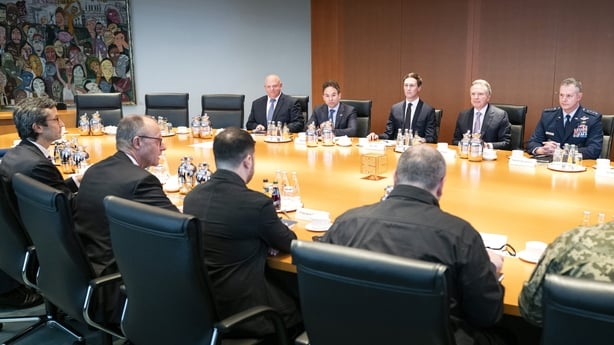
Plans assessed to convert Russian assets into Ukraine loan
Meanwhile, EU foreign ministers meeting in Brussels are continuing to assess a plan to convert hundreds of billions of euro in frozen Russian assets into a long term loan for Ukraine.
Minister for Foreign Affairs Helen McEntee has said it is the Government’s preference that Ukraine be funded in the coming years through frozen Russian assets.
Speaking at the start of a pivotal week in efforts to end the Ukraine war, Minister McEntee said: "It is absolutely essential that we send a very strong signal to Ukraine, but in particular to Russia, that we are going to support, and we will use these assets, to support Ukraine in what has been an illegal invasion.
"We need to make sure that that support is strong and that Europe stands square behind Ukraine, and that will be our priority and our focus."
EU leaders will attempt to forge a consensus on the issue when they meet in Brussels for a key summit on Thursday and Friday.
Belgium remains to be convinced of the plan to use up to €210 billion in immobilised Russian assets to fund Ukraine’s military and financial needs for at least two years.
Italy, Malta and Bulgaria have also suggested an alternative - such as joint borrowing by the EU - should be looked at. Hungary and Slovakia remain opposed to using Russian assets, or to providing any further support for Ukraine.
However, Ireland and most other member states believe the use of frozen Russian assets remains the best option.
Ukraine is expected to run out of money by April of next year.
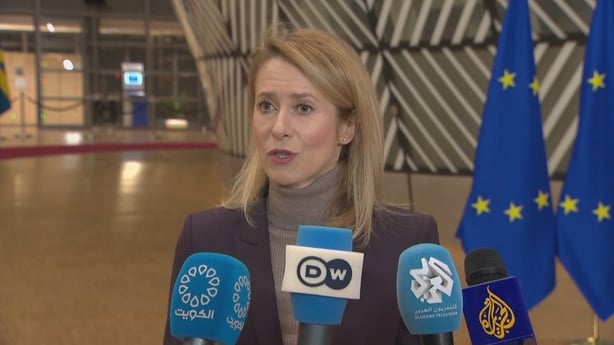
Speaking ahead of the foreign ministers meeting, EU foreign policy chief Kaja Kallas said the EU had to take "very important" decisions on funding Ukraine this week, but acknowledged that talks over using frozen Russian assets were getting harder.
"We are not there yet, and it is increasingly difficult, but we're doing the work and we still have some days," she said. "We will not leave the [EU summit] meeting [on Thursday] before we get a result."
Last week, EU member states agreed to invoke emergency powers to sidestep a Hungarian veto, in order to ensure that the Russian assets remain subject to EU sanctions
The issue has taken on heightened significance since US and Russian officials tabled a 28-point peace plan last month, part of which proposed using a slice of Russia’s frozen overseas assets for joint US-Russian investments.
Yesterday, Mr Zelensky said Ukraine could consider abandoning its ambitions to join NATO if strong security guarantees from the US, Europe and other allies were put in place to prevent a future Russian invasion.
He has resisted Russia’s demands, tacitly supported by the Trump administration, that Ukraine withdraw from parts of the eastern Donbas region that Russia has been unable to capture militarily.
Ms Kallas warned this morning against Ukraine having to concede such territory as part of any peace agreement.
"We have to understand that if he gets Donbas, then the fortress is down and then they definitely move on with taking the whole of Ukraine," she told reporters.
"If Ukraine goes, then other regions are also in danger," she said.
The status of Donbas, comprising Donetsk and Luhansk regions, has emerged as a key sticking point in the talks.
Additional reporting: Tony Connelly
