


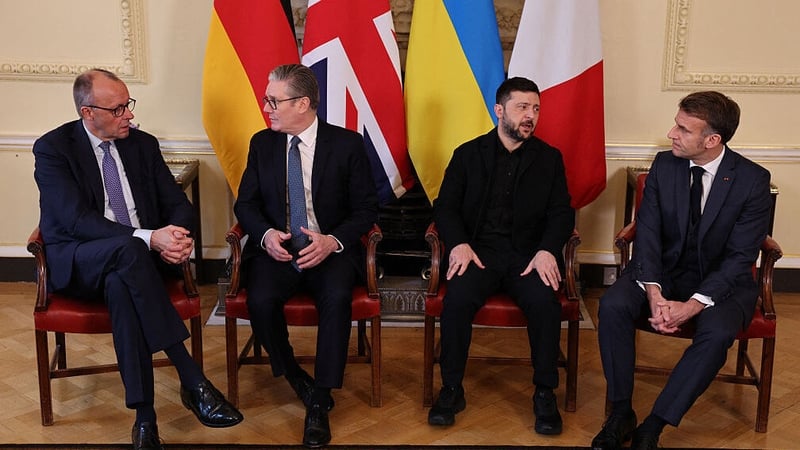
Ukraine will share a revised peace plan with the US tomorrow aimed at ending Russia's war, after talks in London between President Volodymyr Zelensky and the leaders of France, Germany and Britain.
As the war nears its four-year mark, Kyiv, under pressure from the White House to agree quickly to a peace settlement, wants to balance out a US-backed draft that was widely seen as favourable to Moscow.
The hastily arranged meeting among British Prime Minister Keir Starmer, French President Emmanuel Macron, German Chancellor Friedrich Merz and Mr Zelensky aimed to strengthen Ukraine's hand.
Mr Zelensky told reporters after the meeting that the revised plan comprised 20 points, but that there was still no agreement on the issue of giving up territory - which Moscow has pushed for.
No agreement on ceding Ukrainian land to Russia
"The mood of the Americans, in principle, is for finding a compromise," he said. "Of course, there are complex issues related to the territory, and a compromise has not yet been found there."
He repeated his oft-stated position that Ukraine cannot give up any part of its land.
Earlier, a British government source had said today's meeting would focus on using the value of Russian assets frozen in the West.
Mr Starmer, Mr Macron, Mr Merz and Mr Zelensky are also aiming to get US security guarantees to help deter any further attacks from Russia, which launched its full-scale invasion of Ukraine in February 2022.
The publication of a US ceasefire plan last month has gone some way to focus the minds of European leaders, who fear that Kyiv could be forced to accept many Russian demands, which some say could destabilise the continent.
But although US officials said they were in the final stage of reaching an agreement, there has so far been little sign that either Ukraine or Russia is willing to sign the framework deal drawn up by Mr Trump's negotiators.
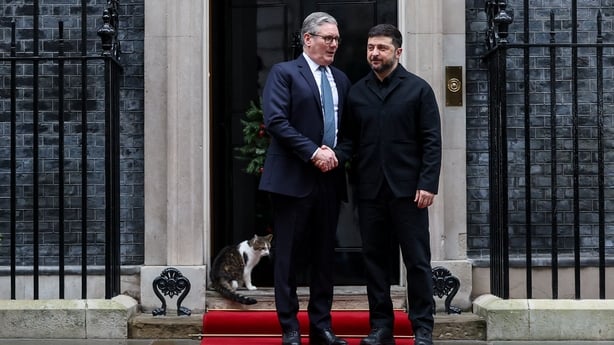
"We stand with Ukraine and, if there was to be a ceasefire, it has to be a just and lasting ceasefire," Mr Starmer said, after welcoming the leaders to his Downing Street residence.
Mr Macron and Mr Merz also expressed their determination to press on with a firm plan, at a time the German chancellor described as "Decisive ... for all of us".
Mr Zelensky pointed to the delicate balancing act the European powers need to strike as they try to negotiate better terms to the proposed US plan: "There are some things we can't manage without the Americans, things we can't manage without Europe; that's why we need to make some important decisions."
Zelensky sets out Ukraine's priorities
Mr Zelensky told Ukrainians in a video address late on Sunday that a "new diplomatic week" was starting.
"First and foremost, security issues, support for our resilience, and support packages for our defence. First and foremost, air defence and long-term funding for Ukraine. Of course, we will discuss a shared vision and common positions in the negotiations," he said.
Ukraine is enduring one of its toughest periods of the war. Russian troops are grinding forward in the east, and Ukrainian cities and towns are suffering hours of power cuts due to intensified Russian strikes on the energy grid and other crucial infrastructure.

Mr Trump's envoy Steve Witkoff and son-in-law Jared Kushner brought a revised plan to Moscow last week, then held several more days of talks with Ukrainian officials in Miami, which ended on Saturday with no breakthrough.
Mr Zelensky called the discussions constructive but not easy.
Mr Trump said on Sunday he was "disappointed" with Mr Zelensky, accusing him of not having read the latest proposals backed by the US.
Taoiseach signs joint letter supporting using frozen Russian assets to underwrite Ukraine loan
Meanwhile, Taoiseach Micheál Martin has signed a joint letter strongly supporting the use of frozen Russian assets to underwrite a multi-billion euro loan to Ukraine.
A proposal to convert up to €210bn in Russian assets into a long term loan to meet Ukraine's budgetary and military needs in the coming years is being assessed by member states ahead of a summit of EU leaders in Brussels on 18 December.
Belgium remains opposed to the plan, fearing retaliation and legal claims by Russia. The bulk of immobilised assets in Europe are held by the Belgian securities depository, Euroclear.
In a joint letter to European Commission President Ursula von der Leyen and European Council President António Costa, seven EU leaders, including the Taoiseach, warn that "time is of the essence" and that the use of Russian assets was "the most financially feasible and politically realistic solution, [as] it addresses the fundamental principle of Ukraine's right to compensation for damages caused by the [Russian] aggression."
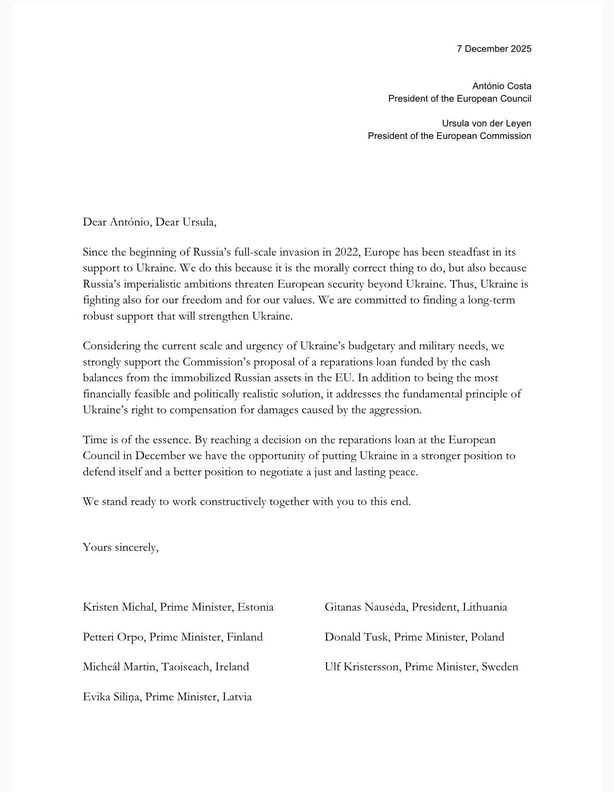
The letter, seen by RTÉ News, was also signed by the leaders of Poland, Sweden, Latvia, Estonia, Lithuania and Finland.
It states that the EU's steadfast support for Ukraine was both the morally right thing to do and because "Russia’s imperialist ambitions threaten the security of Europe beyond Ukraine."
The leaders add: "Considering the scale and urgency of Ukraine’s budgetary and military needs, we strongly support the Commission’s proposal of a reparations loan funded by the cash balances from the immobilised Russian assets in the EU."
"By reaching a decision on the Reparations Loan at the European Council in December we have the opportunity of putting Ukraine in a stronger position to defend itself and a better position to negotiate a just and lasting peace."
Additional reporting Tony Connelly, PA
