


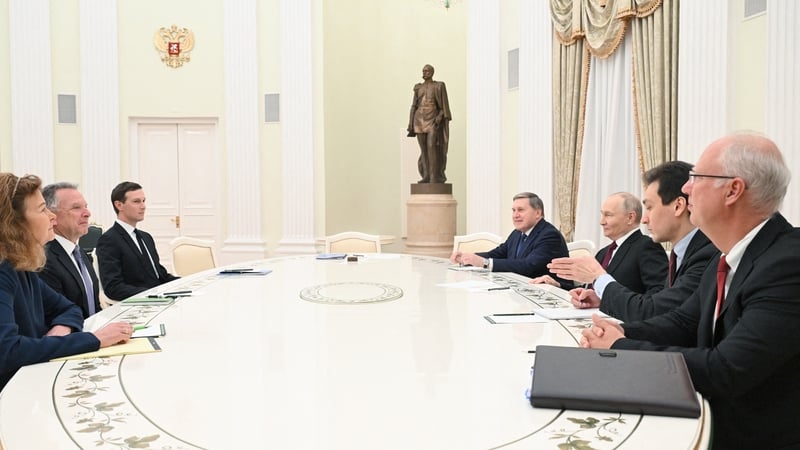
Russia and the US did not reach a compromise on a possible peace deal to end the war in Ukraine after a five-hour meeting between Russian President Vladimir Putin and US President Donald Trump's top envoys, the Kremlin has said.
President Trump has repeatedly complained that ending Europe's deadliest conflict since World War II has been one of the elusive foreign policy aims of his presidency.
The US president has at times scolded both Mr Putin and Ukrainian President Volodymyr Zelensky.
Talks in Moscow between Mr Putin and Mr Trump's special envoy Steve Witkoff in conjunction with his son-in-law Jared Kushner lasted until after midnight.
Afterward, Mr Putin's top foreign policy aide, said: "Compromises have not yet been found."
Yuri Ushakov told reporters at a briefing in the Kremlin that there "is still a lot of work to be done".
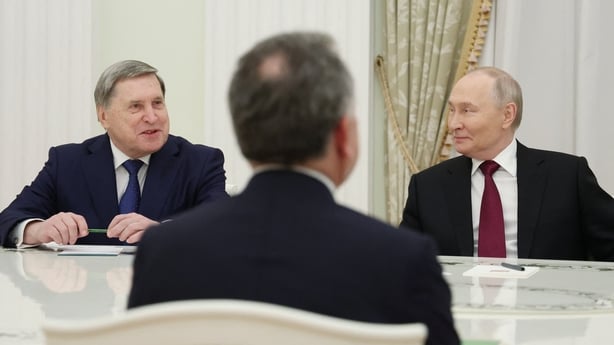
Mr Putin reacted negatively to some US proposals, Mr Ushakov said.
Mr Witkoff went to the US embassy in Moscow after the talks to brief the White House, he added.
Mr Ushakov said that a meeting between Mr Putin and Mr Trump was not currently planned, but he said the talks were constructive and that there were huge opportunities for US-Russian economic cooperation.
Mr Ushakov said Mr Putin had sent a series of important signals and his greetings to Mr Trump, but that the sides had agreed not to disclose details to the media.
He added that they had discussed the "territorial problem", Kremlin shorthand for Russian claims to the whole of Donbas, though Ukraine controls at least 5,000 sq/km of the area which Russia claims as its own.
Almost all countries recognise Donbas as part of Ukraine.
"Some American draft proposals look more or less acceptable, but they need to be discussed," Mr Ushakov said.
"Some of the formulations that have been proposed to us are not suitable for us, that is - the work will continue," he added.
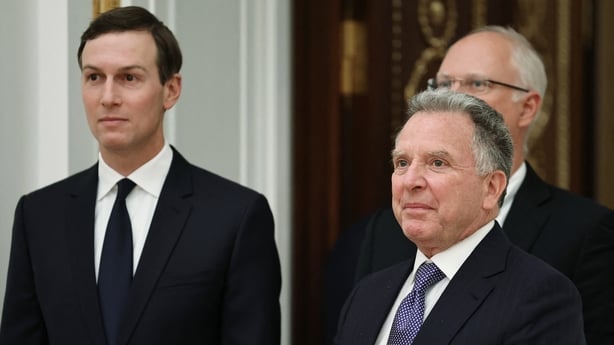
Mr Witkoff, a billionaire US real estate developer who has known Mr Trump since the 1980s, alongside Mr Kushner, the husband of Mr Trump's daughter Ivanka, began talks in the Kremlin after a stroll across Red Square past the mausoleum of Soviet founder Vladimir Lenin to the towers of the Kremlin.
They talked to Mr Putin, Mr Ushakov and Mr Putin's envoy Kirill Dmitriev via interpreters.
"Our people are over in Russia right now to see if we can get it settled," Mr Trump said yesterday in Washington.
"Not an easy situation, let me tell you. What a mess," he said, adding that there were casualties of 25,000 to 30,000 per month in the war.

US Secretary of State Marco Rubio said "some progress" has been made in the talks during an interview that aired yesterday.
"And so what we have tried to do, and I think have made some progress, is figure out, what could the Ukrainians live with that gives them security guarantees for the future," Mr Rubio told Fox News host Sean Hannity.
He added that the US hopes the compromise "allows them not just to rebuild their economy, but to prosper as a country".
Russia invaded Ukraine in February 2022, triggering the biggest confrontation between Moscow and the West since the depths of the Cold War.
A leaked set of 28 US draft peace proposals emerged in November, alarming Ukrainian and European officials who said it bowed to Moscow's main demands.
European powers then came up with a counter-proposal.
At talks in Geneva, the US and Ukraine said they had created an "updated and refined peace framework" to end the war.
Just before the Kremlin meeting with Mr Witkoff, Mr Putin said Russia did not want war with Europe, but that if Europe started one, it would end so swiftly that there would be no one left for Russia to negotiate with.
Mr Putin threatened to sever Ukraine's access to the sea in response to drone attacks on tankers of Russia's "shadow fleet" in the Black Sea.
Ukraine's Foreign Minister Andrii Sybiha said the Russian president's remarks showed he was not ready to end the war.
Watch: Volodymyr Zelenksy said he is afraid the US could lose interest in the peace process
Mr Zelensky, speaking in Dublin, said everything would depend on the talks in Moscow but that he was afraid the US could lose interest in the peace process.
He made the remark during an interview at Iveagh House when he was asked about Mr Putin's comments.
He said: "We don't trust the words, it doesn't matter [that] they are good words or bad words, if you don’t trust [them], it doesn’t matter for me.
"But [if] we’re afraid if America will be tired? Of course. It’s not good for us. It is a goal of Russians - to withdraw interest of America from this situation and this is their [Russia’s] goal."
Mr Zelensky said there will be "no easy solutions", adding that it is "important that everything is fair and open, so that there are no games behind Ukraine's back".
Listen: Russia says no compromise reached in peace talks with US
We need your consent to load this rte-player contentWe use rte-player to manage extra content that can set cookies on your device and collect data about your activity. Please review their details and accept them to load the content.Manage Preferences
The Ukrainian president and First Lady Olena Zelenska were in Ireland for their first official visit, which took place amid US efforts to broker a ceasefire in Russia's invasion of Ukraine.
During the visit, Mr Zelensky addressed a joint sitting of the Oireachtas in which he thanked TDs and Senators for their "steadfast support" for Ukraine, adding that there is a "real chance" for peace if the whole world is prepared to seize it.
Meanwhile, the European Council said it reached an agreement with the European Parliament on phasing out Russian gas imports by 2027 as part of an effort to end dependency on Russian energy.
The agreement will include a legally binding, stepwise prohibition on liquefied natural gas (LNG) and pipeline gas imports from Russia with a full ban from the end of 2026 and autumn 2027, respectively.
As of October, Russia accounted for 12% of EU gas imports, down from 45% before its 2022 invasion of Ukraine.
Hungary, France and Belgium are among the countries still receiving Russian gas.
