


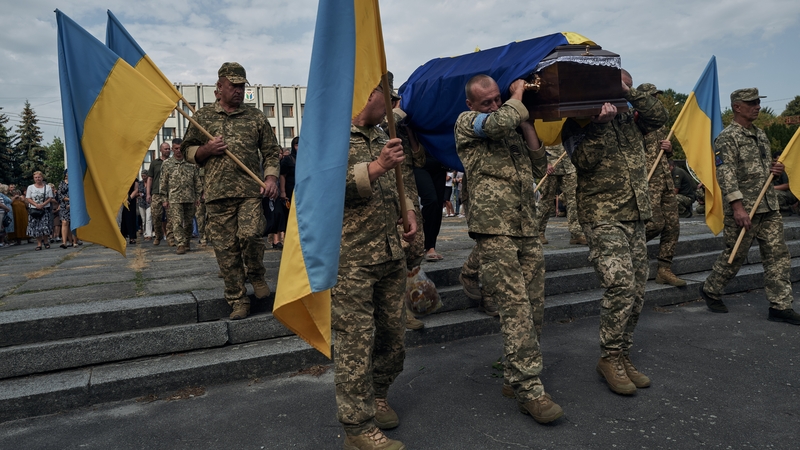
Ukrainian President Volodymyr Zelensky has dismissed Air Force Commander Mykola Oleshchuk, according to a presidential decree.
The dismissal was announced just a day after the Ukrainian military reported that an F-16 jet crashed and its pilot died while repelling a major Russian strike on Monday.
"I have decided to replace the commander of the Air Forces... I am eternally grateful to all our military pilots," President Volodymyr Zelensky said in his evening address.
He did not give a reason for dismissal but mentioned that personnel must be protected, and that there was a need to strengthen the command level.
Ukraine's General Staff said that General Lieutenant Anatoliy Kryvonozhka would temporarily perform the duties of commander.
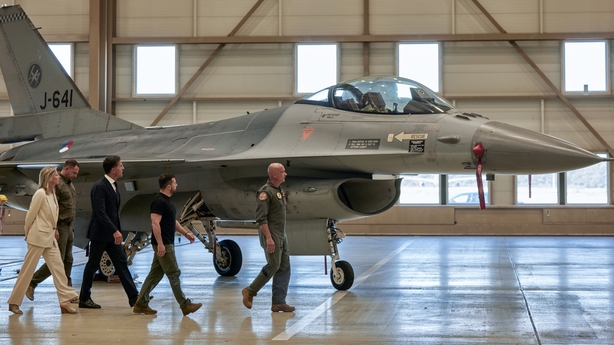
The Ukrainian military did not provide a reason for Monday's crash but said the jet came down while it was approaching a Russian target.
Mr Oleshchuk said on Monday that partners from the US were helping to investigate the incident.
A US defence official told Reuters that the crash did not appear to be the result of Russian fire and that possible causes from pilot error to mechanical failure were still being investigated.
The arrival of the first F-16 jets was a milestone for Ukraine in the fight against the full-scale invasion Russia launched more than two years ago.
The head of Ukraine's power grid operator Ukrenergo, Vadym Kudrytskyi, is also to be dismissed, Forbes Ukraine reported, citing four sources familiar with the matter.
One source said that Mr Kudrytskyi refused to submit his resignation after the decision was made during a meeting with Mr Zelensky, and top officials.
We need your consent to load this rte-player contentWe use rte-player to manage extra content that can set cookies on your device and collect data about your activity. Please review their details and accept them to load the content.Manage Preferences
Ukrenergo did not immediately reply to a Reuters request for comment.
The state-run operator faces the task of keeping Ukraine's electricity grid safe and stable throughout the war, during which Moscow has targeted the energy sector with multiple strikes.
In the latest attack, Russia fired more than 200 missiles and drones on Monday, mostly targeting energy facilities, Kyiv officials said.
Ukrenergo is tasked with protecting power facilities and making sure damaged energy infrastructure is restored.
Kharkiv strike kills six and injures 55
A Russian guided bomb attack on Ukraine's northeastern city of Kharkiv hit a residential building and a playground, killing six people and injuring at least 55 more, local authorities said.
Ihor Terekhov, the city's mayor, said on Telegram one child was killed in the playground.
Three people were killed in the 12-storey apartment block that caught fire as a result of the strike, he said.
About 20 of the injured were in severe condition, regional governor Oleh Syniehubov said.
One end of the block was engulfed in black smoke, with many of the upper floors in flames.
Several cars parked outside were gutted by fire.
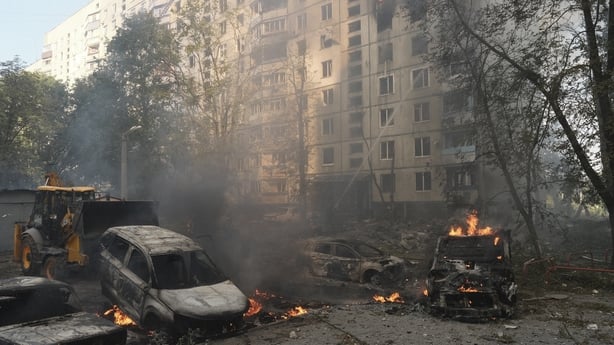
Emergency services and rescue volunteers rushed to carry survivors out of the building.
The body of one of the victims lay under a carpet on the ground outside, surrounded by police.
Residents of all ages, some of them covered in blood, sat stunned on benches and walls outside as medics attended to their injuries.
The authorities did not give the circumstances in which the two other people died in the strikes, which hit four areas of the city.
Kharkiv has been the focus of heavy Russian bombing throughout the war, although there had been a drop in intensity in recent weeks, possibly related to a shock incursion launched by Ukrainian forces into Russia's Kursk region.
Ukrainian authorities said the attack involved five aerial guided bombs launched from planes in Russia's Belgorod region, also known as "glide bombs" which are fitted with a navigation system taking them to their targets.
The weapons are hard to intercept and they have become a fearsome tool in the war in eastern Ukraine in recent months that can cause huge devastation.
Russia denies deliberately targeting civilians. Thousands have been killed and wounded since the war began.
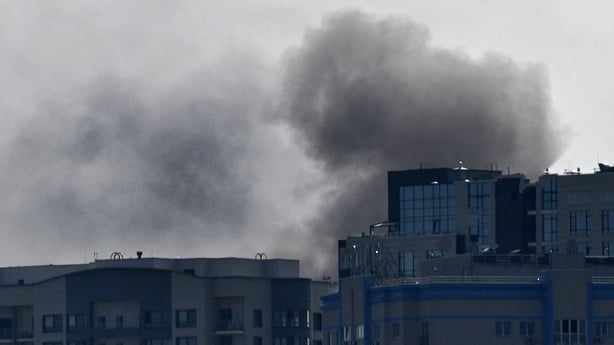
In the wake of the Kharkiv strike, Mr Zelensky renewed a call on Western allies to allow Ukraine to use long-range Western weapons to attack Russian military air bases.
"A strike ... would not have happened if our defence forces had the ability to destroy Russian military aircraft where they are based," Mr Zelensky said on Telegram. "There is no rational reason to restrict Ukraine's defences."
Kyiv says that the most effective way to counter such strikes is to target Russian planes, not the bombs themselves.
