


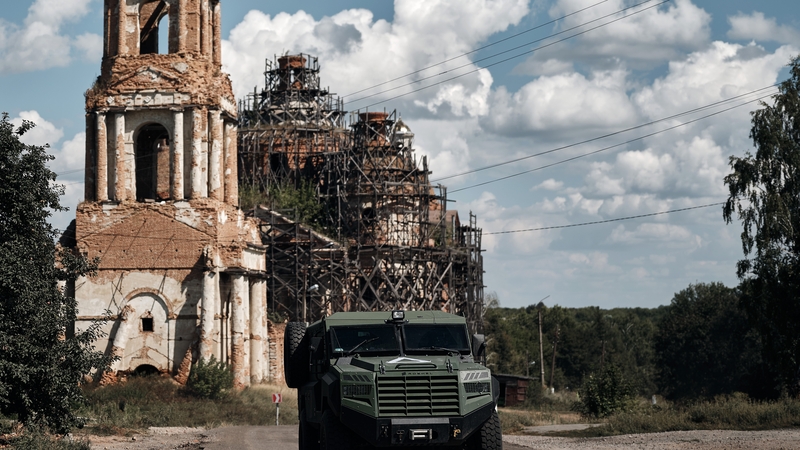
The head of the Ukrainian military Oleksandr Syrsky has said the offensive in Russia's Kursk region had advanced further.
"The troops of the offensive group continue to fight and have advanced in some areas from one to three kilometres towards the enemy," Mr Syrsky told President Volodymyr Zelensky in a video posted on social media.
Mr Syrsky said that fighting continued along the entire front line and that he hoped to take "many prisoners" from a battle ongoing in the village of Mala Loknya, about 13 kilometres from the border.
Ukraine launched a surprise offensive across the border 10 days ago and Kyiv claims to have taken control of more than 80 settlements.
An influential aide to Russian President Vladimir Putin has said that the West and the US-led NATO alliance had helped to plan Ukraine's surprise attack on Russia's Kursk region, something Washington has denied.
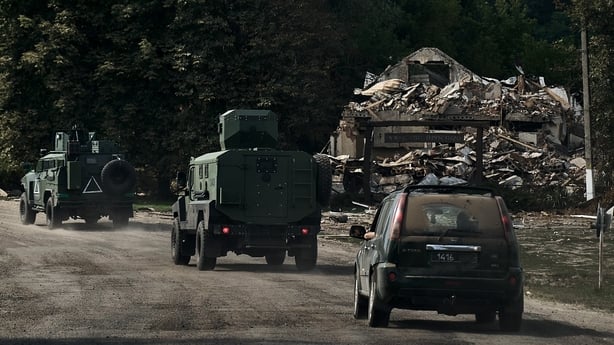
The lightning incursion, the biggest into Russia by a foreign power since World War II, unfurled on 6 August when thousands of Ukrainian troops crossed Russia's western border in a major embarrassment for Mr Putin's military.
Ukraine said the incursion was needed to force Russia, which sent its forces into Ukraine in 2022, to start "fair" peace talks.
But the United States and Western powers, eager to avoid direct military confrontation with Russia, said Ukraine had not given advance notice and that Washington was not involved, though weaponry provided by Britain and the US is reported to have been used on Russian soil.
Influential veteran Kremlin hawk Nikolai Patrushev dismissed the Western assertions in an interview with the Izvestia newspaper.
We need your consent to load this rte-player contentWe use rte-player to manage extra content that can set cookies on your device and collect data about your activity. Please review their details and accept them to load the content.Manage Preferences
"The operation in the Kursk region was also planned with the participation of NATO and Western special services," he was quoted as saying, without offering evidence.
"Without their participation and direct support, Kyiv would not have ventured into Russian territory."
The remarks implied that Ukraine's first acknowledged foray into sovereign Russian territory carried a high risk of escalation.
Mr Putin chaired a meeting of Russia's Security Council, including Mr Patrushev, and said the discussion would focus on "new technical solutions" being employed in the military operation.
Kremlin says Ukraine will pay for US involvement
"Washington's efforts have created all the prerequisites for Ukraine to lose its sovereignty and lose part of its territories," Mr Patrushev said.
Ukraine said yesterday that it had installed a military commandant in the area it controlled, even as Russia intensified its offensives in Ukraine's east.
Russia's defence ministry for its part said it had repelled a series of Ukrainian attacks along the Kursk frontline.
We need your consent to load this rte-player contentWe use rte-player to manage extra content that can set cookies on your device and collect data about your activity. Please review their details and accept them to load the content.Manage Preferences
While the Ukrainian attack has revealed weaknesses in Russian defences and changed the public narrative of the conflict, Russian officials said Ukraine's "terrorist invasion" would not change the course of the war.
Russia has been advancing for most of the year in the key eastern sector of the 1km front and has vast numerical superiority. It controls 18% of Ukraine.
After more than 10 days of fighting, Ukraine holds at least 450sq/km of territory, or less than 0.003% of Russia. But for Mr Putin, the incursion crosses another red line.
One Russian source told Reuters the incursion could embolden hardliners in Moscow who advocate a bigger war, but Mr Putin's choice may not be easy.
He has sought to portray Europe's biggest war in seven decades both as a limited "special military operation" that need not upset daily Russian life and as a historic fight with a West that scorns Moscow's interests and seeks to dismember Russia.
The US, which has said it cannot allow Putin to win the Ukraine war, so far deems the surprise incursion a protective move that justifies the use of US weaponry, officials in Washington said.
But they also expressed worries about complications as Ukrainian troops push further into enemy territory.
One US official, speaking on condition of anonymity, said that if Ukraine started taking Russian villages and other non-military targets using US weapons and vehicles, it could be seen as stretching the limits Washington has imposed, precisely to avoid any perception of a direct NATO-Russia conflict.
Russia's defence ministry has published footage that it said showed a Russian drone destroying a US-made Stryker armoured combat vehicle in the Kursk region.
