


Russian missiles and drones have destroyed a large electricity plant near Kyiv and hit power facilities in several regions of Ukraine, officials have said, ramping up pressure on the embattled energy system as Kyiv runs low on air defences.
The major attack more than two years since Russia's full-scale invasion completely destroyed the Trypilska coal-powered thermal power plant near the capital, a senior official at the company that runs the facility told Reuters.
Footage shared on social media showed a fire raging at the large Soviet-era facility and black smoke belching from it. Reuters was able to confirm the location of the video as the Trypilska station.
"We need air defence and other defence support, not eye-closing and long discussions," President Volodymyr Zelensky said on Telegram, condemning the attacks as "terror".
The Russian defence ministry said it hit fuel and energy facilities in Ukraine in what it described as a massive retaliatory strike using drones and high-precision, long-range weapons from air and sea.
The strikes were a response to Ukrainian drone attacks on Russia's oil, gas and energy facilities, it said.
Ukraine's appeals for urgent air defence supplies from the West have grown increasingly desperate since Russia renewed its long-range aerial assaults on the Ukrainian energy system last month.
The attacks, which hammered thermal and hydroelectric power plants, have caused fears about the resilience of an energy system that was hobbled by a Russian air campaign in the war's first winter.
Ukraine's air force commander said air defences took down 18 of the incoming missiles and 39 drones.
The attack used 82 missiles and drones in total, the military said.
The destroyed power plant outside Kyiv, a major power supplier for the Kyiv, Cherkasy and Zhytomyr regions, is the third and last facility owned by state-owned energy company Centrenergo.
"Everything is destroyed," Andriy Gota, head of the supervisory board of the company, said when asked about the situation at Centrenergo.
The Trypilska plant was the biggest energy facility near Kyiv and was built to have a capacity of 1,800 megawatt hours, more than the pre-war needs of Ukraine's biggest city.

Dire power situation
The Ukrenergo grid operator said its substations and power generating facilities had been damaged in attacks on the regions of Odesa, Kharkiv, Zaporizhzhia, Lviv and Kyiv.
Ukraine's largest private electricity company DTEK, which lost 80% of its generating capacity during Russia's 22 March and 29 March attacks, said Russia's attacks hit two of its power stations, inflicting serious damage.
The strikes also attacked two underground storage facilities where Ukraine stores natural gas, including some owned by foreign companies, energy company Naftogaz said.
The facilities continued to operate, it added.
"The situation in Ukraine is dire; there is not a moment to lose," said US ambassador Bridget Brink, adding that 10 missiles struck critical infrastructure in the Kharkiv area alone.
The region of Kharkiv, which borders Russia and already has long, rolling blackouts in place, was forced to cut electricity for 200,000 people, presidential aide Oleksiy Kuleba said.
Ukraine has warned it could run out of air defence munitions if Russia keeps up the intensity of its strikes and that it is already having to make difficult decisions about what to defend.
There has been a slowdown in vital Western assistance and a major US aid package has been blocked by Republicans in Congress for many months, Ukraine has said.
Foreign Minister Dmytro Kuleba said Russia's overnight attack used six ballistic missiles, which can hit targets within minutes and are much harder to shoot down.
Ukraine says that is why it needs US-made Patriot air defences.
"Ukraine remains the only country in the world facing ballistic strikes. There is currently no other place for 'Patriots' to be," Mr Kuleba wrote on X.
Ukrainian parliament approves army mobilisation law
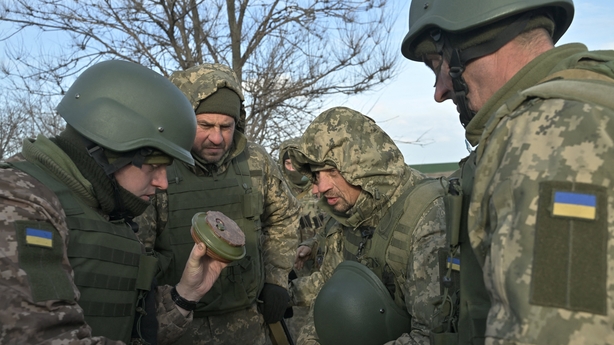
Ukrainian MPs have approved an army mobilisation bill to bolster troop numbers against Russia, a day after a clause allowing long-serving soldiers to return home from the front was scrapped.
The law is designed to facilitate army recruitment but has caused some anger in a nation exhausted by more than two years of battling Moscow's forces.
"The bill on mobilisation was adopted as a whole," MP Yaroslav Zheleznyak said in a post on Telegram.
He said 283 of the parliament's 450 deputies had voted in favour of the legislation, which toughens punishments for draft dodgers.
The Ukrainian military has been weakened by a failed 2023 counter-offensive against Russia and by the blocking in the US Congress of key US military aid.
It is also believed to have suffered huge losses.
Earlier this month Ukrainian President Volodymyr Zelensky lowered the mobilisation age from 27 to 25 because Kyiv is short of soldiers to fight Russian forces.
Yesterday parliament announced a popular clause on demobilising soldiers who had been fighting for 36 months was being scrapped at the demand of the army.
Mr Zelensky is still required to sign the mobilisation law for it to take effect.
He took almost a year to sign a previous bill lowering the mobilisation age after it was passed by parliament.
Separately, Mr Zelensky said that he and his Latvian counterpart had signed a bilateral security deal, as he held talks in Lithuania with leaders on support for Ukraine.
Latvia's president "and I just signed a bilateral security agreement... It envisages Latvia's annual military support for Ukraine at 0.25% of GDP. Latvia also made a 10-year commitment to assist Ukraine with cyber defence, demining and unmanned technologies," Mr Zelensky posted on X.
