

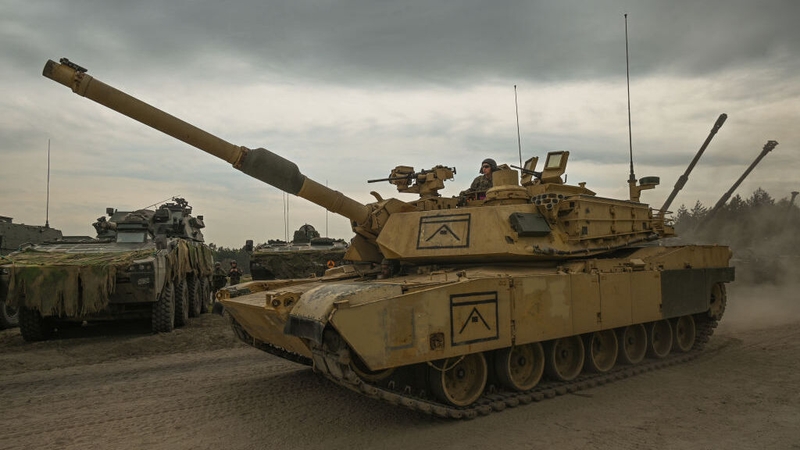
The United States has announced a new security assistance package worth up to $175 million (€204m) for Ukraine, including depleted uranium ammunition for Abrams tanks, the first time the US is sending the controversial armour-piercing munitions to Kyiv.
A by-product of uranium enrichment, depleted uranium is used for ammunition because its extreme density gives rounds the ability to easily penetrate armour plating.
Critics say there are dangerous health risks from ingesting or inhaling depleted uranium dust, including cancers and birth defects.
Russian Deputy Foreign Minister Sergei Ryabkov said the move was "a criminal act", state media reported.
The US Department of Defense said the military aid would also include anti-armour systems, tactical air navigation systems and additional ammunition for High Mobility Artillery Rocket Systems (HIMARS).
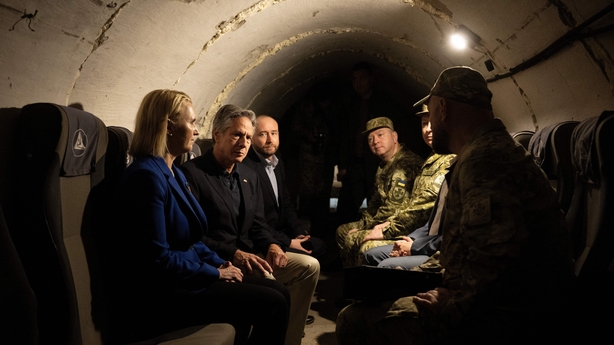
The announcement coincides with US Secretary of State Antony Blinken's visit to Kyiv in a gesture of support as a counteroffensive by Ukraine against occupying Russian troops continues for a fourth month with only small gains.
The package was part of a total of more than $1 billion (€1.2bn) in assistance that Mr Blinken announced in the Ukrainian capital.
It also included over $665m (€776m) in new military and civilian security assistance and millions of dollars in support for Ukraine's air defences and other areas.
Although the UK sent depleted uranium munitions to Ukraine earlier this year, this is the first US shipment of the ammunition.
"This is not just an escalatory step, but it is a reflection of Washington's outrageous disregard for the environmental consequences of using this kind of ammunition in a combat zone.
"This is, in fact, a criminal act, I cannot give any other assessment," Russian news agency TASS quoted Mr Ryabkov as saying.

In a speech at a security seminar, he also reiterated previous warnings by Russia about the risk of a nuclear war, because of what he called Western "pressure" on Moscow.
"Now this pressure is dangerously balancing on the brink of direct armed conflict between nuclear powers," he added.
Russia has long accused the West of using Ukraine to wage a proxy war aimed at inflicting a "strategic defeat" on Moscow.
The US and its allies say they are arming Ukraine to defend itself against Russia's invasion and recover territory seized by Moscow in the course of the 18-month war.
Mr Blinken hailed progress in the pushback and said of the fresh US package of support: "This new assistance will help sustain it and build further momentum."
Washington previously announced it would send cluster munitions to Ukraine, despite concerns over the dangers such weapons pose to civilians.
The use of depleted uranium munitions has been fiercely debated, with opponents such as the International Coalition to Ban Uranium Weapons saying there are dangerous health risks from ingesting or inhaling depleted uranium dust, including cancers and birth defects.
Meanwhile, Russia's deployment of tactical nuclear weapons in Belarus is proceeding on schedule, Mr Ryabkov said.
"Several stages have now been completed in terms of creating the appropriate infrastructure and re-equipping the corresponding carriers. This work continues."
Moscow announced the deployment earlier this year, calling it a deterrent to the West.
Ukraine counteroffensive 'moving forward' - NATO
Ukrainian forces have been able to break through Russian defences and are making progress in their counteroffensive against Moscow's troops, according to NATO Secretary General Jens Stoltenberg.
He said that when Russia launched its invasion, its military was seen as the second strongest in the world, adding: "Now the Russian army is the second strongest in Ukraine.
"The Ukrainians are gradually gaining ground and it proves the importance of our support and also our ability and willingness to continue the support," he told MEPs.
"This is heavy fighting, difficult fighting, but they have been able to breach the defensive lines of the Russian forces, and they are moving forward."
In recent days, Ukraine has claimed to have broken through Russia's heavily fortified first line of defence in its gruelling southern offensive.
Ukraine received shipments of Western military equipment from NATO members, including battle tanks and armoured vehicles, to aid its push.
But Kyiv admits the months-long drive southwards has been slower than hoped and has inflicted a heavy toll on its forces.
Ukraine's troops have reportedly had to increasingly resort to smaller-scale attacks on foot after full-frontal assaults were stalled by the dense minefields laid by the Russians.
"Hardly any time in history we have seen more mines on the battlefield than we see in Ukraine today. So it was obvious that this was going to be extremely difficult," Mr Stoltenberg said.
"But the Ukrainians decided to launch the offensive because they are going to liberate their land, and they are making progress. Not perhaps as much as we hoped for, but they are gaining ground gradually, some 100 metres per day.
"In hardly any war we will see only victories for the side we support. There will be bad days and good days. We need to be with Ukraine not only (in) good times, but also bad times."
He insisted "we support them when they win and if they lose, we are there with Ukraine."
Russia's invasion of Ukraine has reinvigorated the US-led NATO military alliance, leading it to bolster its forces on its eastern flank and grow its membership.
Mr Stoltenberg said he expected Turkey to approve Sweden's bid to join "as soon as possible" after its parliament reconvenes.
Turkish President Recep Tayyip Erdoğan agreed at a NATO summit in Vilnius this summer to clear the way for Stockholm's membership after a year of holding it up.
