

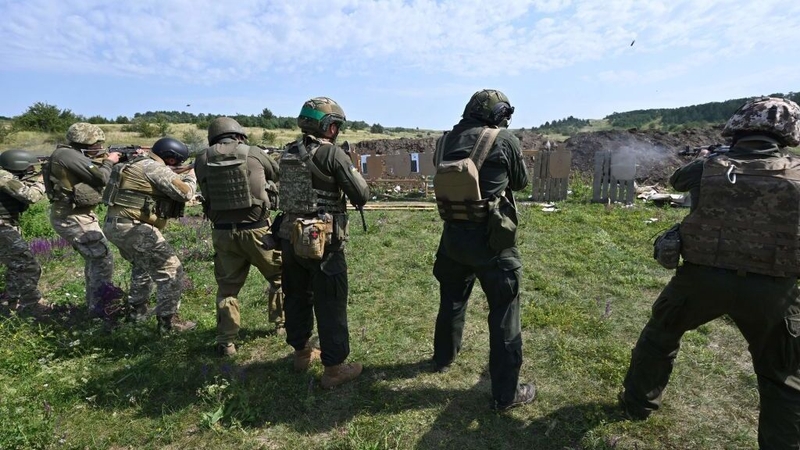
Ukrainian soldiers have recaptured the southeastern village of Staromaiorske in the Donetsk region from Russian forces, according to a video published by President Volodymyr Zelensky.
"The 35th brigade and the 'Ariy' territorial defence unit have fulfilled their task and liberated the village of Staromaiorske. Glory to Ukraine!" said a soldier in the footage.
The village lies to the south of a cluster of small settlements that Ukraine recaptured during a counteroffensive it began early last month against Russian forces who hold parts of southern and eastern Ukraine.
Declaring Staromaiorske liberated, Ukrainian Deputy Defence Minister Hanna Maliar said: "Our defenders are now continuing to clear the settlement".
Oleksandr Kovalenko, a military analyst, said Ukrainian troops now needed to reach another village, Staromlynivka, less than 5kms away.
"It really serves as a stronghold for the Russian occupiers, the peak of the second defensive line in this location," he said in an interview with the RBC UA media outlet.
"The process is therefore entirely logical - first, take Staromayorske, stabilise the flanks, and advance to the second line, where the main striking groups will be engaged to break through," he said.
Russian troops are heavily entrenched in the strategically important south where they have prepared a sprawling network of trenches, minefields, anti-tank ditches and lines of "dragon's teeth" barricades.
Russian President Vladimir Putin said that Ukrainian attacks in the south had intensified.
Mr Zelensky has acknowledged progress in the counteroffensive has been slower than desired, but spoke of "very good results" from the front, without providing details.
Zelensky visits Odesa church damaged in Russia strike
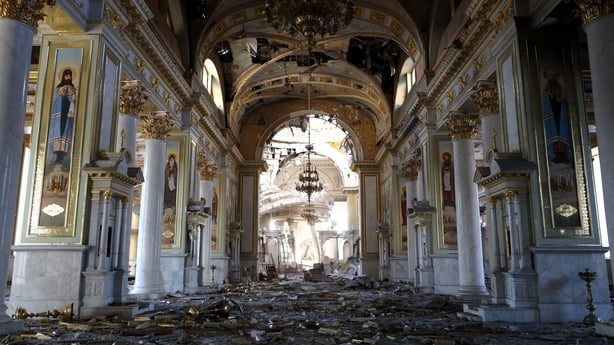
The Ukrainian President has visited a historic cathedral in the southern port city of Odesa, days after it was damaged by a Russian strike.
"Volodymyr Zelensky inspected the destruction in the Transfiguration cathedral caused by the recent massive bombardments of civilian infrastructure and the Odesa historical city centre," his office said in a statement.
"The head of state was informed about the state of the destruction inside the church and its current condition".
In the aftermath of the attack, Ukraine described it as a "war crime that will never be forgotten and forgiven" while United Nations cultural agency UNESCO condemned it as "brazen".
Russia has been pounding Odesa, a centuries-old city on the shores of the Black Sea and one of Ukraine's main ports, since Moscow withdrew from an agreement that allowed Kyiv to export its grain despite the war.
The Orthodox Savior and Transfiguration Cathedral sits in the historic Odesa city centre, parts of which are on the UNESCO World Heritage List.
The cathedral was originally built in 1794 under Imperial Russian rule.
It was demolished under Soviet leader Josef Stalin in 1936 and rebuilt in the 1990s after the collapse of the Soviet Union.
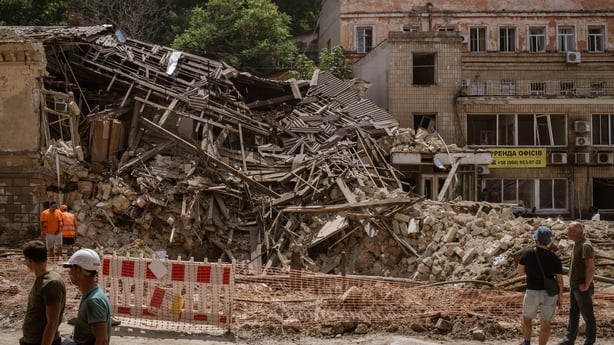
Russian forces fired missiles at port infrastructure in the Odesa region overnight, killing one security guard and damaging a cargo terminal, the region's governor has said.
Before the attack, Ukrainian Deputy Prime Minister Oleksandr Kubrakov said Russian air strikes had damaged 26 port infrastructure facilities and five civilian vessels in the previous nine days.
He gave no further details of the damage.
Odesa Governor Oleh Kiper said Russia fired Kalibr missiles at an unspecified port from a submarine in the Black Sea in the overnight attack.
He said a security building had been destroyed and two cars damaged.
Ukraine's air force said two missiles were fired in the attack, and that it had been unable to shoot them down, but that air defences had intercepted eight drones that Russia launched to attack other regions of Ukraine overnight.
Natalia Humeniuk, spokesperson for Ukraine's southern military command, said an overnight thunderstorm had helped Russia in the attack.
"The enemy took advantage of the weather conditions, and launched the missile during the thunder and wind and at an extremely low height in order to make spotting them more difficult," she said.
Ms Humeniuk added that air defences had been strengthened in certain areas, but that further strengthening was needed.
President Zelensky - during a visit to the city of Dnipro in southeastern Ukraine - discussed supplies to the war front and air defences.
"We started the working day in Dnipro," he said on the Telegram messaging app.
Mr Zelensky said he, top military commanders and senior government officials had discussed the situation on the battlefield, supplies of munitions to troops and how to strengthen air defences.
"As always, we pay close attention to the supply of ammunition to our troops.
"The efficiency of using the existing air defence systems and reinforcing the sky shield, taking into account supplies from partners."
The city of Dnipro, an important economic centre, is not far from the front line that stretches from Kherson in the south, through the Donbas region and further north to the Kharkiv region.
The city had a pre-war population of about one million people, and has become a logistical and humanitarian hub for Ukraine since Russia's full-scale invasion on 24 February 2022.
President Zelensky said he discussed a review of conscription offices across the country that was launched after multiple allegations of corruption and complaints about the mobilisation process.
"The comprehensive inspection ... is coming to an end. Eleven regions are under special control," he said.
