


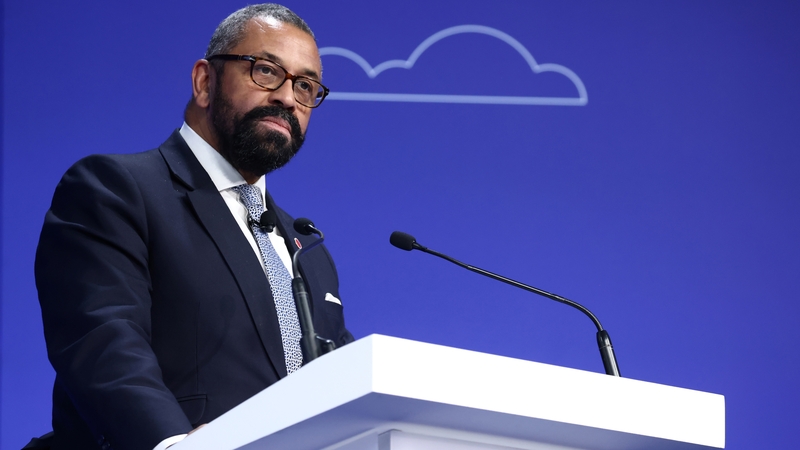
Foreign donors have pledged €60bn of new financial support for Ukraine, as an international conference aimed at funding the war-ravaged country's reconstruction ended.
"We had not envisaged this to be a pledging conference. Nevertheless, today at this conference, we can announce a combined €60 billion in support to Ukraine," said James Cleverly, foreign minister of the UK, which hosted the meeting.
The commitments from governments and international organisations target supporting Ukraine in the short- and medium-term, Mr Cleverly said at the closing session of the London conference.
"This provides us with the medium-term predictable support that will unlock the macro-economic stability that Ukraine needs," he said, adding that efforts were focused on unlocking "the enormous potential of the private sector".
Ukrainian Prime Minister Denys Shmygal attended the conference, telling delegates that "we are starting to rebuild Ukraine this year, we are not waiting for the end of the war" as he thanked them for their financial backing.
"We are much closer to fully mobilising the $14.1 billion (€12.9bn) we need," he added, referring to a World Bank estimate of what is urgently required.
In the medium-term, more than €365bn will be needed to rejuvenate the Ukrainian economy, according to estimates.
Mr Shmygal also welcomed the commitment of "almost all" of those present in supporting the idea that Russia "must pay for its crimes and the destruction it has caused in Ukraine".
"We need to finalise a compensation mechanism that will allow frozen Russian assets to be used to rebuild Ukraine," he urged, with international efforts currently mired in legal discussions.
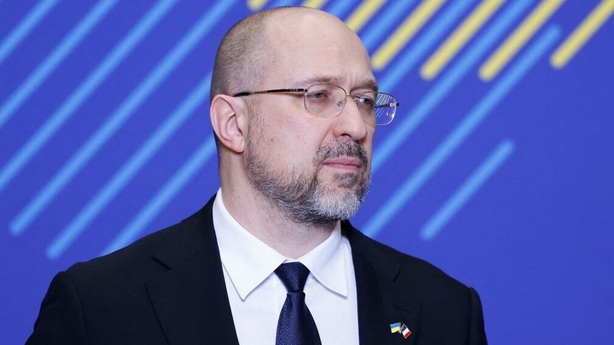
One of the conference's main goals was to involve the private sector by putting in place mechanisms to guarantee investments in Ukraine, whose army is in the midst of a counteroffensive against Russian forces.
Nearly 500 companies from 42 countries have pledged to play their part, Mr Cleverly said.
The bulk of the €60bn comes from a €50bn aid package that the European Union plans to roll out until 2027, which was announced on the eve of the conference.
The United States also announced $1.3bn (€1.2bn) in aid, targeting the energy and infrastructure sectors in particular.
Russia says Crimea bridge hit by Ukrainian missiles
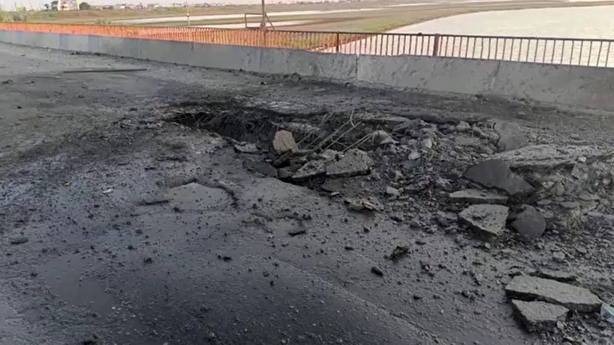
Ukrainian missiles struck the Chonhar road bridge connecting Crimea with Russian-held parts of the southern Kherson region overnight, forcing traffic to be diverted to a different route, Russian-appointed officials have said.
The so-called "gate to Crimea", known by Russians with a different spelling as the Chongar Bridge, is one of a handful of links between Crimea - which Moscow annexed from Ukraine in 2014 - and mainland Ukraine.
It is on a route used by the Russian military to move between Crimea and other parts of Ukraine under its control.
Kyiv says it wants to retake Crimea and drive all Russian forces from its territory. Yuriy Sobolevsky, a Ukrainian official on the governing body for the Kherson region, said the strike was "a blow to the military logistics of the occupiers".
"The psychological impact on the occupiers and the occupying power is even more important. There is no place on the territory of Kherson region where they can feel safe," he said via Telegram.
Vladimir Saldo, the Russian-appointed governor of Kherson, parts of which Russian forces have captured during its invasion of Ukraine, said the road bridge had been damaged but that there were no casualties.
One picture he posted on Telegram showed a large hole in the bridge's surface with water visible beneath it and debris scattered nearby.
Meanwhile, Ukrainian President Volodymyr Zelensky said that Russian forces were considering launching a "terror attack" at the Russian-controlled Zaporizhzhia nuclear plant, a recurring flash point of concern throughout the invasion.
"Intelligence services have received information that Russia is considering the scenario of a terrorist act at the Zaporizhzhia nuclear plant - a terrorist act with the release of radiation. They have prepared everything for this," he said in a statement on Telegram.
Moscow rejected Mr Zelensky's claims, pointing to a recent visit to the facility by the head of the United Nations International Atomic Energy Agency (IAEA).
"This is another lie. There were just contacts with the IAEA at the site - a very high assessment from the IAEA. They saw everything, everything they wanted to see," Kremlin spokesman Dmitry Peskov told reporters.
Moscow announced that UN nuclear chief Rafael Grossi would be arriving in the Russian region of Kaliningrad to meet with the head of Russia's nuclear agency.
Separately, German Chancellor Olaf Scholz pledged long-term security assurances to Ukraine but dashed Kyiv's hopes for a swift accession to NATO.
"We have to take a sober look at the current situation," Mr Scholz told German MPs in a speech in parliament, adding the government in Kyiv had itself acknowledged the country would not be able to join NATO as long as the war was still going on.
"Therefore, I suggest we focus on the top priority (at the NATO summit) in Vilnius (in mid-July), namely strengthening the combat power of Ukraine," Mr Scholz said.
Berlin and its partners in the G7 and the European Union are working on long-term security assurances to Kyiv, he added.
